
[Paper Review] Size - Stellar Mass Relation and Morphology of Quiescent Galaxies at $z\geq3$ in Public $JWST$ Fields
This study analyzes the size-mass relation and morphology of 26 quiescent galaxies at z≥3 using JWST/NIRCam imaging, finding a negative size-wavelength correlation and a rest-frame 0.5 μm size-mass relation that lies below local relations by ~0.6 kpc at M⋆=5×10¹⁰ M☉. The results imply monotonic size growth from z≈3–5, with evolving morphology suggesting a transition toward bulge-dominated structures by z>3.
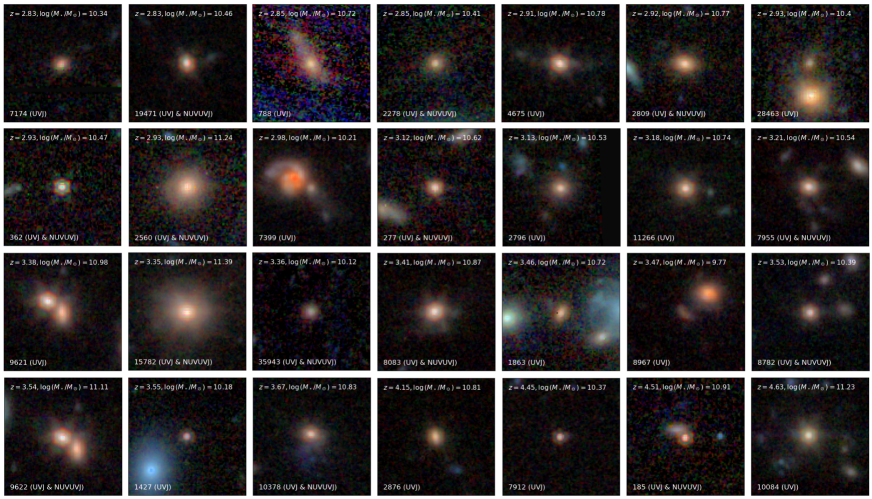
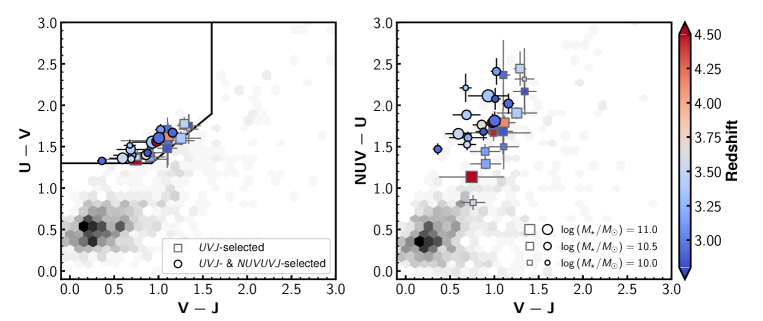
We present the results of a systematic study of the rest-frame optical morphology of quiescent galaxies at $z \geq 3$ using the Near-Infrared Camera (NIRCam) onboard $JWST$. Based on a sample selected by $UVJ$ color or $NUVUVJ$ color, we focus on 26 quiescent galaxies with $9.8<\log{(M_\star/M_\odot)}<11.4$ at $2.810.3$ implies that our size - stellar mass relations are below those at lower redshifts, with the amplitude of $\sim0.6\, { m kpc}$ at $M_\star = 5 imes 10^{10}\, M_\odot$. This value agrees with the extrapolation from the size evolution of quiescent galaxies at $z<3$ in the literature, implying that the size of quiescent galaxies increases monotonically from $z\sim3-5$. Our sample is mainly composed of galaxies with bulge-like structures according to their median Sérsic index and axis ratio of $n\sim3-4$ and $q\sim0.6-0.8$, respectively. On the other hand, there is a trend of increasing fraction of galaxies with low Sérsic index, suggesting $3
Motivation & Objective
- To investigate the rest-frame optical morphology of quiescent galaxies at z≥3 using JWST/NIRCam data.
- To measure the size-mass relation of high-redshift quiescent galaxies and compare it with lower-redshift relations.
- To assess the structural evolution of quiescent galaxies from z≈3 to z≈5 through Sérsic profile fitting.
- To determine whether morphological transformation, including the emergence of disky components, occurs during this epoch.
Proposed method
- Selected 26 quiescent galaxies via UVJ or NUVUVJ color selection from public JWST fields with 2.8<zphot<4.6 and 9.8<log(M⋆/M☉)<11.4.
- Fitted Sérsic profiles to multi-band NIRCam images using Galfit to measure effective radius, Sérsic index, and axis ratio.
- Calibrated sizes to rest-frame 0.5 μm by extrapolating from observed-band measurements, correcting for wavelength-dependent size bias.
- Assessed fitting quality using flags and bootstrapped uncertainties; validated with mock galaxy simulations for small sizes (re<0.02 arcsec).
- Compared the derived size-mass relation with lower-redshift relations (e.g., z<3) to infer size evolution trends.
- Analyzed morphological trends via Sérsic index and axis ratio distributions, especially across redshift bins.
Experimental results
Research questions
- RQ1How does the rest-frame 0.5 μm size-mass relation of quiescent galaxies at z≥3 compare to those at lower redshifts?
- RQ2What is the structural morphology (Sérsic index, axis ratio) of high-redshift quiescent galaxies, and how does it evolve with redshift?
- RQ3Is there evidence for a morphological transformation epoch between z≈3 and z≈5, particularly the emergence of disky components?
- RQ4To what extent do size measurements in different bands correlate, and how does this affect rest-frame size calibration?
- RQ5How robust are size measurements for compact, low-S/N galaxies near the PSF resolution limit?
Key findings
- The size-mass relation for quiescent galaxies at z≥3 lies ~0.6 kpc below the local relation at M⋆=5×10¹⁰ M☉, consistent with size evolution from z≈3–5.
- Galaxies at z≥3 show a significant correlation between rest-frame 0.5 μm size and stellar mass, with median Sérsic indices of n≈3–4 and axis ratios of q≈0.6–0.8, indicating bulge-like morphology.
- A trend of increasing fraction of low-Sérsic-index (n<3) galaxies at higher redshift (3<z<5) suggests a morphological transition phase with notable disky quenched components.
- Size measurements in multiple bands show a negative correlation with observed wavelength, necessitating multi-band fitting to derive rest-frame sizes.
- The size-mass relation at z≥3 is consistent with extrapolation of size evolution from z<3, implying continuous size growth from z≈5 to present.
- Robustness tests confirm that size and structural parameter measurements remain reliable even for compact galaxies near the PSF resolution limit (re≈0.02 arcsec).
Better researchstarts right now
From reading papers to final review, dramatically reduce your research time.
No credit card · Free plan available
This review was created by AI and reviewed by human editors.