
[Paper Review] Smart Home Energy Management: VAE-GAN synthetic dataset generator and Q-learning
This paper proposes a VAE-GAN framework to generate high-fidelity synthetic time-series data for smart home energy consumption, including load profiles, PV generation, and EV charging. When used to train a Q-learning-based HEMS, the synthetic data enables the agent to achieve near-optimal online performance, outperforming models trained on GAN- and GMM-generated data, with the VAE-GAN approach showing superior statistical similarity to real data and higher real-world profit across varying energy storage capacities.
Recent years have noticed an increasing interest among academia and industry towards analyzing the electrical consumption of residential buildings and employing smart home energy management systems (HEMS) to reduce household energy consumption and costs. HEMS has been developed to simulate the statistical and functional properties of actual smart grids. Access to publicly available datasets is a major challenge in this type of research. The potential of artificial HEMS applications will be further enhanced with the development of time series that represent different operating conditions of the synthetic systems. In this paper, we propose a novel variational auto-encoder-generative adversarial network (VAE-GAN) technique for generating time-series data on energy consumption in smart homes. We also explore how the generative model performs when combined with a Q-learning-based HEMS. We tested the online performance of Q-learning-based HEMS with real-world smart home data. To test the generated dataset, we measure the Kullback-Leibler (KL) divergence, maximum mean discrepancy (MMD), and the Wasserstein distance between the probability distributions of the real and synthetic data. Our experiments show that VAE-GAN-generated synthetic data closely matches the real data distribution. Finally, we show that the generated data allows for the training of a higher-performance Q-learning-based HEMS compared to datasets generated with baseline approaches.
Motivation & Objective
- To address the scarcity of publicly available, high-quality smart home energy datasets for training machine learning models.
- To develop a scalable, data-driven method for generating realistic time-series energy consumption data that captures temporal dynamics and diverse household loads.
- To evaluate whether synthetic data generated by VAE-GAN can effectively train a Q-learning-based HEMS for real-world deployment.
- To compare the performance of HEMS trained on synthetic data from VAE-GAN, vanilla GAN, and GMM against a real-data baseline.
- To assess the feasibility, scalability, and economic benefits of using synthetic data in smart home energy management systems.
Proposed method
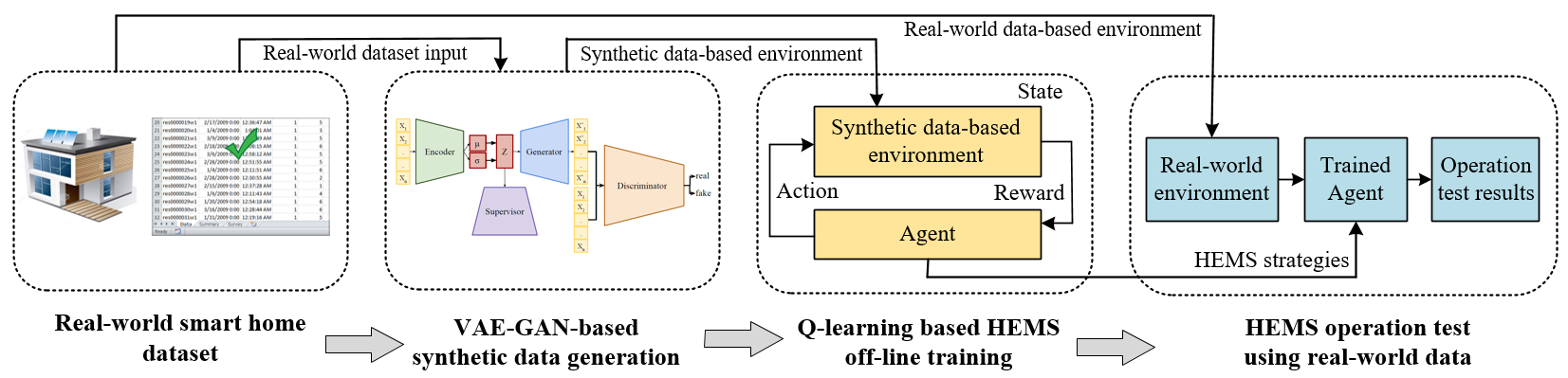
- A VAE-GAN architecture is used to generate synthetic time-series data for smart home energy consumption, PV generation, and EV charging, combining the disentangled latent space of VAEs with the generative power of GANs.
- The model is trained end-to-end on real-world smart meter data to learn complex, non-linear temporal patterns without requiring prior modeling of individual devices or behaviors.
- Statistical metrics—Kullback–Leibler divergence, maximum mean discrepancy (MMD), and Wasserstein distance—are used to evaluate distributional similarity between real and synthetic data.
- A Q-learning-based HEMS is trained offline using the synthetic datasets to optimize long-term energy cost savings and profit through energy storage and demand response decisions.
- The trained HEMS agents are evaluated online using real-world data to measure performance in terms of daily profit and stability of learning.
- The method is compared against baseline models using GAN and Gaussian Mixture Models (GMM) for data generation, with performance assessed across varying energy storage system (ESS) capacities.
Experimental results
Research questions
- RQ1Can a VAE-GAN model generate synthetic smart home energy consumption data that closely matches the statistical and temporal distribution of real-world data?
- RQ2How does the performance of a Q-learning-based HEMS trained on VAE-GAN-generated synthetic data compare to that trained on real data or other synthetic data methods?
- RQ3Does the quality of synthetic data significantly impact the real-world online performance of a HEMS agent?
- RQ4How does the capacity of the energy storage system (ESS) influence the relative performance of HEMS agents trained on different synthetic data sources?
- RQ5What are the scalability, management cost, and economic feasibility of deploying a VAE-GAN-based synthetic data pipeline in real-world smart home energy management?
Key findings
- The VAE-GAN-generated synthetic data achieved the lowest Kullback–Leibler divergence (0.02), MMD (0.01), and Wasserstein distance (0.03) compared to real data, indicating superior statistical fidelity.
- The HEMS trained on VAE-GAN synthetic data achieved the highest average online profit across all ESS capacities, outperforming those trained on GAN- and GMM-generated data.
- On 40-day online testing, the VAE-GAN-based HEMS achieved comparable profit to the real-data baseline on most days, with the gap narrowing as ESS capacity increased.
- The Q-learning agent trained on VAE-GAN data showed stable convergence after the exploration phase, indicating reliable learning from synthetic data.
- The proposed method demonstrated high scalability and low management cost, as model updates only require retraining with new datasets when system configurations change.
- The economic benefits of the VAE-GAN-based HEMS were highest in larger-scale deployments, such as smart buildings and communities, due to improved energy arbitrage and demand response.

Better researchstarts right now
From reading papers to final review, dramatically reduce your research time.
No credit card · Free plan available
This review was created by AI and reviewed by human editors.