
[Paper Review] Spectral calculations of 3D RMHD simulations of super-Eddington accretion onto a stellar-mass black hole
This study uses Monte Carlo radiation transfer post-processing on 3D RMHD simulations of super-Eddington accretion onto a 6.62 M⊙ black hole to compute synthetic X-ray spectra. It demonstrates that a multi-group Compton scattering treatment yields harder spectra and higher temperatures than the gray approximation, producing post-processed spectra that closely match observed hard X-ray tails in ULXs like NGC 1313 X-1.
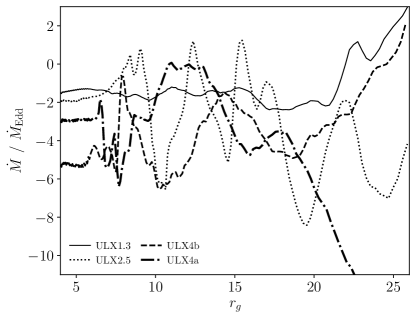
We use the Athena++ Monte Carlo (MC) radiation transfer module to post-process simulation snapshots from non-relativistic Athena++ radiation magnetohydrodynamic (RMHD) simulations. These simulations were run using a gray (frequency integrated) approach but were also restarted and ran with a multi-group approach that accounts for Compton scattering with a Kompaneets operator. These simulations produced moderately super-Eddington accretion rates onto a 6.62 $M_\odot$ black hole. Since we only achieve inflow equilibrium out to 20-25 gravitational radii, we focus on the hard X-ray emission. We provide a comparison between the MC and RMHD simulations showing that the treatment of Compton scattering in the gray RMHD simulations underestimates the gas temperature in the regions above and below the accretion disk. In contrast, the restarted multi-group snapshots provides a treatment for the radiation field that is more consistent with the MC calculations, and result in post-processed spectra with harder X-ray emission compared to their gray snapshot counterparts. We characterize these MC post-processed spectra using commonly employed phenomenological models used for spectral fitting. We also attempt to fit our MC spectra directly to observations of the ultraluminous X-ray source (ULX) NGC 1313 X-1, finding best fit values that are competitive to phenomenological model fits, indicating that first principle models of super-Eddington accretion may adequately explain the observed hard X-ray spectra in some ULX sources.
Motivation & Objective
- To compute synthetic X-ray spectra from 3D non-relativistic RMHD simulations of super-Eddington accretion onto a stellar-mass black hole.
- To assess the impact of Compton scattering treatment—gray vs. multi-group—on simulated spectra and gas temperatures.
- To compare post-processed Monte Carlo spectra with observational data from the ULX NGC 1313 X-1.
- To evaluate whether first-principles simulations can reproduce the hard X-ray components seen in ULXs without relying on phenomenological models.
Proposed method
- Post-process snapshots from Athena++ non-relativistic RMHD simulations using a Monte Carlo radiation transfer module.
- Apply a gray radiation transfer approach with frequency-integrated opacities and radiation forces in initial simulations.
- Restart simulations using a multi-group approach with a Kompaneets operator to model Compton scattering more accurately.
- Compute spectral energy distributions via Monte Carlo photon transport, using blackbody assumptions for initial Compton cooling estimates.
- Fit the resulting synthetic spectra with standard phenomenological models (e.g., SIMPL, POW) and directly compare to XMM-Newton and NuSTAR observations.
- Generate an XSPEC table model from the Monte Carlo spectra to enable direct fitting against observational data.
Experimental results
Research questions
- RQ1How does the treatment of Compton scattering in gray versus multi-group RMHD simulations affect the predicted X-ray spectra and gas temperatures?
- RQ2To what extent do post-processed Monte Carlo spectra from 3D RMHD simulations reproduce the hard X-ray tails observed in ULXs like NGC 1313 X-1?
- RQ3Can first-principles simulations of super-Eddington accretion produce spectra competitive with phenomenological models used in spectral fitting?
- RQ4What are the limitations of the current simulation setup—particularly regarding inflow equilibrium and radiation field treatment—in reproducing observed ULX spectra?
Key findings
- The gray RMHD simulations underestimate gas temperatures in the funnel regions above and below the accretion disk due to inaccurate Compton cooling estimates using blackbody assumptions.
- Multi-group simulations with a Kompaneets-like Compton scattering treatment produce higher temperatures and significantly harder X-ray spectra than their gray counterparts.
- Spectra from multi-group snapshots yield power-law slopes of Γ ≈ 2–3 in the hard X-ray band, consistent with observations of NGC 1313 X-1 and Holmberg IX X-1.
- The SIMPL model provides a better fit to the hard X-ray component than the power-law (POW) model when fitting spectra from gray RMHD snapshots, with Γ ≈ 2–4.
- Direct fitting of the Monte Carlo spectra to NGC 1313 X-1 observations yields a good fit below 10 keV, though the model is slightly too steep or flat in the hard X-ray tail depending on the source component.
- Best-fit normalizations imply lower luminosities than observed, suggesting discrepancies possibly due to missing general relativistic effects or incomplete inflow equilibrium.

Better researchstarts right now
From reading papers to final review, dramatically reduce your research time.
No credit card · Free plan available
This review was created by AI and reviewed by human editors.