
[Paper Review] Spin relaxation dynamics with a continuous spin environment: the dissipaton equation of motion approach
This paper develops a dissipaton equation of motion (DEOM) approach for spin relaxation dynamics in a continuous spin bath, deriving a fluctuation-dissipation theorem (FDT) for arbitrary spin quantum number $S$ and using time-domain Prony fitting to construct exponential decay basis functions. The method enables accurate and efficient simulation of non-Gaussian, anharmonic environments beyond the standard spin-boson model.
We present the quantum dynamics of a spin coupling to a bath of independent spins via the dissipaton equation of motion (DEOM) approach. The bath, characterized by a continuous spectral density function, is composed of spins that are independent level systems described by the su(2) Lie algebra. This represents an extreme class of anharmonic environment. Based on the conclusion drawn by Suarez and Silbey [J. Chem. Phys. 95, 9115 (1991)] and Makri [J. Chem. Phys. 111, 6164 (1999)] that the spin bath can be mapped to a Gaussian environment under its linear response limit, we derive the fluctuation-dissipation theorem (FDT) of the spin bath from a microscopic perspective, and generalize the discussion to the case of arbitrary bath spin quantum number S. Next, the time-domain Prony fitting decomposition scheme is applied to the bare-bath time correlation function (TCF) given by FDT to generate the exponential decay basis (or pseudo modes) for DEOM construction. The accuracy and efficiency of this strategy has been justified by a variety of numerical results. We envision this work provides new insights to extend the hierarchical equations of motion (HEOM) and DEOM approach to certain types of anharmonic enviroments with arbitrary TCF or spectral density
Motivation & Objective
- To develop a quantum dynamics framework for a two-level system coupled to a continuous spin bath with arbitrary spin quantum number $S$.
- To derive the fluctuation-dissipation theorem (FDT) for such spin baths from a microscopic perspective, generalizing prior results to non-zero $S$.
- To enable the use of the DEOM formalism for anharmonic environments by constructing an exponential decay basis via time-domain Prony fitting of the bare-bath time correlation function (TCF).
- To validate the accuracy and efficiency of the method across diverse bath parameters and temperature regimes.
Proposed method
- Derive the FDT for a spin bath composed of independent $\mathfrak{su}(2)$-algebraic level systems with arbitrary spin quantum number $S$, yielding an effective spectral density $J_{\text{eff}}(\omega;\beta,S)$.
- Use the time-domain Prony fitting decomposition (t-PFD) to approximate the bare-bath TCF as a sum of exponential decays, forming the basis for DEOM construction.
- Construct the dissipaton hierarchy using the resulting pseudo-mode representation to describe non-Markovian dynamics in the presence of an anharmonic spin bath.
- Generalize the approach to arbitrary spectral densities and non-Gaussian environments by leveraging the linear response limit and effective spectral density mapping.
- Validate the method numerically by comparing results with known benchmarks, particularly in the high-$S$ limit where the spin bath reduces to a Gaussian (bosonic) bath.
- Apply the framework to model systems with varying bath cutoff frequency and coupling strength, assessing convergence and computational cost.
Experimental results
Research questions
- RQ1How can the fluctuation-dissipation theorem be derived microscopically for a spin bath with arbitrary spin quantum number $S$?
- RQ2To what extent does the time-domain Prony fitting strategy accurately represent the bare-bath time correlation function for spin baths with different $S$ and temperature?
- RQ3Can the DEOM formalism be effectively extended to describe non-Gaussian, anharmonic environments such as spin baths, beyond the standard bosonic bath assumption?
- RQ4How does the accuracy of the t-PFD-based DEOM depend on the number of exponential terms and bath parameters like $\alpha$ and $\omega_c/\Delta$?
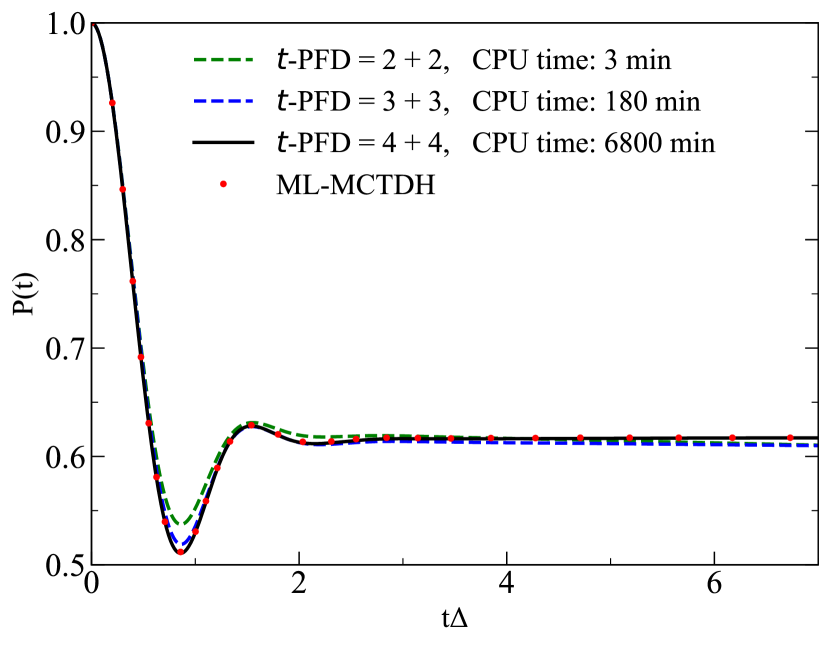
- RQ5What is the computational cost-accuracy trade-off in using different t-PFD schemes for finite-temperature spin baths?
Key findings
- The FDT for the spin bath is derived as $ C(t) = \frac{1}{\pi} \int_{-\infty}^{\infty} d\omega \, e^{-i\omega t} \frac{J_{\text{eff}}(\omega;\beta,S)}{1 - e^{-\beta\omega}} $, with $ J_{\text{eff}}(\omega;\beta,S) = J(\omega) \zeta(\omega;\beta,S) $, where $ \zeta(\omega;\beta,S) $ accounts for spin statistics.
- For $ S = 1/2 $, $ \zeta(\omega;\beta,1/2) = \tanh(\beta\omega/2) $, recovering the known result in the literature.
- In the high-spin limit $ S \gg 1 $, the spin bath becomes isomorphic to a bosonic bath via the Holstein-Primakoff transformation, recovering the standard spin-boson model.
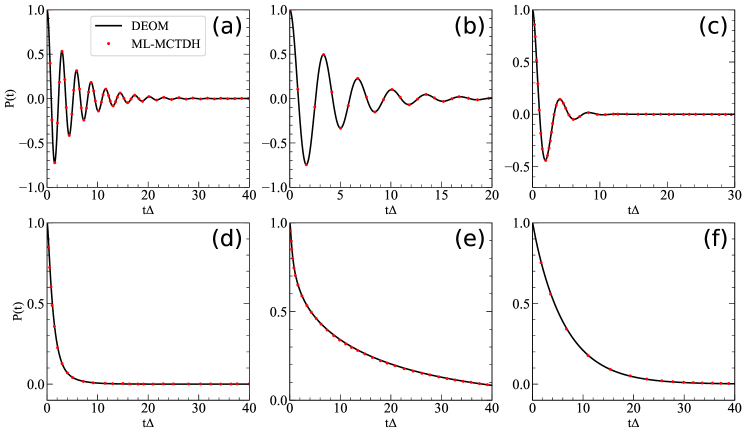
- The t-PFD strategy with $ 4+4 $ terms accurately fits both real and imaginary parts of the TCF for finite-temperature models, with visual inspection confirming high accuracy.
- The method achieves high accuracy with a moderate number of exponential terms, demonstrating computational efficiency and scalability for complex anharmonic environments.
- Numerical results confirm that the approach is robust across varying bath parameters, including high cutoff frequencies and strong coupling ($ \alpha = 10 $), and maintains accuracy even at finite temperatures.
Better researchstarts right now
From reading papers to final review, dramatically reduce your research time.
No credit card · Free plan available
This review was created by AI and reviewed by human editors.