
[Paper Review] Stability of local tip pool sizes
This paper proposes a continuous-time stochastic model to analyze the stability of local tip pool sizes in DAG-based distributed ledgers under heterogeneous and random network delays. It proves that tip pool sizes are ergodic and converge to a stationary distribution, with quantitative bounds on pool sizes dependent on delay distributions and node activity rates.
In distributed ledger technologies (DLTs) with a directed acyclic graph (DAG) data structure, a block-issuing node can decide where to append new blocks and, consequently, how the DAG grows. This DAG data structure is typically decomposed into two pools of blocks, dependent on whether another block already references them. The unreferenced blocks are called the tips. Due to network delay, nodes can perceive the set of tips differently, giving rise to local tip pools. We present a new mathematical model to analyse the stability of the different local perceptions of the tip pools and allow heterogeneous and random network delay in the underlying peer-to-peer communication layer. Under natural assumptions, we prove that the number of tips is ergodic, converges to a stationary distribution, and provide quantitative bounds on the tip pool sizes. We conclude our study with agent-based simulations to illustrate the convergence of the tip pool sizes and the pool sizes' dependence on the communication delay and degree of centralization.
Motivation & Objective
- To model the evolution of local tip pools in DAG-based distributed ledgers under realistic network delay conditions.
- To address the gap in prior work by incorporating heterogeneous and random communication delays, unlike previous models with deterministic delays.
- To establish theoretical stability properties—specifically stationarity and ergodicity—of local tip pool sizes in a continuous-time framework.
- To quantify the impact of delay distribution and node activity heterogeneity on tip pool size dynamics.
- To provide a foundation for deriving bounds on expected tip pool sizes and convergence speed in practical DAG-based systems.
Proposed method
- Models block creation and propagation as a continuous-time, spatially distributed stochastic process with Poisson arrivals and random network delays.
- Introduces a regeneration structure based on block references to analyze long-term behavior and prove stationarity and ergodicity of tip pool sizes.
- Uses a marked point process to represent block creation and propagation, with marks encoding node identity, reference set, and transmission delay.
- Applies stochastic coupling and negative drift analysis to derive concentration bounds on tip pool sizes under general delay distributions.
- Employs agent-based simulations with varying delay distributions (random vs. constant) and node rate heterogeneity (Zipf-distributed) to validate theoretical findings.
- Leverages regeneration theory and exponential moment bounds to suggest large deviation and extreme value results for tip pool size fluctuations.
Experimental results
Research questions
- RQ1How does heterogeneous and random network delay affect the stability and size of local tip pools in DAG-based distributed ledgers?
- RQ2Under what conditions does the number of tips in a node's local pool converge to a stationary distribution?
- RQ3What is the impact of node activity rate heterogeneity (e.g., Zipf-distributed rates) on local tip pool size variation?
- RQ4How does the randomness of message delays compare to constant delays in terms of tip pool size stability?
- RQ5Can quantitative bounds on expected tip pool size and convergence speed be derived from the model?
Key findings
- The number of tips in a node's local pool is ergodic and converges to a stationary distribution under mild and natural assumptions.
- The model proves asymptotic negative drift in tip pool size, implying concentration around a stable mean value.
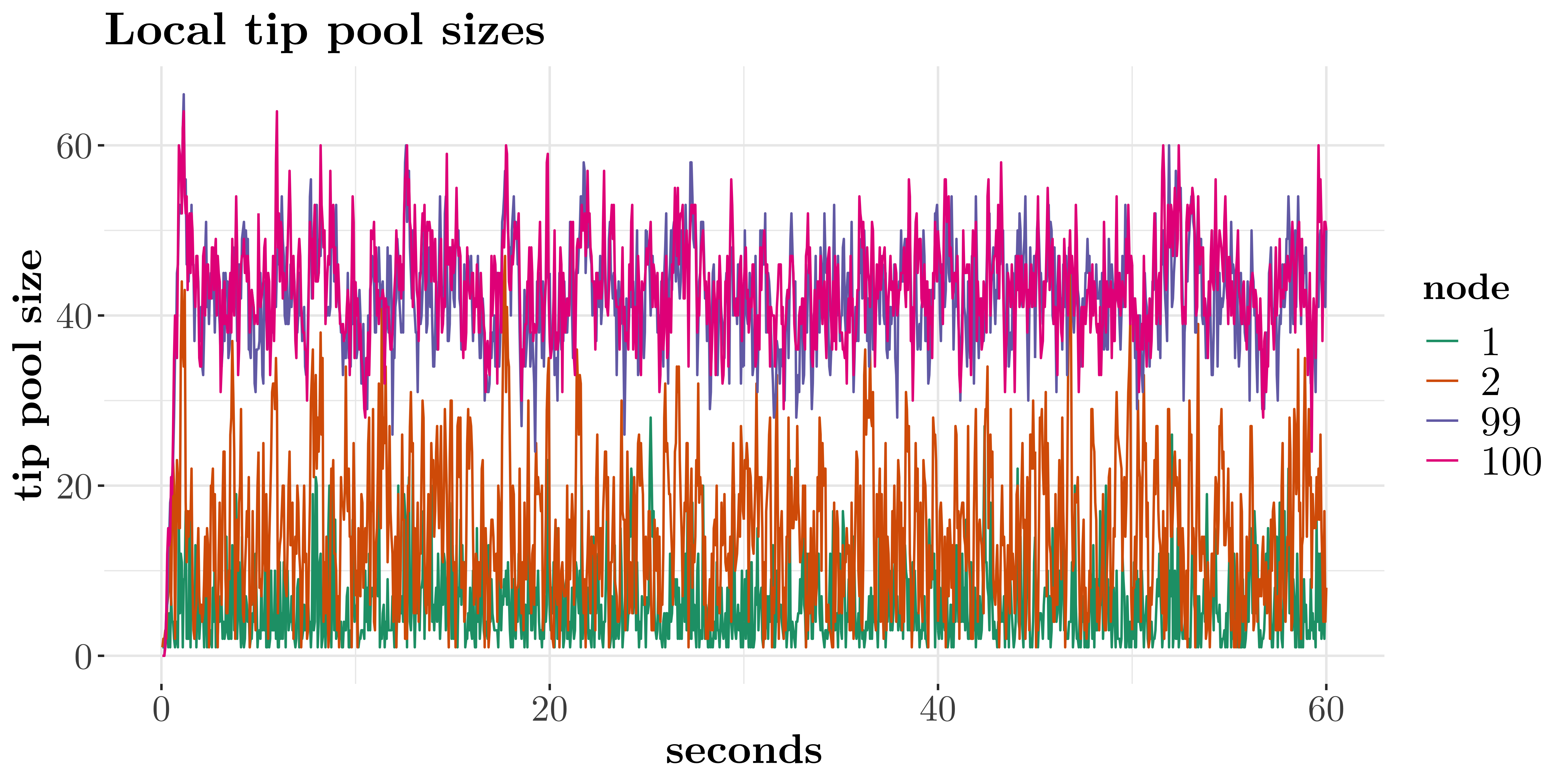
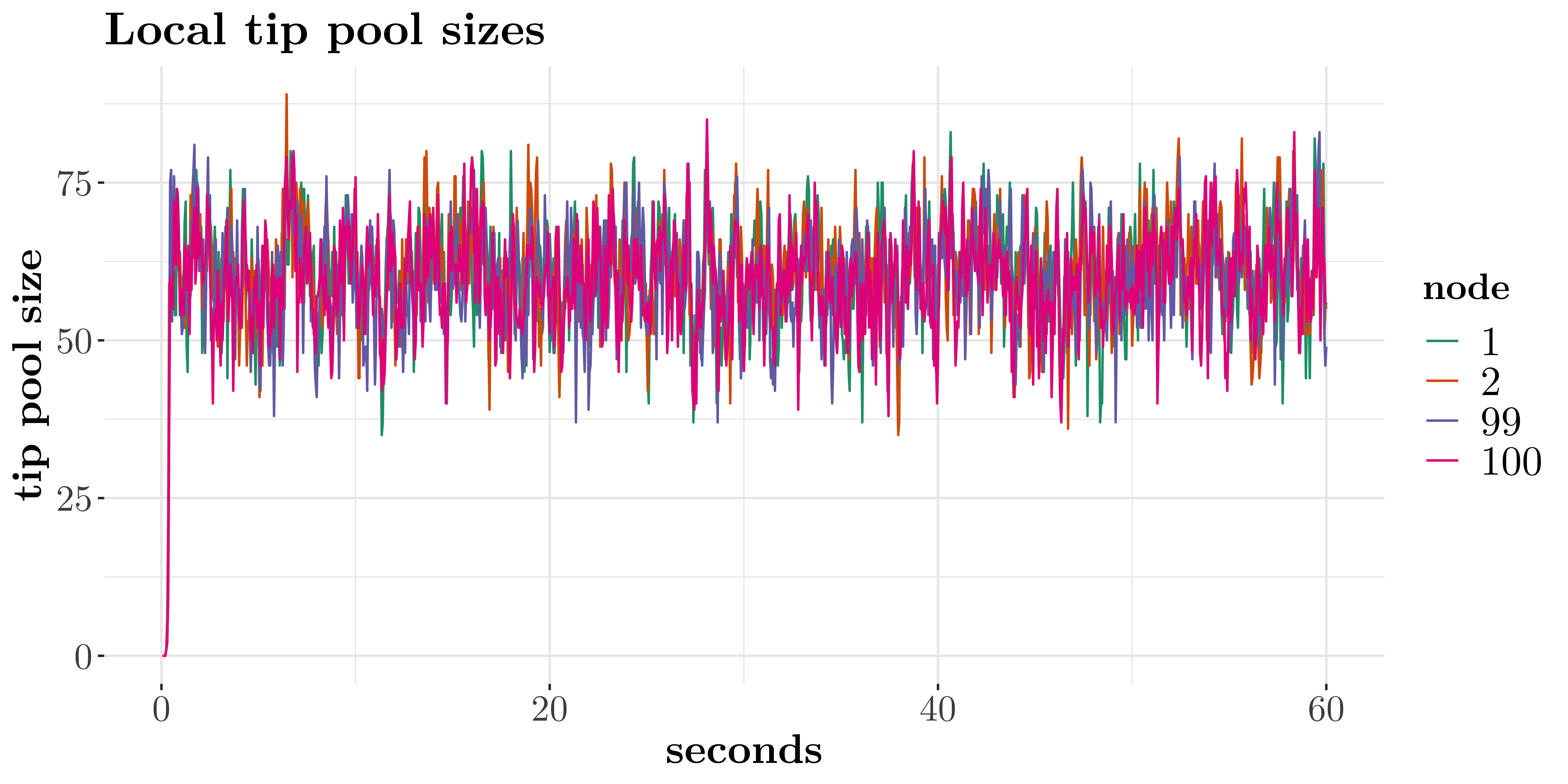
- Random network delays lead to smaller and more stable tip pools compared to constant delays, even with identical mean delays.
- Heterogeneous node activity rates (e.g., Zipf-distributed) result in more disparate and generally smaller local tip pool sizes.
- Simulations confirm fast convergence to the stationary regime, with tip pool sizes strongly dependent on delay distribution and node rate heterogeneity.
- The regeneration structure enables theoretical extensions to large deviation principles and extreme value theory for tip pool size fluctuations.
Better researchstarts right now
From reading papers to final review, dramatically reduce your research time.
No credit card · Free plan available
This review was created by AI and reviewed by human editors.