
[Paper Review] Standard Siren Cosmology with Gravitational Waves from Binary Black Hole Mergers in Active Galaxy Nuclei
This paper proposes a novel standard siren cosmology method using gravitational waves from binary black hole mergers in active galactic nuclei (AGNs), leveraging AGN flares or catalogs as redshift indicators without requiring unique host galaxy identification. It achieves H₀ constraints at 2–7% precision within 1–2 years of LIGO/Virgo/KAGRA observations at design (A+) sensitivity, depending on flare detection efficiency and cosmological priors.
The detection of gravitational waves (GW) with an electromagnetic counterpart enabled the first Hubble Constant $H_0$ measurement through the standard siren method. Current constraints suggest that $\sim 20-30\%$ of LIGO/Virgo/KAGRA (LVK) Binary Black Hole (BBH) mergers might occur in Active Galactic Nuclei (AGN) disks. The claim for a possible association of several BBH mergers with flaring AGNs suggests that cosmological analyses using BBH and AGNs might be promising. We explore standard siren analyses through a method that takes into account the presence of background flaring AGNs, without requiring a unique host galaxy identification, and apply it to realistic GW simulations. Depending on the fraction of LVK BBHs that induce flares, we expect to constrain $H_0$ at the $\sim 6-7\%$ ($\sim 4-5\%$) precision with $\sim 2-3$ years or $\sim 160-240$ events ($\sim 1$ year or $500$ events) of LVK at design (A+) sensitivity, assuming that systematic BBH follow-up searches are performed. %Assuming a more restrictive $Ω_{ m m}$ prior and that at least $20\%$ of BBHs produces detectable flares, we may reach a $3\%$ ($2\%$) precision in $H_0$ after 2 (1) year of LVK at design (A+) sensitivity. We also show that in a scenario where only $\sim 1\%$ of the BBHs induce detectable flares it is possible to achieve an $H_0$ precision from $7.5\%$ to $15\%$ with $\sim 240$ events. In addition, a $\sim 5-27\%$ precision is achievable with complete AGN catalogs and 1 year of LVK run, without the need of any flare identification.
Motivation & Objective
- Address the persistent H₀ tension by enabling independent cosmological measurements using gravitational waves.
- Overcome the challenge of lacking electromagnetic counterparts for most binary black hole (BBH) mergers by using AGN flares as redshift indicators.
- Develop a statistical method to associate GW events with AGNs or flares without requiring time-critical follow-up or unique host galaxy identification.
- Quantify the cosmological precision achievable using BBH mergers in AGNs, considering realistic AGN density and flare probability.
- Assess the impact of cosmological priors and AGN flare detection efficiency on H₀ measurement precision.
Proposed method
- Model GW-AGN associations using an inhomogeneous Poisson process to account for spatial and temporal distributions of AGNs and flares.
- Apply Bayes' theorem to compute the posterior on cosmological parameters, marginalizing over the fraction of BBHs inducing flares (λ) and sky positions.
- Use the likelihood function (Eq. 3) that combines the probability of a GW event matching an AGN’s sky position and redshift with the background rate of chance coincidences.
- Incorporate detection probabilities for AGNs and flares (P_det^AGN) and compute the expected number of background associations (μ_i) via integration over sky and redshift (Eq. 4).
- Sample the posterior distribution using the emcee MCMC package to estimate cosmological parameters and λ in a wCDM cosmological model.
- Test the method on realistic GW simulations with varying AGN number densities (n_AGN = 10^{-4.75} to 10^{-4.5} Mpc⁻³) and flare probabilities (α_flare = 10^{-4} to 10^{-3}).
Experimental results
Research questions
- RQ1Can AGN flares or catalogs be used as redshift indicators for standard siren cosmology without identifying a unique host galaxy?
- RQ2What level of H₀ precision can be achieved using BBH mergers in AGNs with current and future GW detector sensitivities?
- RQ3How does the inclusion of cosmological priors (e.g., on Ω_m) affect the precision of H₀ measurements in this framework?
- RQ4What is the expected precision in measuring the fraction of BBHs that induce detectable AGN flares (λ), and how does it depend on event count and AGN density?
- RQ5Can the method achieve sub-5% H₀ precision without time-critical follow-up observations, using only AGN catalogs?
Key findings
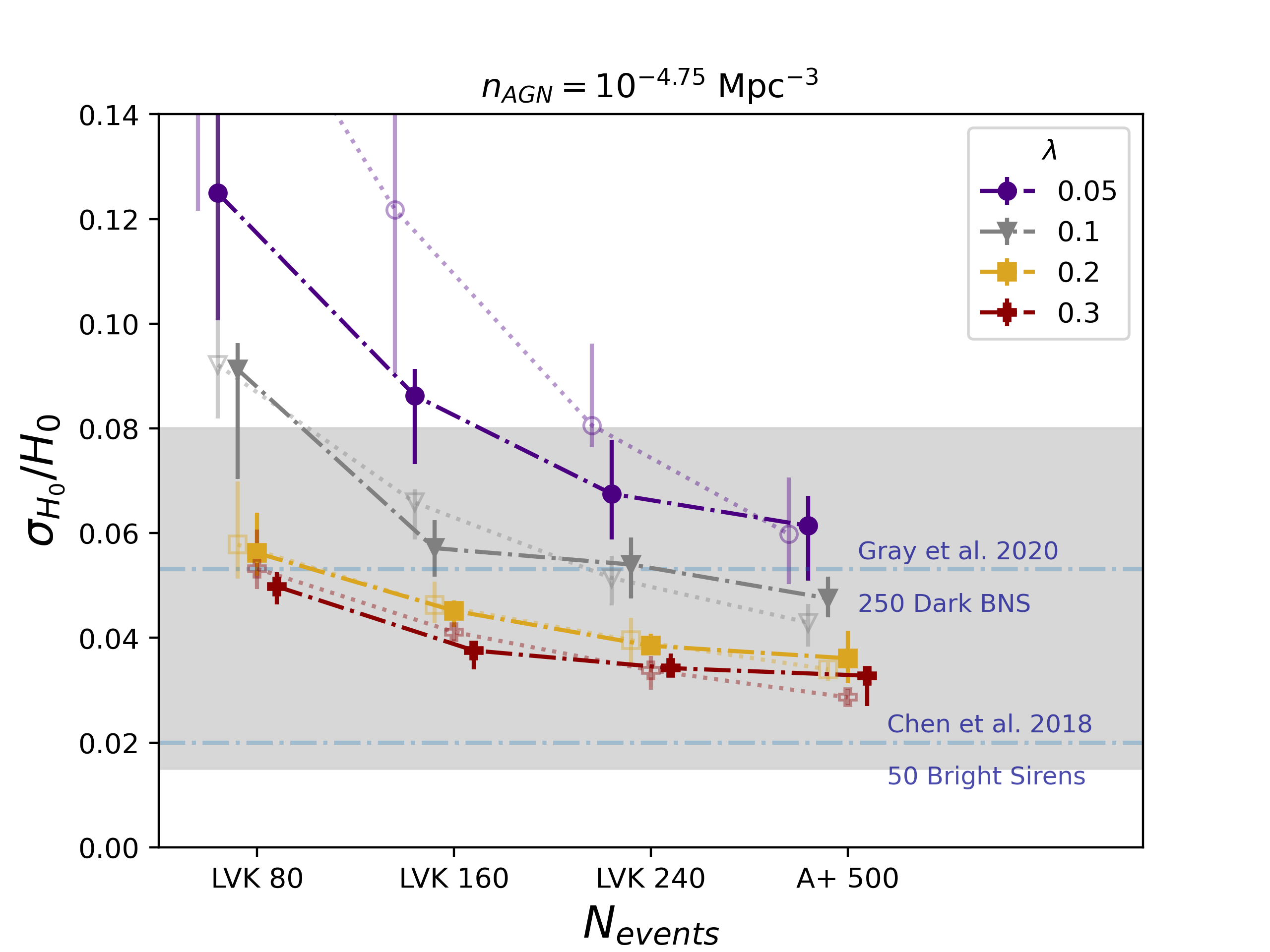
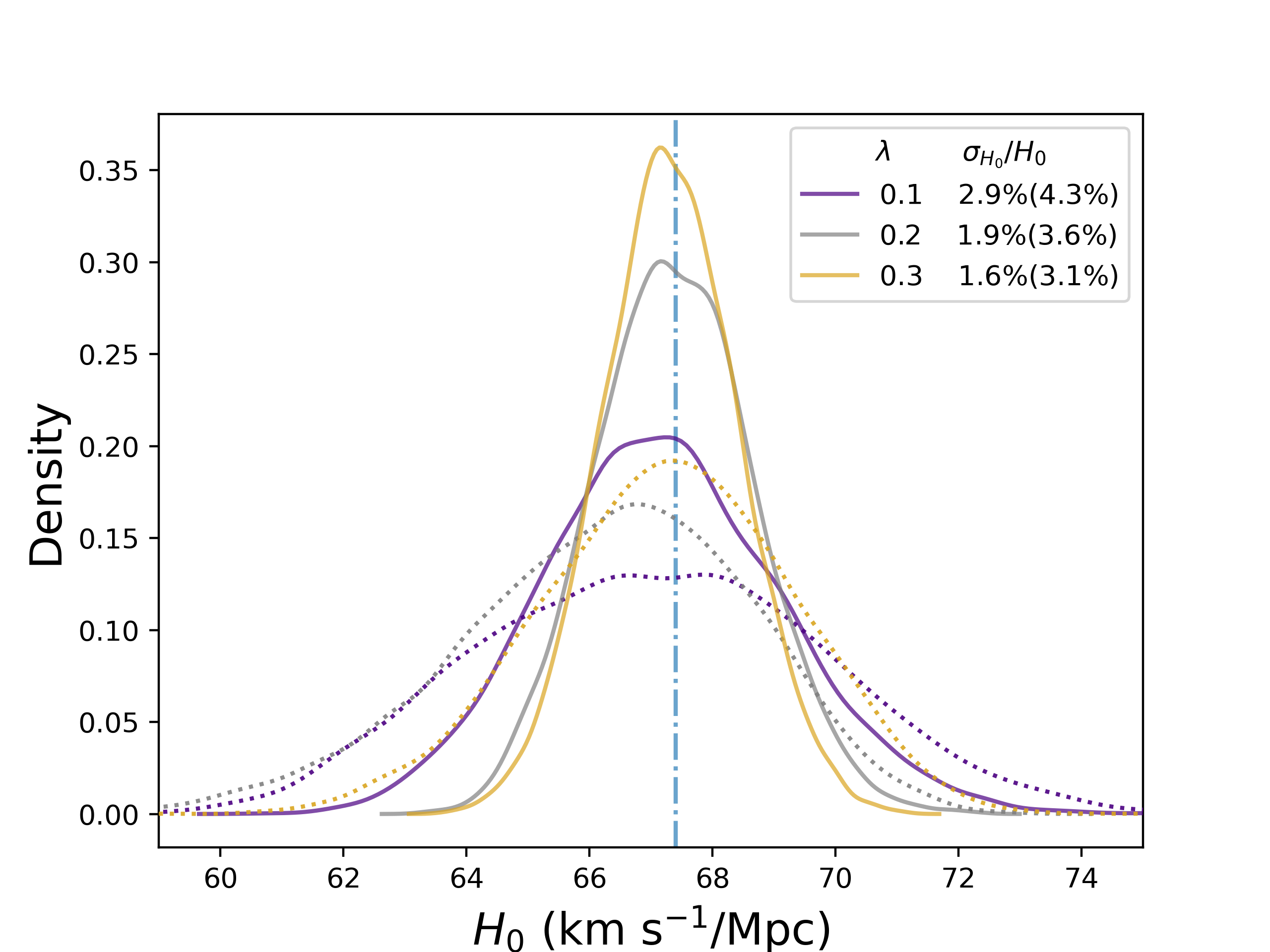
- With 160 BBH events over ~2 years of LIGO/Virgo/KAGRA at design sensitivity, H₀ can be constrained to 3.5–7% precision, assuming 20–80% of BBHs occur in AGNs.
- With 500 events over ~1 year at A+ sensitivity, H₀ precision improves to 2.5–5% under the same assumptions.
- Assuming a 20% BBH flare fraction and a restrictive Ω_m prior, H₀ precision reaches 3% (2%) after 2 (1) years at A+ sensitivity.
- A 5–10% H₀ precision is achievable using only complete AGN catalogs and 1 year of LVK data, without requiring time-critical follow-up observations.
- The method enables λ (fraction of BBHs inducing flares) to be constrained with ~10–30% precision, providing insights into BBH formation channels in AGNs.
- The posterior contours show a banana-shaped degeneracy typical of standard sirens, confirming the method’s consistency with standard siren cosmology principles.
Better researchstarts right now
From reading papers to final review, dramatically reduce your research time.
No credit card · Free plan available
This review was created by AI and reviewed by human editors.