
[Paper Review] StockEmotions: Discover Investor Emotions for Financial Sentiment Analysis and Multivariate Time Series
This paper introduces StockEmotions, a novel 10,000-sample dataset of financial social media comments from StockTwits, annotated with 12 fine-grained emotion classes and financial sentiment, enabling advanced sentiment and emotion analysis. Using a hybrid human-PLM annotation pipeline, the study demonstrates that combining text, emotion, and price features in a Temporal Attention LSTM improves multivariate time series forecasting performance on the S&P 500 beyond using price data alone.
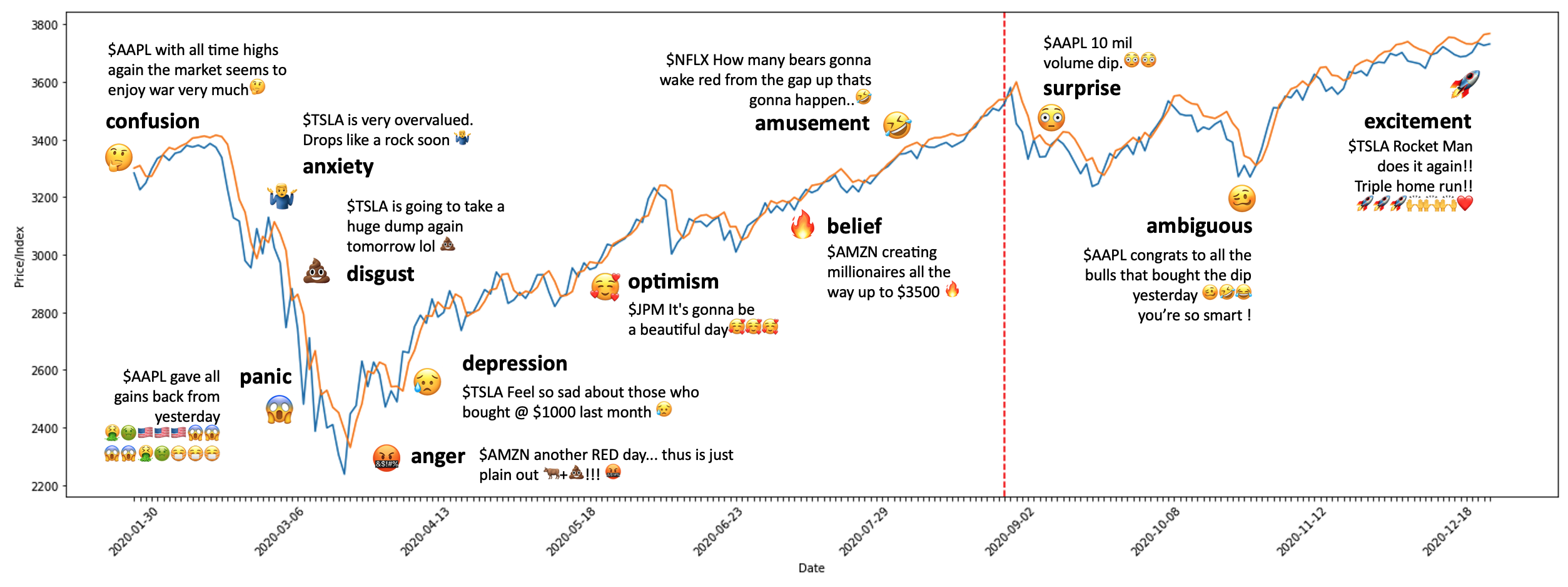
There has been growing interest in applying NLP techniques in the financial domain, however, resources are extremely limited. This paper introduces StockEmotions, a new dataset for detecting emotions in the stock market that consists of 10,000 English comments collected from StockTwits, a financial social media platform. Inspired by behavioral finance, it proposes 12 fine-grained emotion classes that span the roller coaster of investor emotion. Unlike existing financial sentiment datasets, StockEmotions presents granular features such as investor sentiment classes, fine-grained emotions, emojis, and time series data. To demonstrate the usability of the dataset, we perform a dataset analysis and conduct experimental downstream tasks. For financial sentiment/emotion classification tasks, DistilBERT outperforms other baselines, and for multivariate time series forecasting, a Temporal Attention LSTM model combining price index, text, and emotion features achieves the best performance than using a single feature.
Motivation & Objective
- Address the scarcity of large-scale, fine-grained financial sentiment and emotion datasets in NLP for finance.
- Overcome limitations of existing datasets that lack emotion granularity, emoji, and time-series alignment.
- Develop a robust, multi-step annotation pipeline combining pre-trained language models and expert validation for emotion labeling.
- Demonstrate the utility of investor emotions in improving multivariate stock market time series forecasting.
- Establish baseline models for financial sentiment and emotion classification, and for joint forecasting using text, emotion, and price data.
Proposed method
- Collected 10,000 English comments from StockTwits, a financial social media platform, focusing on investor sentiment and emotional expression.
- Designed a 12-class emotion taxonomy grounded in behavioral finance and psychological research, including emotions like excitement, anxiety, anger, and optimism.
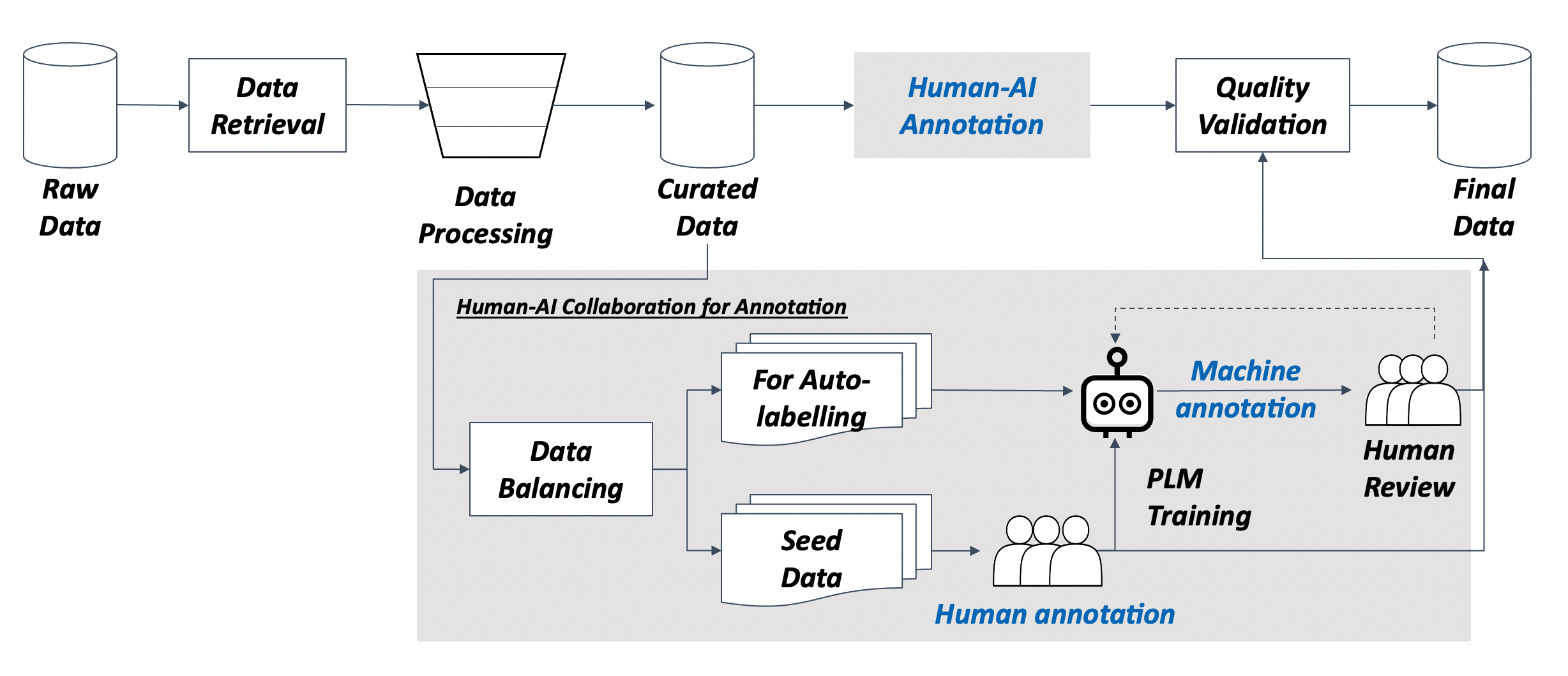
- Employed a hybrid annotation pipeline: first using a pre-trained language model (PLM) to predict emotions, then validated and corrected by finance experts and human annotators.
- Integrated multiple data modalities: financial sentiment (bullish/bearish), fine-grained emotions, emojis, and time-series stock index data (e.g., S&P 500).
- Trained and evaluated seven baseline models—Logistic Regression, NBSVM, GRU, Bi-GRU, DistilBERT, BERT, and RoBERTa—for sentiment and emotion classification.
- Built a Temporal Attention LSTM model that jointly processes price index, textual sentiment, and emotion features to forecast S&P 500 movements with attention over time windows.
Experimental results
Research questions
- RQ1Can a fine-grained, 12-class emotion taxonomy improve financial sentiment and emotion classification beyond binary sentiment labels?
- RQ2How effective is a hybrid human-PLM annotation pipeline in generating reliable emotion labels for financial text?
- RQ3To what extent do investor emotions enhance multivariate time series forecasting performance when combined with price and text data?
- RQ4Which deep learning architecture—DistilBERT, BERT, or LSTM—yields the best performance for financial sentiment and emotion classification?
- RQ5Does joint modeling of text, emotion, and price features outperform models using only numeric or textual inputs in S&P 500 forecasting?
Key findings
- DistilBERT achieved the highest F1-score of 0.81 for financial sentiment classification and 0.42 for emotion classification, outperforming other baselines.
- The Temporal Attention LSTM model that jointly learns from price index, text, and emotion features achieved the best forecasting performance on the S&P 500 compared to models using only price data.
- Emotion classification performance was moderate, with macro F1 scores of 0.48 (Ekman mapping) and 0.40 (Plutchik mapping) using BERT, indicating room for improvement in emotion detection in financial text.
- The dataset revealed high prevalence of financial slang and sarcasm, which confused models—e.g., 'BTD' (Buy The Dip) and 'ATH' (All Time High) were frequently misclassified.
- Emotion labels were often inconsistent with sentiment due to investor position bias: e.g., anger expressed by a long holder during a drop was labeled as 'bullish' sentiment, reflecting underlying optimism.
- The model's performance was sensitive to hyperparameter tuning, with learning rate and dropout values significantly affecting results, especially for smaller models like Logistic Regression and NBSVM.
Better researchstarts right now
From reading papers to final review, dramatically reduce your research time.
No credit card · Free plan available
This review was created by AI and reviewed by human editors.