
[Paper Review] Strong gravitational lenses from the Vera C. Rubin Observatory
This paper forecasts that the Vera C. Rubin Observatory will discover over 100,000 strong gravitational lenses—over 100× more than currently known—enabling transformative constraints on dark energy through four complementary lensing probes: time-delayed quasars, lensed Type Ia supernovae, single-deflector lenses with stellar kinematics, and double-source-plane systems. The study demonstrates that combining these samples will make strong lensing the most powerful dark energy probe in the Rubin LSST era, improving constraints on the dark energy equation of state parameters $w_0$ and $w_a$ beyond current limits.
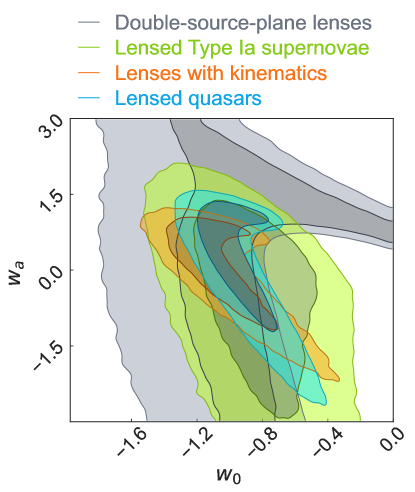
Like many areas of astrophysics and cosmology, the Vera C. Rubin Observatory will be transformational for almost all the applications of strong lensing, thanks to the dramatic increase in the number of known strong lenses by two orders of magnitude or more and the readily available time-domain data for the lenses with transient sources. In this article, we provide an overview of the forecasted number of discovered lenses of different types and describe the primary science cases these large lens samples will enable. We provide an updated forecast on the joint constraint for the dark energy equation-of-state parameters, $w_0$ and $w_a$, from combining all strong lensing probes of dark energy. We update the previous forecast from the Rubin Observatory Dark Energy Science Collaboration's Science Review Document by adding two new crucial strong lensing samples: lensed Type Ia supernovae and single-deflector lenses with measured stellar kinematics. Finally, we describe the current and near-future activities and collaborative efforts within the strong lensing community in preparation for the arrival of the first real dataset from Rubin in early 2026.
Motivation & Objective
- To forecast the number of strong gravitational lenses expected to be discovered by the Rubin LSST, including galaxy-scale lenses, lensed quasars, and lensed Type Ia supernovae.
- To evaluate the scientific potential of these large lens samples for cosmological parameter estimation, particularly for dark energy.
- To update the forecast for joint constraints on the dark energy equation of state parameters $w_0$ and $w_a$ by incorporating new lensing probes.
- To summarize current community efforts in preparation for the Rubin LSST's first data release in 2026, including simulation pipelines and data challenges.
Proposed method
- The authors use updated simulations and forecasts based on the LSST's 10-year survey to estimate the number of detectable strong lensing systems, including galaxy-scale lenses and lensed transient sources.
- They employ a realistic simulation pipeline (SLSim) to model deflector and source populations with empirical luminosity functions and scaling relations, enabling accurate selection function estimation.
- The forecast for dark energy constraints combines four lensing probes: time-delayed lensed quasars, time-delayed lensed SNe Ia, single-plane lenses with stellar kinematics, and double-source-plane systems.
- The joint constraint on $w_0$ and $w_a$ is computed using Markov Chain Monte Carlo (MCMC) methods, with public code available on GitHub.
- The study leverages existing tools such as lenstronomy, emcee, and hierArc for lens modeling and statistical inference.
- Community coordination is supported through the LSST Strong Lensing Science Collaboration and DESC-SLTT, with joint efforts in pipeline development and data challenges for early data (Data Preview 2, 2026).
![Figure 1: Forecasted number of galaxy–galaxy lenses to be discovered by the Rubin LSST [ 4 ] . The numbers for the Year-10 dataset are the directly forecasted ones, and those for the intermediate years are scaled with the imaging signal-to-noise ratio, simply assuming a uniform coverage and cadence,](https://ar5iv.labs.arxiv.org/html/2406.08919/assets/x1.png)
Experimental results
Research questions
- RQ1How many strong gravitational lenses, including galaxy-scale systems and lensed transients, are expected to be discovered by the Rubin LSST over its 10-year survey?
- RQ2What is the projected improvement in constraining the dark energy equation of state parameters $w_0$ and $w_a$ when combining four distinct strong lensing probes?
- RQ3How will the inclusion of lensed Type Ia supernovae and single-deflector lenses with stellar kinematics enhance the dark energy forecast compared to previous studies?
- RQ4What community-driven efforts are currently underway to prepare for the analysis of the first Rubin LSST data, expected in early 2026?
- RQ5How effective are machine learning and citizen science techniques in identifying $\mathcal{O}(10^5)$ strong lenses from $\mathcal{O}(10^{10})$ galaxies in the LSST catalog?
Key findings
- The Rubin LSST is forecast to discover approximately 120,000 galaxy-scale strong lenses with optimal image stacking, representing a two-order-of-magnitude increase over current known systems.
- Even in a conservative scenario requiring blue-red difference imaging, the LSST is expected to discover 62,000 galaxy-scale lenses.
- The LSST is projected to detect around 380 unresolved lensed supernovae, including approximately 180 Type Ia supernovae, via magnification selection.
- The joint analysis of four strong lensing probes—time-delayed quasars, lensed SNe Ia, single-plane lenses with kinematics, and double-source-plane systems—will make strong lensing the most constraining dark energy probe for the Rubin LSST.
- The updated forecast shows that combining these four samples significantly improves constraints on the dark energy equation of state parameters $w_0$ and $w_a$, surpassing the sensitivity of other probes.
- The community is actively preparing through the development of the SLSim simulation pipeline and coordinated data challenges, with full readiness anticipated for the first Rubin LSST data release in early 2026.
Better researchstarts right now
From reading papers to final review, dramatically reduce your research time.
No credit card · Free plan available
This review was created by AI and reviewed by human editors.