
[Paper Review] Strongly interacting matter exhibits deconfined behavior in massive neutron stars
This study uses Bayesian inference and astrophysical constraints to demonstrate that the equation of state (EoS) in the cores of massive neutron stars exhibits strong evidence for deconfined quark matter. By quantifying conformal symmetry restoration and matching degrees of freedom to quark matter, the authors find high credibility for a phase transition to deconfined matter in stars near the maximum mass limit, with results robust across multiple interpolation and Gaussian process methods.
Neutron-star cores contain matter at the highest densities in our Universe. This highly compressed matter may undergo a phase transition where nuclear matter melts into deconfined quark matter, liberating its constituent quarks and gluons. Quark matter exhibits an approximate conformal symmetry, predicting a specific form for its equation of state (EoS), but it is currently unknown whether the transition takes place inside at least some physical neutron stars. Here, we quantify this likelihood by combining information from astrophysical observations and theoretical calculations. Using Bayesian inference, we demonstrate that in the cores of maximally massive stars, the EoS is consistent with quark matter. We do this by establishing approximate conformal symmetry restoration with high credence at the highest densities probed and demonstrating that the number of active degrees of freedom is consistent with deconfined matter. The remaining likelihood is observed to correspond to EoSs exhibiting phase-transition-like behavior, treated as arbitrarily rapid crossovers in our framework.
Motivation & Objective
- To determine whether the equation of state (EoS) in neutron star cores exhibits signatures of deconfined quark matter at the highest densities.
- To test the hypothesis that strongly interacting matter in massive neutron stars undergoes a phase transition to quark matter by analyzing conformal symmetry restoration.
- To quantify the likelihood of quark matter in neutron star cores using astrophysical observations and theoretical constraints from perturbative QCD.
- To assess the robustness of results across different EoS parameterization techniques, including piecewise interpolation and Gaussian processes.
- To distinguish between phase transition-like behavior and smooth crossovers by analyzing the number of active degrees of freedom and conformal measures.
Proposed method
- Employed Bayesian inference to combine astrophysical data (pulsar masses, tidal deformabilities from GW170817, X-ray measurements) with theoretical constraints from perturbative QCD (pQCD) at high densities.
- Used a 4-segment speed of sound interpolation ($c_{ ext{s},4}^2$) and Gaussian process (GP) regression to non-parametrically reconstruct the EoS from observational data.
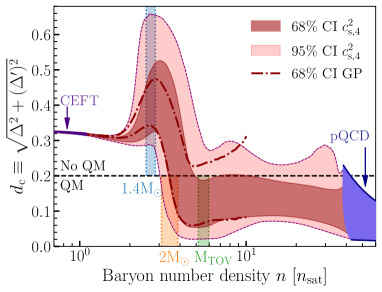
- Defined a conformal measure $d_{ ext{c}} = ext{sqrt}( riangle^2 + ( riangle')^2)$ to quantify the degree of conformal symmetry restoration, where $ riangle$ is the normalized trace anomaly and $ riangle'$ its logarithmic derivative.
- Evaluated the number of active degrees of freedom in the EoS and compared them to expectations for deconfined quark matter, particularly near the maximum neutron star mass.
- Treated phase transitions as arbitrarily rapid crossovers within the framework, allowing for model-agnostic detection of transition-like behavior.
- Constrained EoS models using causality, thermodynamic consistency, and the requirement that high-density points connect smoothly to the pQCD limit at $40n_{ ext{sat}}$.
Experimental results
Research questions
- RQ1Does the equation of state in the core of massive neutron stars exhibit strong evidence for deconfined quark matter through conformal symmetry restoration?
- RQ2To what extent do astrophysical observations and high-density QCD constraints support a phase transition to quark matter in neutron stars near the maximum mass?
- RQ3How robust are the conclusions about deconfined matter across different EoS parameterization methods, such as piecewise interpolation and Gaussian processes?
- RQ4Can the number of active degrees of freedom in the EoS be reconciled with those expected for deconfined quark matter in the core of massive neutron stars?
- RQ5What is the likelihood of a phase transition-like behavior in neutron star cores, and how does it compare to smooth crossover scenarios?
Key findings
- The conformal measure $d_{ ext{c}}$ shows a clear qualitative change around $n \sim 2-3n_{\text{sat}}$, with the highest-density regions of maximally massive neutron stars ($M_{\text{TOV}}$) lying below the threshold for nearly conformal matter, indicating strong support for deconfined quark matter.
- The posterior credible intervals for the conformal measure $d_{\text{c}}$ at the central densities of $M_{\text{TOV}}$ stars lie below the nearly conformal threshold, with high credibility, suggesting restoration of approximate conformal symmetry.
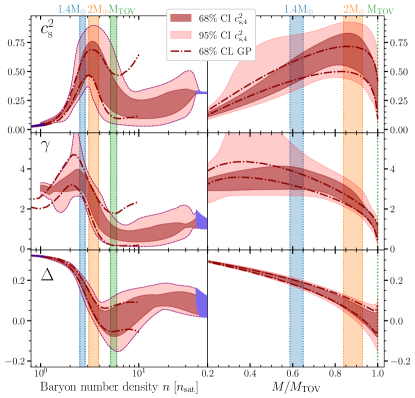
- The number of active degrees of freedom inferred from the EoS is consistent with that expected for deconfined quark matter, particularly in the core of massive neutron stars.
- The inclusion of high-density pQCD constraints significantly improves the consistency of the EoS with quark matter, especially when combined with GW170817 tidal deformability and X-ray measurements.
- Results are robust across multiple interpolation schemes ($c_{ ext{s},4}^2$, $p_4$, GP), with posterior distributions showing consistent trends in $c_{ ext{s}}^2$, $ ho$, and $p$–$ ho$ relations.
- The likelihood of phase-transition-like behavior is high, and it is treated as a rapid crossover in the framework, with the data favoring a transition to a state with quark-like degrees of freedom in the most massive stars.
Better researchstarts right now
From reading papers to final review, dramatically reduce your research time.
No credit card · Free plan available
This review was created by AI and reviewed by human editors.