
[Paper Review] Summarizing, Simplifying, and Synthesizing Medical Evidence Using GPT-3 (with Varying Success)
This study evaluates GPT-3's ability to summarize, simplify, and synthesize biomedical evidence from clinical trials in zero-shot settings using expert-annotated data. While GPT-3 generates factually accurate single-document summaries and plain-language simplifications, it struggles with multi-document evidence synthesis, often producing inaccurate or misleading aggregations of findings across multiple trials.
Large language models, particularly GPT-3, are able to produce high quality summaries of general domain news articles in few- and zero-shot settings. However, it is unclear if such models are similarly capable in more specialized, high-stakes domains such as biomedicine. In this paper, we enlist domain experts (individuals with medical training) to evaluate summaries of biomedical articles generated by GPT-3, given zero supervision. We consider both single- and multi-document settings. In the former, GPT-3 is tasked with generating regular and plain-language summaries of articles describing randomized controlled trials; in the latter, we assess the degree to which GPT-3 is able to \emph{synthesize} evidence reported across a collection of articles. We design an annotation scheme for evaluating model outputs, with an emphasis on assessing the factual accuracy of generated summaries. We find that while GPT-3 is able to summarize and simplify single biomedical articles faithfully, it struggles to provide accurate aggregations of findings over multiple documents. We release all data and annotations used in this work.
Motivation & Objective
- To assess the factual accuracy of GPT-3-generated summaries of biomedical literature in zero-shot settings.
- To evaluate GPT-3’s ability to produce plain-language simplifications of technical clinical trial summaries.
- To investigate GPT-3’s capacity to synthesize findings across multiple clinical trial abstracts into a coherent, evidence-based summary.
- To identify common factual errors and risks associated with LLM-generated medical summaries.
Proposed method
- Used GPT-3 (text-davinci-003) to generate technical and plain-language summaries from 100 RCT abstracts and 50 meta-analyses.
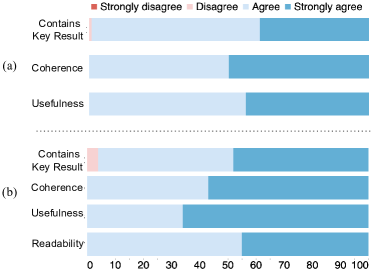
- Employed a custom annotation scheme with domain experts to evaluate factuality, fluency, and usefulness of summaries.
- Collected 300 annotations (3 per sample) using Label Studio, focusing on PICO elements (population, intervention, comparison, outcome).
- Implemented a two-phase strategy for multi-document summarization to handle token length limits.
- Used Likert-scale and free-text annotations to assess linguistic quality, readability, and factual consistency.
- Released all model outputs and annotations to support future research on medical LLM evaluation.
Experimental results
Research questions
- RQ1RQ1: Does GPT3-D3 produce faithful summaries of medical articles in a zero-shot setting?
- RQ2RQ2: Can GPT3-D3 accurately simplify technical summaries while preserving factual content?
- RQ3RQ3: Can GPT3-D3 synthesize findings from multiple clinical trial abstracts into an accurate, evidence-based summary?
- RQ4RQ4: What types of factual errors does GPT3-D3 make, and what are the associated risks in high-stakes medical contexts?
Key findings
- GPT-3 produced factually accurate and fluent technical summaries for single clinical trial abstracts, with minimal omissions or errors in PICO elements.
- GPT-3 successfully simplified technical summaries into plain language, with most simplifications preserving key information and improving readability.
- In the multi-document setting, GPT-3 frequently failed to accurately aggregate evidence, often introducing factual inconsistencies or misrepresenting the strength of evidence.
- The model showed a tendency to oversimplify or misrepresent the comparative effectiveness of interventions when synthesizing multiple studies.
- Annotators identified major factual errors in 22% of multi-document summaries, including incorrect claims about treatment efficacy and missing key outcome data.
- Despite strong performance on single-document tasks, GPT-3’s inability to reliably synthesize evidence across multiple studies poses significant risks in clinical decision support applications.

Better researchstarts right now
From reading papers to final review, dramatically reduce your research time.
No credit card · Free plan available
This review was created by AI and reviewed by human editors.