
[Paper Review] Superconductivity emerging from density-wave-like order in a correlated kagome metal
This study identifies CsCr₃Sb₅ as a correlated kagome bad metal hosting strong electron correlations and fragile density-wave (DW) orders. Under high pressure (~4–8 GPa), DW orders are suppressed near a quantum critical point, triggering unconventional superconductivity with a maximum Tc of 6.4 K, establishing a rare platform for studying unconventional superconductivity in a correlated kagome system.
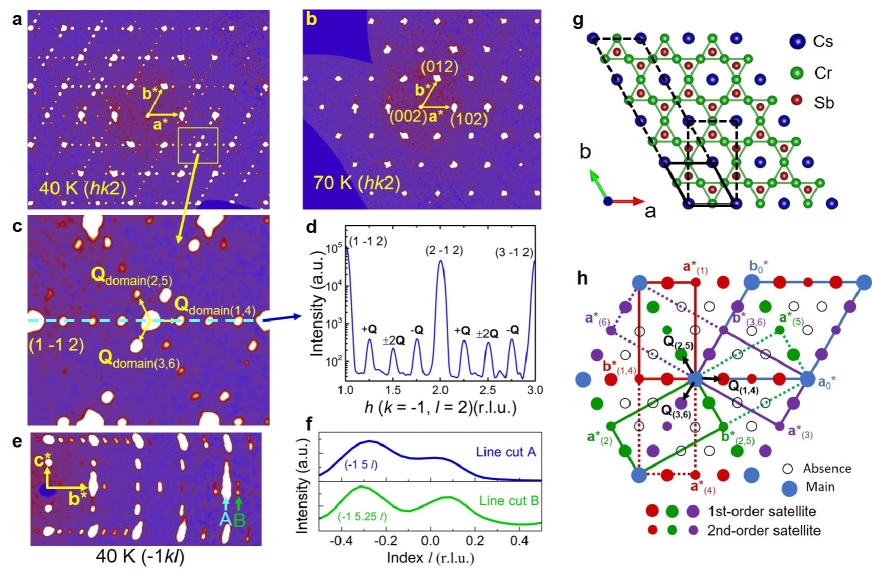
Unconventional superconductivity (USC) in a highly correlated kagome system has been theoretically proposed for years, yet the experimental realization is hard to achieve. The recently discovered vanadium-based kagome materials, which exhibit both superconductivity and charge density wave (CDW) orders, are nonmagnetic and weakly correlated, thus unlikely host USC as theories proposed. Here we report the discovery of a chromium-based kagome metal, CsCr$_3$Sb$_5$, which is contrastingly characterised by strong electron correlations, frustrated magnetism, and characteristic flat bands close to the Fermi level. Under ambient pressure, it undergoes a concurrent structural and magnetic phase transition at 55 K, accompanying with a stripe-like $4a_0$ structural modulation. At high pressure, the phase transition evolves into two transitions, probably associated with CDW and antiferromagnetic spin-density-wave orderings, respectively. These density-wave (DW)-like orders are gradually suppressed with pressure and, remarkably, a superconducting dome emerges at 3.65-8.0 GPa. The maximum of the superconducting transition temperature, $T_\mathrm{c}^{\mathrm{max}}=$ 6.4 K, appears when the DW-like orders are completely suppressed at 4.2 GPa, and the normal state exhibits a non-Fermi-liquid behaviour, reminiscent of USC and quantum criticality in iron-based superconductors. Our work offers an unprecedented platform for investigating possible USC in a correlated kagome system.
Motivation & Objective
- To identify and characterize a new chromium-based kagome material with strong electron correlations and fragile density-wave orders.
- To investigate the emergence of superconductivity in the presence of competing density-wave and magnetic orders.
- To explore the role of electron correlations and quantum criticality in driving unconventional superconductivity in kagome lattices.
- To establish a new platform for studying unconventional superconductivity in correlated kagome systems.
Proposed method
- Single crystals of CsCr₃Sb₅ were grown via a self-flux method and characterized using single-crystal X-ray diffraction and energy dispersive X-ray spectroscopy.
- Electrical resistivity, specific heat, magnetic susceptibility, and magnetotransport measurements were performed to probe electronic and magnetic transitions.
- High-pressure resistivity and magnetization measurements were used to tune the system toward a quantum critical point and detect superconducting transitions.
- Density functional theory (DFT) calculations were employed to analyze the electronic structure and confirm proximity to flat bands in the kagome lattice.
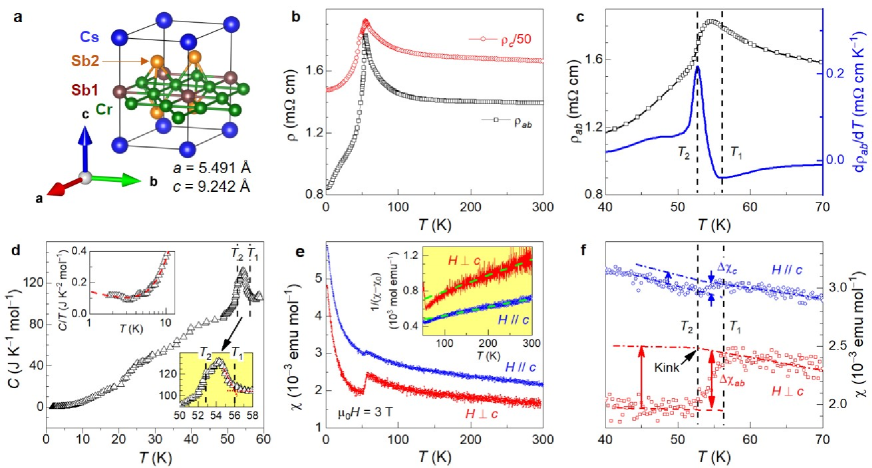
- Analysis of the resistivity and specific heat anomalies at T₁ ≈ 54 K and T₂ ≈ 52 K identified successive phase transitions associated with charge and spin density wave orders.
- The Curie-Weiss fit of inverse magnetic susceptibility confirmed the presence of local magnetic moments and antiferromagnetic spin correlations.
Experimental results
Research questions
- RQ1Can unconventional superconductivity emerge in a kagome lattice material with strong electron correlations and competing density-wave orders?
- RQ2What is the role of electron correlations and quantum criticality in mediating superconductivity in CsCr₃Sb₅?
- RQ3How do pressure-induced phase transitions suppress density-wave orders and stabilize superconductivity?
- RQ4What is the electronic structure of CsCr₃Sb₅, and how does it relate to the emergence of flat bands and correlated quantum phases?
Key findings
- CsCr₃Sb₅ crystallizes in a hexagonal P6/mmm structure with a kagome lattice of Cr atoms and exhibits strong electron correlations and frustrated magnetism.
- Successive phase transitions at ~54 K and ~52.7 K are attributed to stripe-like 4a₀ structural modulations, indicating coexisting charge density wave (CDW) and antiferromagnetic spin-density wave (SDW) orders.
- Under high pressure (4–8 GPa), density-wave orders are suppressed, and superconductivity emerges with a maximum transition temperature Tc of 6.4 K.
- A quantum critical point is identified at P ≈ 4 GPa, where non-Fermi-liquid behavior emerges, signaling proximity to a quantum phase transition.
- The electronic structure calculations show that the electron filling is near the van Hove singularity of the kagome lattice, consistent with flat bands and enhanced correlations.
- The upper critical field Hc2,max reaches 14.34 T at zero temperature, significantly exceeding the Pauli limit, suggesting spin-triplet or strong spin-orbit coupling in the superconducting state.
Better researchstarts right now
From reading papers to final review, dramatically reduce your research time.
No credit card · Free plan available
This review was created by AI and reviewed by human editors.