
[Paper Review] Tensor Network Methods for Extracting CFT Data from Fixed-Point Tensors and Defect Coarse Graining
This paper presents a tensor network method to extract conformal field theory (CFT) data—such as scaling dimensions and OPE coefficients—from fixed-point tensors of the 2D classical Ising model using linearized tensor renormalization group (lTRG) and graph-independent local truncation (GILT). It demonstrates that inserting defects into the lattice generates conformal states matching lTRG eigenvectors, and that HOTRG+GILT enables accurate two- and four-point functions under controlled conditions, with improved stability via minimal canonical form.
We present a comprehensive study on the extraction of CFT data using tensor network methods, specially, from the fixed-point tensor of the linearized tensor renormalization group (lTRG) for the 2D classical Ising model near the critical temperature. Utilizing two different methods, we extract operator scaling dimensions and operator-product-expansion (OPE) coefficients by introducing defects on the lattice and by employing the fixed-point tensor. We also explore the effects of point-like defects in the lattice on the coarse-graining process. We find that there is a correspondence between coarse-grained defect tensors and conformal states obtained from lTRG fixed-point equation. We also analyze the capabilities and limitations of our proposed coarse-graining scheme for tensor networks with point-like defects, which includes graph independent local truncation (GILT) and higher-order tensor renormalization group (HOTRG). Our results provide a better understanding of the capacity and limitations of the tenor renormalization group scheme in coarse-graining defect tensors, and we show that GILT+HOTRG can be used to give accurate two- and four-point functions under specific conditions. We also find that employing the minimal canonical form further improves the stability of the RG flow.
Motivation & Objective
- To develop a method for extracting CFT data, including scaling dimensions and OPE coefficients, from fixed-point tensors of critical lattice models.
- To investigate how point-like defects in the lattice affect tensor network coarse-graining and whether they can be used to construct conformal states.
- To evaluate the performance and limitations of HOTRG and GILT in preserving correlation functions and RG flow stability under defect presence.
- To establish a correspondence between coarse-grained defect tensors and conformal states derived from lTRG fixed-point equations.
- To explore the feasibility of constructing fixed-point tensors from CFT data as a reverse bootstrap approach.
Proposed method
- The study uses the linearized tensor renormalization group (lTRG) to extract scaling dimensions and OPE coefficients from the fixed-point tensor of the 2D Ising model near criticality.
- Defects are introduced on the lattice by modifying local tensors to simulate insertions of conformal operators, enabling the construction of conformal states.
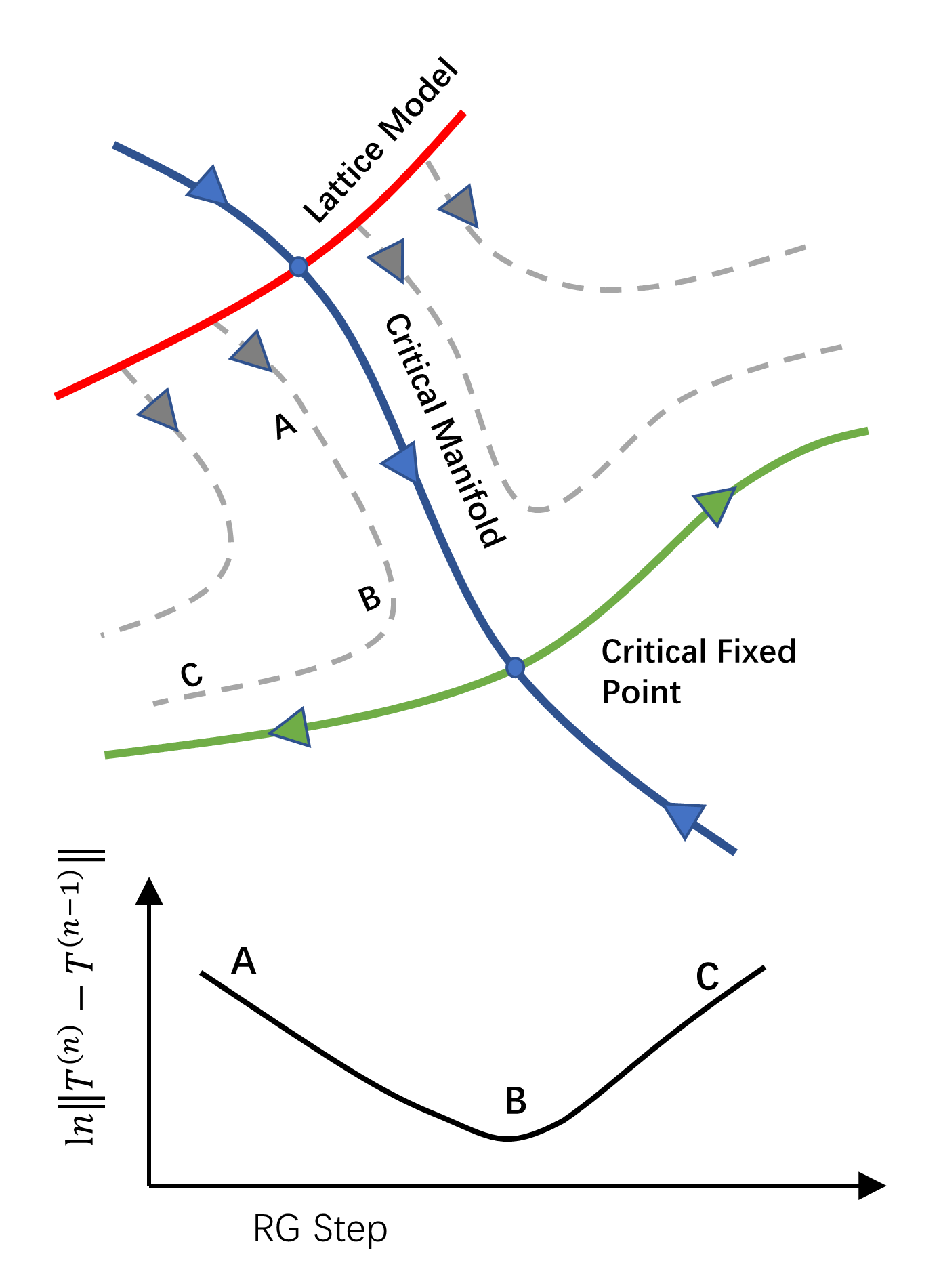
- Graph-independent local truncation (GILT) is applied to remove spurious correlations (CDL tensors) and stabilize the RG flow during coarse-graining.
- Higher-order tensor renormalization group (HOTRG) is used for efficient coarse-graining of the lattice, with truncation and filtering applied at each step.
- The eigenvectors of the lTRG fixed-point equation are compared with coarse-grained defect tensors to verify correspondence with conformal states.
- A minimal canonical form is employed to improve the stability of the RG flow and reduce numerical artifacts.
Experimental results
Research questions
- RQ1Can scaling dimensions and OPE coefficients be accurately extracted from the fixed-point tensor of the 2D Ising model using lTRG and GILT?
- RQ2Is there a direct correspondence between coarse-grained defect tensors and conformal states obtained from the lTRG fixed-point equation?
- RQ3How do point-like defects behave under HOTRG and GILT coarse-graining, and what is the impact on correlation functions?
- RQ4To what extent can GILT+HOTRG preserve two- and four-point correlation functions in the presence of defects?
- RQ5Can the minimal canonical form enhance the stability and accuracy of the tensor network RG flow for defect systems?
Key findings
- Scaling dimensions for conformal states with Δ < 3 in the critical 2D Ising model were extracted with high accuracy using both lTRG and transfer matrix methods, matching analytical results.
- The OPE coefficient Cσσε was successfully computed from the lTRG eigenvectors, confirming consistency with known CFT data.
- Two-point spin-spin correlation functions were computed near criticality, and the extracted exponent matched the scaling dimension with high precision.
- Four-point correlation functions were computed, and while the quality was lower, they still enabled extraction of scaling dimensions and OPE coefficients.
- Defects were found to be smeared into 'particle clouds' during coarse-graining, with stronger smearing at corners and edges, but this effect could be mitigated to recover accurate correlation functions.
- The eigenvectors of the lTRG fixed-point equation were shown to correspond precisely to coarse-grained defect tensors, validating the construction of conformal states from lattice operator insertions.

Better researchstarts right now
From reading papers to final review, dramatically reduce your research time.
No credit card · Free plan available
This review was created by AI and reviewed by human editors.