
[Paper Review] Test of lepton universality in beauty-quark decays
The paper measures the RK ratio in B+ → K+ l+l− decays to test lepton universality, finding RK = 0.846^{+0.044}_{-0.041} in the 1.1–6.0 GeV^2/c^4 q^2 range, indicating evidence for lepton Universality Violation at 3.1σ.
The Standard Model of particle physics currently provides our best description of fundamental particles and their interactions. The theory predicts that the different charged leptons, the electron, muon and tau, have identical electroweak interaction strengths. Previous measurements have shown a wide range of particle decays are consistent with this principle of lepton universality. This article presents evidence for the breaking of lepton universality in beauty-quark decays, with a significance of 3.1 standard deviations, based on proton-proton collision data collected with the LHCb detector at CERN's Large Hadron Collider. The measurements are of processes in which a beauty meson transforms into a strange meson with the emission of either an electron and a positron, or a muon and an antimuon. If confirmed by future measurements, this violation of lepton universality would imply physics beyond the Standard Model, such as a new fundamental interaction between quarks and leptons.
Motivation & Objective
- Test lepton universality in b → s l+ l− transitions.
- Measure the ratio of branching fractions for muons vs electrons in B+ → K+ l+ l−.
- Control and cancel systematic uncertainties via a double-ratio technique using B+ → J/ψ(K+) decays as normalization.
- Provide cross-checks with related resonant channels (e.g., ψ(2S)) to validate efficiency corrections.
Proposed method
- Use proton-proton collision data from LHCb corresponding to 9 fb−1 collected at 7, 8, and 13 TeV.
- Define R_K as the double ratio of differential branching fractions in 1.1 < q^2 < 6.0 GeV^2/c^4 (Eq. 2).
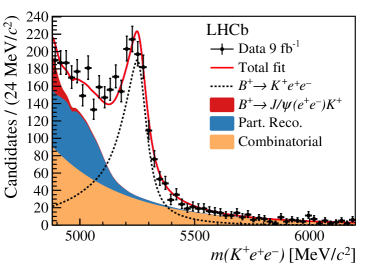
- Separate nonresonant B+ → K+ μ+ μ− from resonant B+ → J/ψ(→ μ+ μ−) K+ decays using q^2 and mass fits.
- Correct for reconstruction efficiencies via simulated events and calibrate with control channels to achieve percent-level accuracy.
- Extract yields with unbinned extended maximum-likelihood fits to m(K+ ℓ+ ℓ−) and m(J/ψ(K+ ℓ+ ℓ−)), incorporating Gaussian constraints for resonant modes.
- Cross-check efficiency universality with the r_{J/ψ} ratio (μ/μ) and validate with ψ(2S) channels (R_{ψ(2S)}).

Experimental results
Research questions
- RQ1Does the B+ → K+ μ+ μ− decay occur at the same rate as B+ → K+ e+ e− when integrated over 1.1 < q^2 < 6.0 GeV^2/c^4?
- RQ2Is there evidence for lepton-universality violation in b → s l+ l− transitions beyond the SM prediction of unity?
- RQ3How robust is the measurement to systematic uncertainties in efficiencies and background modelling?
- RQ4Do resonant control channels (e.g., J/ψ, ψ(2S)) corroborate the nonresonant RK result?
- RQ5How does the measured RK compare with prior experiments and SM expectations?
Key findings
- RK in 1.1 < q^2 < 6.0 GeV^2/c^4 is 0.846^{+0.044}_{-0.041} (stat+sys).
- Combined statistical and systematic uncertainty yields RK = 0.846^{+0.044}_{-0.041}.
- Evidence for lepton universality violation at 3.1 standard deviations (p-value 0.10%).
- The r_{J/ψ} ratio is measured as 0.981 ± 0.020, consistent with unity within uncertainties.
- An independent validation with R_{ψ(2S)} gives 0.997 ± 0.011, supporting the analysis method.
- The measurement supersedes previous RK results with greater precision and shows consistency across data subsets.
Better researchstarts right now
From reading papers to final review, dramatically reduce your research time.
No credit card · Free plan available
This review was created by AI and reviewed by human editors.