
[Paper Review] The AI Ghostwriter Effect: When Users Do Not Perceive Ownership of AI-Generated Text But Self-Declare as Authors
This paper investigates authorship perception in human-AI collaborative text generation, revealing the 'AI Ghostwriter Effect'—users do not self-identify as authors of AI-generated text but often fail to credit the AI, even when personally customized. The effect persists regardless of personalization quality and is stronger when authorship is declared via open-ended responses, highlighting a critical disconnect between ownership perception and public attribution in AI-assisted writing.
Human-AI interaction in text production increases complexity in authorship. In two empirical studies (n1 = 30 & n2 = 96), we investigate authorship and ownership in human-AI collaboration for personalized language generation. We show an AI Ghostwriter Effect: Users do not consider themselves the owners and authors of AI-generated text but refrain from publicly declaring AI authorship. Personalization of AI-generated texts did not impact the AI Ghostwriter Effect, and higher levels of participants' influence on texts increased their sense of ownership. Participants were more likely to attribute ownership to supposedly human ghostwriters than AI ghostwriters, resulting in a higher ownership-authorship discrepancy for human ghostwriters. Rationalizations for authorship in AI ghostwriters and human ghostwriters were similar. We discuss how our findings relate to psychological ownership and human-AI interaction to lay the foundations for adapting authorship frameworks and user interfaces in AI in text-generation tasks.
Motivation & Objective
- To investigate how users perceive ownership and authorship when co-creating personalized text with AI using large language models.
- To examine whether personalization of AI-generated content affects users’ sense of ownership and declared authorship.
- To compare user behavior in authorship declaration when collaborating with AI versus human ghostwriters.
- To explore the psychological and interaction design factors influencing the gap between perceived ownership and public authorship attribution.
- To inform the development of user-centered authorship frameworks and interface designs for AI-assisted text generation.
Proposed method
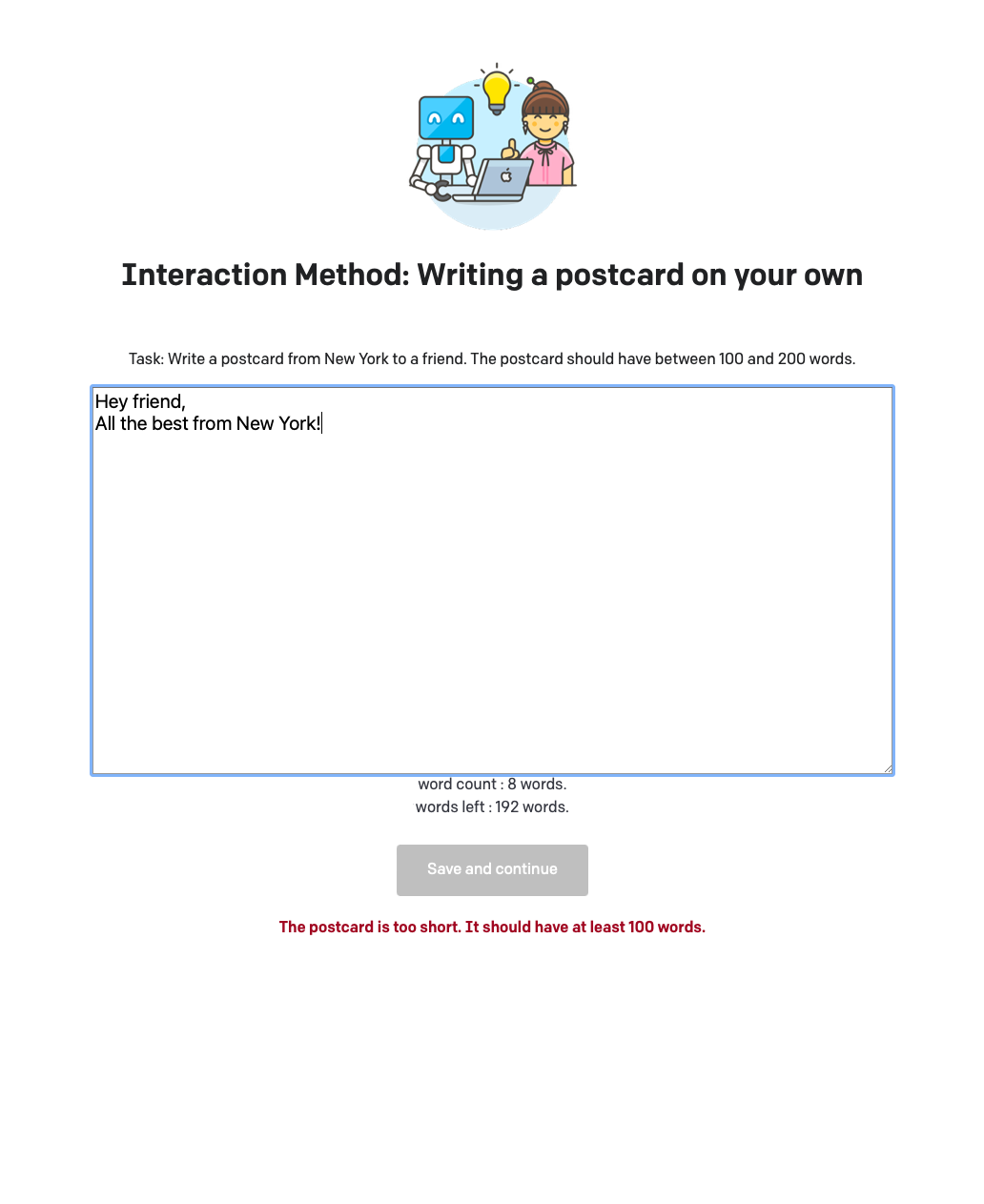
- Conducted two empirical studies (n1 = 30, n2 = 96) with participants generating personalized postcards using fine-tuned LLMs.
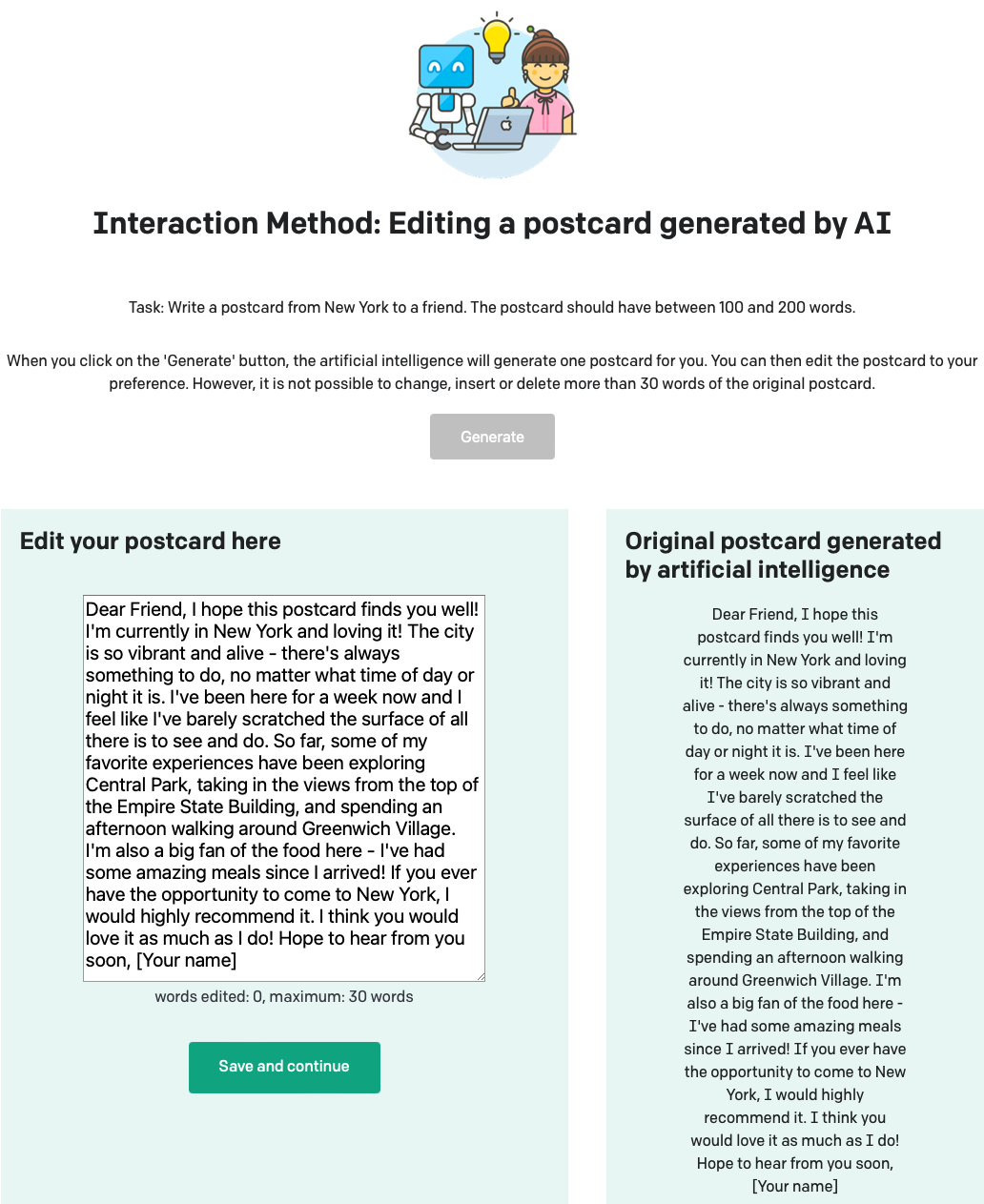
- Varied interaction methods (e.g., prompt-based generation, editing) to assess their impact on perceived ownership and authorship declaration.
- Used placebo personalization in Study 1 to isolate the effect of perceived personalization from actual model fine-tuning.
- Replicated findings in Study 2 with a larger sample and introduced a human ghostwriter condition for comparison.
- Collected data through structured surveys and free-text author declaration fields, with pre-registration of Study 2 (https://aspredicted.org/RKV_ZXX).
- Analyzed rationalizations for authorship declarations to compare reasoning patterns across AI and human ghostwriter conditions.
Experimental results
Research questions
- RQ1How does personalization of AI-generated text affect users’ perceived ownership and declared authorship?
- RQ2What is the impact of interaction method (e.g., prompt input, editing) on users’ sense of ownership and authorship attribution?
- RQ3How does the AI Ghostwriter Effect compare to human ghostwriter scenarios in terms of authorship declaration and ownership perception?
- RQ4What rationalizations do users provide for claiming or not claiming authorship when using AI or human ghostwriters?
- RQ5To what extent does perceived control over the text influence the ownership-authorship discrepancy in human-AI collaboration?
Key findings
- The AI Ghostwriter Effect is robust: participants did not perceive themselves as authors of AI-generated text, even after personalization.
- Only 20% of participants in Study 1 explicitly declared AI as an author in open-ended response fields, indicating low public attribution despite AI involvement.
- In Study 2, 70% of participants declared AI as an author when given a predefined menu, suggesting interface design significantly influences authorship disclosure.
- Participants showed higher perceived ownership when they had greater influence over the text, indicating control enhances sense of ownership.
- Users were more likely to attribute authorship to human ghostwriters than AI ghostwriters, indicating a stronger ownership-authorship discrepancy for AI-assisted writing.
- Rationalizations for authorship were similar across AI and human ghostwriter conditions, suggesting comparable psychological justifications regardless of the collaborator’s identity.
Better researchstarts right now
From reading papers to final review, dramatically reduce your research time.
No credit card · Free plan available
This review was created by AI and reviewed by human editors.