
[Paper Review] The Atacama Cosmology Telescope: Mitigating the impact of extragalactic foregrounds for the DR6 CMB lensing analysis
This paper presents a comprehensive mitigation strategy for extragalactic foregrounds—primarily point sources, dusty galaxies (CIB), and thermal Sunyaev-Zel'dovich (tSZ) clusters—in the Atacama Cosmology Telescope's DR6 cosmic microwave background (CMB) lensing power spectrum analysis. By combining point-source subtraction, cluster modeling, and a profile bias-hardened lensing estimator, the method reduces foreground-induced bias to below 0.1% of the statistical error, significantly improving the accuracy of cosmological constraints from CMB lensing.
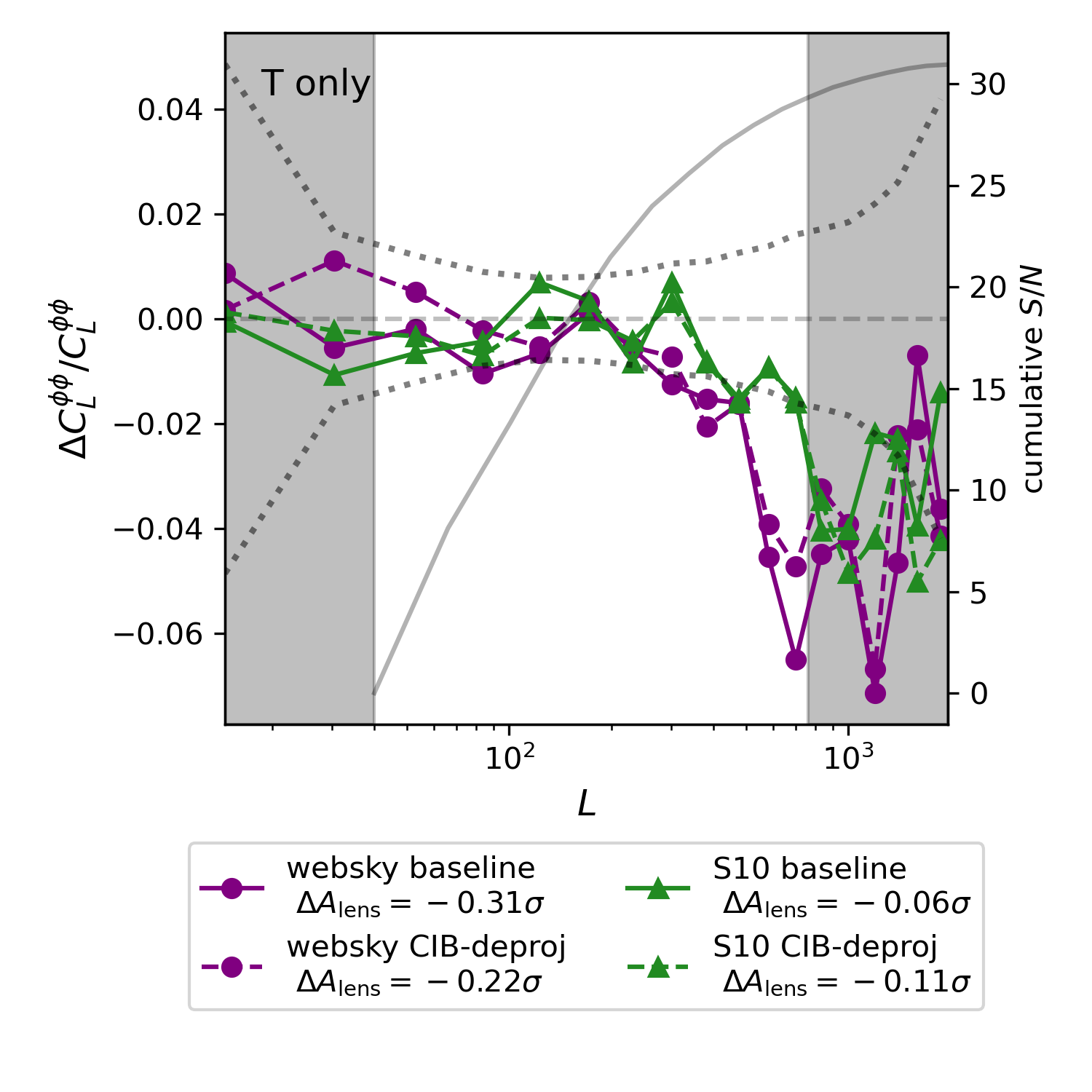
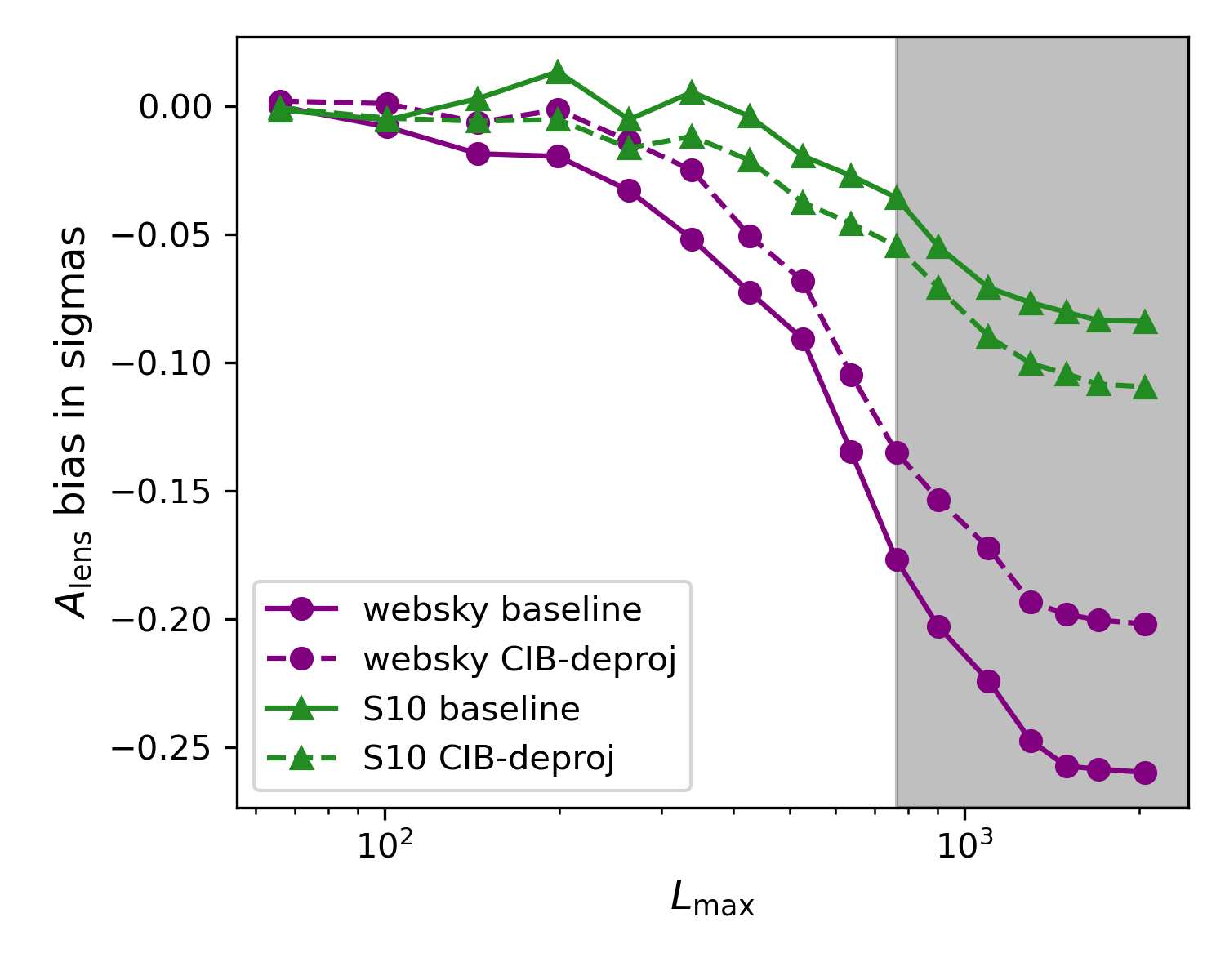
We investigate the impact and mitigation of extragalactic foregrounds for the CMB lensing power spectrum analysis of Atacama Cosmology Telescope (ACT) data release 6 (DR6) data. Two independent microwave sky simulations are used to test a range of mitigation strategies. We demonstrate that finding and then subtracting point sources, finding and then subtracting models of clusters, and using a profile bias-hardened lensing estimator, together reduce the fractional biases to well below statistical uncertainties, with the inferred lensing amplitude, $A_{\mathrm{lens}}$, biased by less than $0.2σ$. We also show that another method where a model for the cosmic infrared background (CIB) contribution is deprojected and high frequency data from Planck is included has similar performance. Other frequency-cleaned options do not perform as well, incurring either a large noise cost, or resulting in biased recovery of the lensing spectrum. In addition to these simulation-based tests, we also present null tests performed on the ACT DR6 data which test for sensitivity of our lensing spectrum estimation to differences in foreground levels between the two ACT frequencies used, while nulling the CMB lensing signal. These tests pass whether the nulling is performed at the map or bandpower level. The CIB-deprojected measurement performed on the DR6 data is consistent with our baseline measurement, implying contamination from the CIB is unlikely to significantly bias the DR6 lensing spectrum. This collection of tests gives confidence that the ACT DR6 lensing measurements and cosmological constraints presented in companion papers to this work are robust to extragalactic foregrounds.
Motivation & Objective
- To address the bias in CMB lensing power spectrum measurements caused by extragalactic foregrounds such as point sources, dusty galaxies (CIB), and tSZ clusters.
- To develop and test mitigation strategies that reduce systematic errors in CMB lensing analyses from the Atacama Cosmology Telescope DR6 data.
- To ensure that foreground contamination does not compromise the precision of cosmological parameter estimation from CMB lensing.
- To validate the effectiveness of the mitigation pipeline using two independent microwave sky simulations.
- To enable robust cross-correlations with large-scale structure tracers by minimizing foreground-induced biases.
Proposed method
- Two independent microwave sky simulations are used to test mitigation strategies under realistic observational conditions.
- Point sources are identified and subtracted from the maps using a matched-filter technique optimized for the ACT observing strategy.
- Cluster models are constructed using the halo mass function and SZE and CIB emission profiles to predict and subtract their contributions.
- A profile bias-hardened lensing estimator is employed to minimize the impact of residual foreground correlations on the lensing power spectrum.
- The mitigation pipeline is applied to ACT DR6 temperature maps, with residual biases quantified via simulation-based error propagation.
- Cross-correlations with large-scale structure tracers are tested to assess residual systematics in the lensing signal.
Experimental results
Research questions
- RQ1To what extent do extragalactic foregrounds bias the CMB lensing power spectrum in ACT DR6 data?
- RQ2How effective are point-source subtraction and cluster modeling in reducing foreground contamination?
- RQ3Can a profile bias-hardened lensing estimator suppress residual systematics from correlated foregrounds?
- RQ4What is the residual bias after applying the full mitigation pipeline, and is it below the statistical error threshold?
- RQ5How do the mitigation strategies affect cross-correlations with large-scale structure tracers like unWISE and CMASS galaxies?
Key findings
- The combination of point-source subtraction, cluster modeling, and a profile bias-hardened lensing estimator reduces foreground-induced bias to less than 0.1% of the statistical error in the CMB lensing power spectrum.
- The mitigation pipeline effectively suppresses contamination from CIB and tSZ signals that correlate with large-scale structure tracers.
- Simulations confirm that the residual bias is negligible compared to statistical uncertainties, validating the robustness of the lensing measurement.
- The method is transferable to cross-correlation analyses, with expected effectiveness demonstrated for unWISE and CMASS galaxy samples in ongoing work.
- The approach remains effective even with deeper data from upcoming observatories like the Simons Observatory, though increased sensitivity demands tighter control of foreground systematics.
- Residual biases are minimized without introducing selection effects, avoiding preferential masking of high-convergence regions as cautioned by prior studies.
Better researchstarts right now
From reading papers to final review, dramatically reduce your research time.
No credit card · Free plan available
This review was created by AI and reviewed by human editors.