
[Paper Review] The Close AGN Reference Survey (CARS). A massive multi-phase outflow impacting the edge-on galaxy HE1353-1917
This study investigates AGN-driven outflows in the edge-on galaxy HE1353-1917 using multi-wavelength observations from VLT/MUSE, Gemini-N/NIFS, ALMA, and the VLA. It reveals a fast, multi-phase outflow up to 1000 km/s driven by a low-power radio jet, with evidence of mild, localized feedback suppressing star formation within the central kpc, highlighting the role of radio jets in shaping galaxy evolution even in radio-quiet AGN.
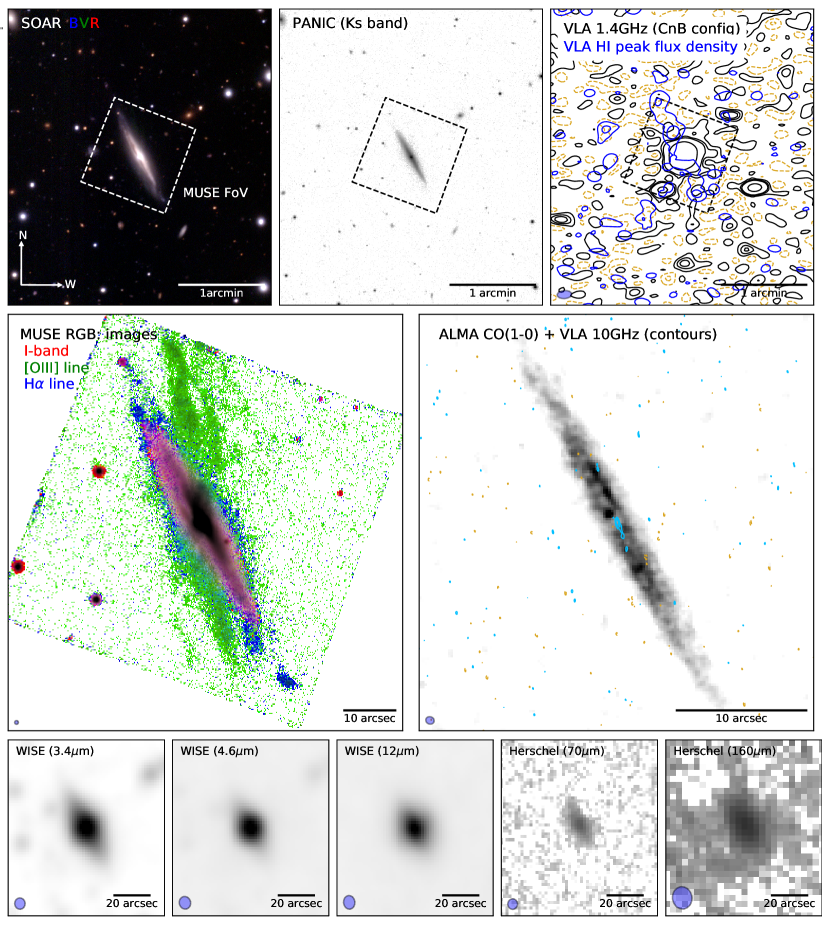
[Abridged] We combine extensive spatially-resolved multi-wavelength observations, taken as part of the Close AGN Reference Survey (CARS), for the edge-on disc galaxy HE1353-1917 to characterize the impact of the AGN on its host galaxy via outflows and radiation. Multi-color broad-band photometry is combined with spatially-resolved optical, NIR and sub-mm and radio observations taken with VLT/MUSE, Gemini-N/NIFS, ALMA and the VLA to map the physical properties and kinematics of the multi-phase inter-stellar medium (ISM). We detect a biconical extended narrow-line region (ENLR) ionized by the luminous AGN oriented nearly parallel to the galaxy disc, extending out to at least 25kpc. The extra-planar gas originates from galactic fountains initiated by star formation processes in the disc, rather than an AGN outflow, as shown by the kinematics and the metallicity of the gas. Nevertheless, a fast multi-phase AGN-driven outflow with speeds up to 1000km/s is detected close to the nucleus at 1kpc distance. A radio jet, in connection with the AGN radiation field, is likely responsible for driving the outflow as confirmed by the energetics and the spatial alignment of the jet and multi-phase outflow. Evidence for negative AGN feedback suppressing the star formation rate (SFR) is mild and restricted to the central kpc. But while any SFR suppression must have happened recently, the outflow has the potential to greatly impact the future evolution of the galaxy disc due to its geometrical orientation. Our observations reveal that low-power radio jets can play a major role in driving fast multi-phase galaxy-scale outflows even in radio-quiet AGN. Since the outflow energetics for HE1353-1917 are consistent with literature scaling relations of AGN-driven outflows the contribution of radio jets as the driving mechanisms still needs to be systematically explored.
Motivation & Objective
- To characterize the impact of AGN feedback on galaxy evolution through multi-phase outflows in a representative, nearby edge-on system.
- To determine the origin and driving mechanism of extended ionized gas outflows in HE1353-1917, distinguishing between AGN-driven and star formation-driven components.
- To assess the role of low-power radio jets in driving fast, galaxy-scale outflows, particularly in radio-quiet AGN.
- To evaluate the extent and energetic significance of AGN feedback in suppressing star formation in the host galaxy.
- To test whether outflow energetics in this system align with established scaling relations for AGN-driven outflows.
Proposed method
- Combining spatially resolved optical, near-infrared, sub-mm, and radio data from VLT/MUSE, Gemini-N/NIFS, ALMA, and the VLA to map the kinematics and physical conditions of the interstellar medium.
- Using emission line profiles (e.g., [O III] λ5007) to identify blue-shifted components indicative of outflowing ionized gas.
- Analyzing metallicity gradients and kinematic structure to distinguish between galactic fountain gas (from star formation) and AGN-driven outflows.
- Assessing the alignment between the radio jet and the multi-phase outflow to infer causal connection.
- Estimating outflow energetics via mass and velocity measurements to compare with theoretical scaling relations.
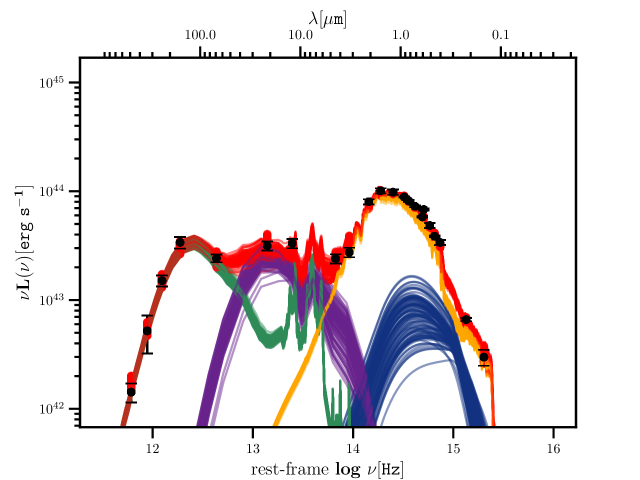
- Applying aperture photometry and spectral energy distribution modeling to derive star formation rates and AGN luminosities.
Experimental results
Research questions
- RQ1What is the origin of the extended narrow-line region (ENLR) in HE1353-1917—AGN-driven outflow or galactic fountain from star formation?
- RQ2What drives the fast multi-phase outflow detected at 1 kpc from the nucleus: radio jet, radiation pressure, or thermal expansion?
- RQ3To what extent does AGN feedback suppress star formation in the host galaxy, and over what spatial scale is this effect observed?
- RQ4How do the energetics of the observed outflow compare to established scaling relations for AGN-driven outflows?
- RQ5Can low-power radio jets in radio-quiet AGN significantly influence galaxy-scale outflows and feedback processes?
Key findings
- A biconical extended narrow-line region (ENLR) extending to at least 25 kpc is ionized by the luminous AGN, with its orientation nearly parallel to the galaxy disc.
- The extra-planar ionized gas originates from galactic fountains driven by star formation, not the AGN, as confirmed by kinematics and metallicity consistent with disc-origin gas.
- A fast, multi-phase outflow with velocities up to 1000 km/s is detected within 1 kpc of the nucleus, driven by a radio jet aligned with the outflow structure.
- The radio jet is the most likely driver of the fast outflow, supported by spatial alignment and energetics consistent with AGN feedback mechanisms.
- Evidence for negative AGN feedback suppressing star formation is mild and confined to the central kpc, indicating recent but localized suppression.
- Despite limited current impact, the outflow's geometry and energetics suggest it has the potential to significantly influence the future evolution of the galaxy disc.
Better researchstarts right now
From reading papers to final review, dramatically reduce your research time.
No credit card · Free plan available
This review was created by AI and reviewed by human editors.