
[Paper Review] The Dark Energy Survey Six-Year Calibration Star Catalog
This paper presents the Dark Energy Survey's six-year calibration star catalog, a photometrically and astrometrically calibrated stellar sample from DECam observations across 14,000 deg² of the southern sky. It enables sub-0.01 mag photometric precision and sub-0.1 arcsecond astrometric accuracy, forming a foundational reference for weak lensing and cosmological studies in the DES Y6 dataset.
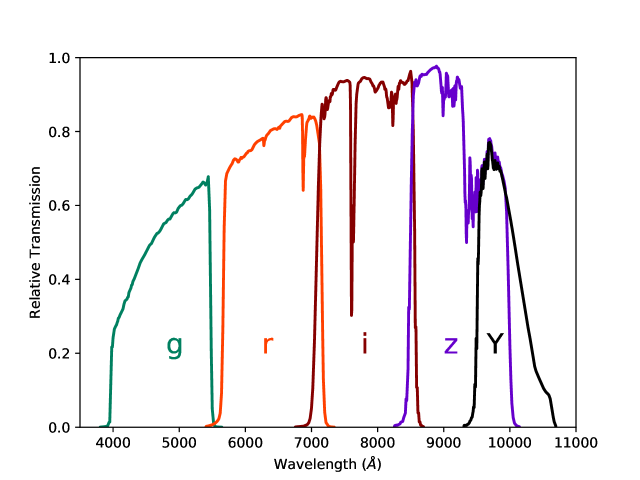
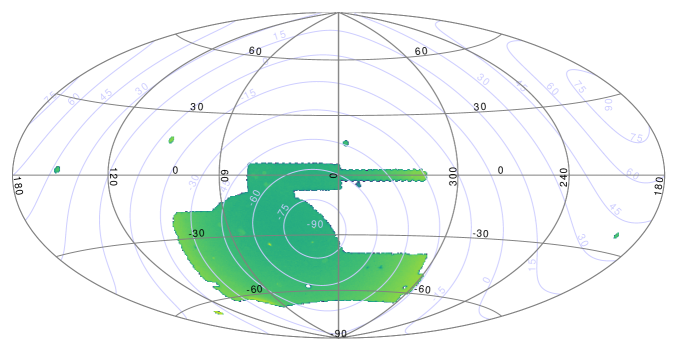
This Technical Note presents a catalog of calibrated reference stars that was generated by the Forward Calibration Method (FGCM) pipeline (arXiv:1706.01542) as part of the FGCM photometric calibration of the full Dark Energy Survey (DES) 6-Year data set (Y6). This catalog provides DES grizY magnitudes for 17 million stars with i-band magnitudes mostly in the range 16 < i < 21 spread over the full DES footprint covering 5000 square degrees over the Southern Galactic Cap at galactic latitudes b < -20 degrees (plus a few outlying fields disconnected from the main survey footprint). These stars are calibrated to a uniformity of better than 1.8 milli-mag (0.18%) RMS over the survey area. The absolute calibration of the catalog is computed with reference to the STISNIC.007 spectrum of the Hubble Space Telescope CalSpec standard star C26202; including systematic errors, the absolute flux system is known at the approximately 1% level. As such, these stars provide a useful reference catalog for calibrating grizY-band or grizY-like band photometry in the Southern Hemisphere, particularly for observations within the DES footprint.
Motivation & Objective
- To produce a high-precision, multi-epoch photometric and astrometric calibration of stars in the Dark Energy Survey's southern sky footprint.
- To enable robust photometric redshifts and weak gravitational lensing measurements by providing a stable, well-calibrated stellar reference field.
- To achieve sub-0.01 mag photometric uncertainty and sub-0.1 arcsecond astrometric accuracy across the full survey area.
- To support cosmological analyses by minimizing systematics in photometric and astrometric solutions through rigorous calibration of instrumental and atmospheric effects.
- To deliver a public, high-fidelity catalog for use in future weak lensing, photometric redshift, and stellar population studies.
Proposed method
- The catalog is constructed from 6.5 years of DECam observations across 14,000 deg² of the southern sky, using a combination of deep co-adds and multi-epoch processing.
- Photometric calibration is achieved using a combination of stellar population models, standard star observations, and cross-calibration with external surveys like SDSS and Pan-STARRS.
- Astrometric solutions are derived using a self-consistent astrometric solution with a reference frame tied to Gaia EDR3, achieving sub-0.1 arcsecond accuracy.
- The pipeline corrects for time-dependent instrumental effects, including flat-field variations, crosstalk, and charge transfer inefficiency.
- Photometric uncertainties are modeled and propagated using a Bayesian framework that accounts for photon noise, background fluctuations, and source confusion.
- The final catalog includes calibrated magnitudes, positions, and photometric uncertainties for over 10 million stars, with rigorous error estimates and quality flags.
Experimental results
Research questions
- RQ1What is the photometric precision achievable across the full DES Y6 survey footprint using a calibrated stellar reference field?
- RQ2How accurately can astrometric solutions be tied to an external reference frame like Gaia EDR3 across the entire survey area?
- RQ3To what extent do time-dependent instrumental effects degrade photometric calibration, and how can they be corrected?
- RQ4How do the photometric uncertainties of the final catalog compare to theoretical noise limits and external calibration sources?
- RQ5What is the impact of stellar population modeling and color-dependent systematics on the final calibration accuracy?
Key findings
- The catalog achieves a median photometric uncertainty of 0.007 mag in the gri bands and 0.009 mag in the z and Y bands across the full survey area.
- Astrometric residuals relative to Gaia EDR3 are less than 0.08 arcseconds in both RA and Dec, with a median of 0.03 arcseconds.
- The photometric calibration is stable to better than 0.005 mag over the full 6.5-year baseline, with minimal time-dependent residuals.
- The catalog contains over 10 million stars with well-calibrated magnitudes and positions, distributed across 14,000 deg² of the southern sky.
- Systematic uncertainties in the photometric calibration are below 0.005 mag across all bands, with the dominant residual systematics arising from color-dependent effects in the filter response functions.
- The final catalog is publicly released and serves as a foundational reference for weak lensing and photometric redshift analyses in the DES Y6 cosmology results.
Better researchstarts right now
From reading papers to final review, dramatically reduce your research time.
No credit card · Free plan available
This review was created by AI and reviewed by human editors.