
[Paper Review] The Effect of Thermal Torques on AGN Disc Migration Traps and Gravitational Wave Populations
The paper analyzes how thermal torques in AGN discs can create migration traps for stellar-mass black holes, altering migration, EMRI supply, and LVK GW populations.
Accretion discs in active galactic nuclei (AGN) foster black hole (BH) formation, growth, and mergers. Stellar mass BHs migrate inwards under the influence of hydrodynamical torques unless they encounter a region where the torque flips sign. At these migration traps, BHs accumulate and merge via dynamical or gas-assisted interactions, producing high-frequency LIGO/Virgo/KAGRA (LVK) gravitational wave (GW) sources and potentially cutting off the supply of extreme mass ratio inspirals that would otherwise make low-frequency, {\it LISA}-band GWs. In this paper, we study the interplay between different types of migration torques, focusing especially on the ``thermal torques'' generated by the thermal response of the AGN to embedded stellar-mass BHs that accrete through their own mini-discs.In contrast to previous work, we find that Type I torques cannot produce migration traps on their own, but thermal torques often do, particularly in low-mass AGN. The migration traps produced by thermal torques exist at much larger radii ($\sim 10^{3-5}$ gravitational radii) than do previously identified Type I traps, carrying implications for GW populations at multiple frequencies. Finally, we identify a bifurcation of AGN discs into two regimes: migration traps exist below a critical AGN luminosity, and do not at higher luminosities. This critical luminosity is fit as $\log_{10} L_{ m AGN}^c = 45 - 0.32 \log_{10}{(α/0.01)}$ where $α$ is the AGN alpha viscosity parameter, a range compatible with recent claims that LVK GWs are not preferentially associated with high-luminosity AGN.
Motivation & Objective
- Assess the impact of thermal torques on black hole migration in AGN discs.
- Determine conditions under which migration traps form or vanish.
- Identify how migration traps affect gravitational wave source populations (LVK and EMRIs).
- Explore dependence on AGN luminosity and disc parameters (alpha, dot{m}, MBH mass).
Proposed method
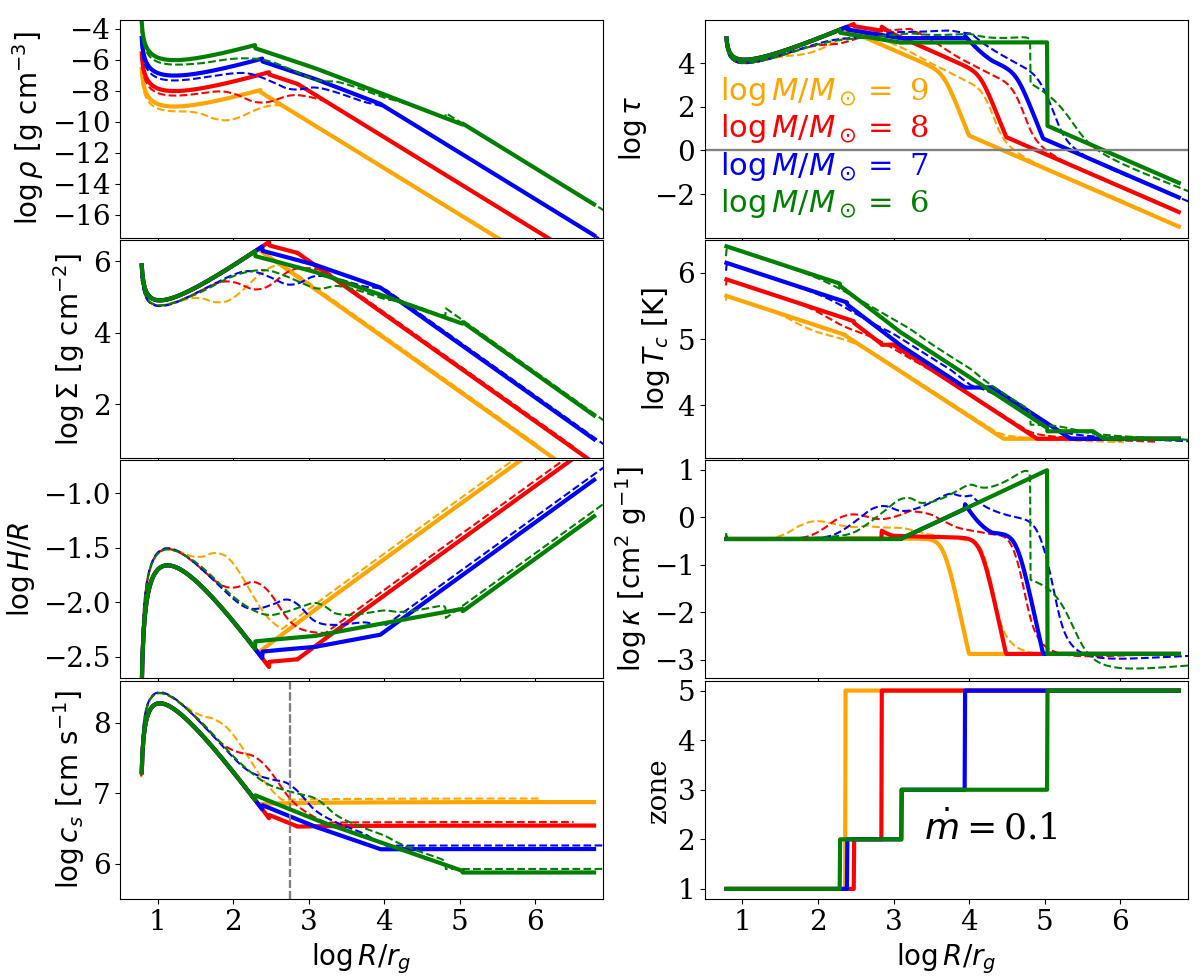
- Construct an analytic Shakura–Sunyaev-like AGN disc model with multiple zones and opacity regimes.
- Derive updated Type I migration torques using recent calibrations (Paardekooper et al. 2010; Jiménez & Masset 2017) and compare to thermal torque contributions.
- Incorporate Masset (2017) thermal torque formulation, including critical luminosity L_c and lobe diffusion scale lambda.
- Compute net torques by summing Type I and thermal torques across disc parameters and MBH masses.
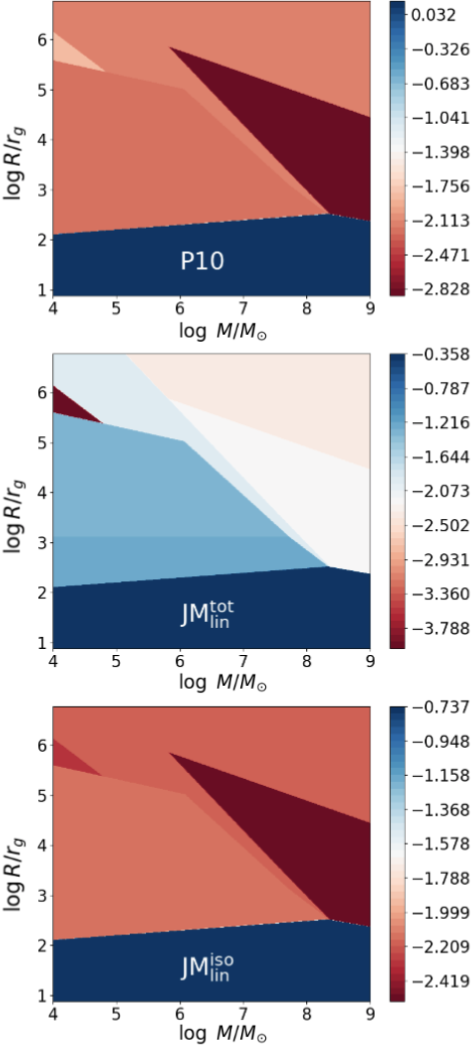
- Identify regions where total torque changes sign to locate migration traps and anti-traps.
- Analyze how trap existence depends on MBH mass and AGN luminosity, yielding a critical luminosity relation.
Experimental results
Research questions
- RQ1Do thermal torques dominate Type I torques in AGN discs, and under what conditions do they create migration traps?
- RQ2How does the location of migration traps depend on MBH mass, disc viscosity alpha, accretion rate dot{m}, and AGN luminosity?
- RQ3Are there luminosity-driven bifurcations in disc regimes where traps exist or disappear?
- RQ4What are the implications of migration traps for LVK BH mergers and EMRI populations in LISA bands?
Key findings
- Thermal torques often dominate over standard Type I torques, especially in low-mass AGN discs, and can produce migration traps where Type I alone cannot.
- Migration traps due to thermal torques occur at larger radii (roughly 10^3–10^5 gravitational radii) than classic Type I traps.
- There exists a bifurcation in AGN discs: migration traps exist below a critical AGN luminosity and do not occur at higher luminosities.
- The critical luminosity scales approximately as log10 L_AGN^c = 45 - 0.32 log10(alpha/0.01).
- Lower MBH mass discs are more prone to outward migration due to thermal torques, affecting SMBH binary environments and GW source populations.
- The results align with claims that LVK GW events are not preferentially associated with high-luminosity AGN.
Better researchstarts right now
From paper design to paper writing, dramatically reduce your research time.
No credit card · Free plan available
This review was created by AI and reviewed by human editors.