
[Paper Review] The Elasticity of Quantitative Investment
This paper measures the price elasticity of demand for twelve canonical quantitative investment models from academic literature, finding they exhibit strikingly inelastic demand—contrary to classical models that assume high elasticity. The inelasticity arises from the difficulty of identifying profitable trading opportunities amid dynamic price movements, suggesting a fundamental limit to arbitrage beyond traditional frictions, with counterfactual experiments showing persistent and sometimes increasing alpha when these strategies are inserted into markets.
What is the demand elasticity of statistical arbitrageurs that invest according to the advice of modern cross-sectional asset pricing models? Thirteen models from the literature exhibit strikingly inelastic demand, in contrast to classical models that rely on statistical arbitrageurs to create elastic market demand for assets. This inelasticity arises from the difficulty of trading against price changes. A quantitative equilibrium model shows that aggregate demand remains inelastic even with these statistical arbitrageurs in the market.
Motivation & Objective
- To measure the price elasticity of demand for canonical quantitative investment strategies from the academic literature.
- To resolve the contradiction between high elasticity calibrations in classical asset pricing models and empirically observed inelastic demand in real-world funds.
- To assess whether the inelasticity of these models stems from structural limitations in identifying mispricing under dynamic price movements.
- To evaluate the implications of inelastic demand for theoretical models relying on highly elastic arbitrageurs.
- To provide a realistic elasticity benchmark for new factor models and quantitative investment strategies.
Proposed method
- The study evaluates twelve canonical portfolio choice models, including Fama-French, BLP, HXZ, and KNS, using their standard return and risk assumptions.
- It derives the demand functions for each model by analyzing how portfolio weights respond to changes in asset prices, capturing the elasticity of demand as the percentage change in holdings per percentage change in price.
- The analysis uses a flexible functional form to estimate demand elasticity, allowing for comparison with empirical estimates from mutual and hedge funds.
- Counterfactual experiments simulate the insertion of these models into real market data, measuring alpha persistence under recursive learning, wealth effects, and fund flow dynamics.
- The models are tested under alternative specifications, including exact demand functions (non-linear) and varying assumptions about investor AUM and covariance structure.
- Robustness checks include alternative alpha measures (e.g., CAPM vs. multi-factor models), endogenized AUM, and less elastic incumbent demand to test sensitivity.
Experimental results
Research questions
- RQ1What is the price elasticity of demand for twelve canonical quantitative investment models from the academic literature?
- RQ2Why do these models exhibit inelastic demand despite being designed for statistical arbitrage?
- RQ3How does the elasticity of these models compare to empirically estimated elasticity values from mutual and hedge funds?
- RQ4To what extent do counterfactual insertions of these models into real markets generate persistent alpha?
- RQ5Does the inelasticity of these models represent a fundamental limit to arbitrage, independent of standard friction-based explanations?
Key findings
- The twelve canonical quantitative investment models exhibit strikingly inelastic demand, with elasticity values comparable to empirically estimated fund-level elasticity (0.3–1.6), contradicting classical model calibrations that suggest elasticity values as high as 5,000–6,000.
- The inelasticity arises not from transaction costs or leverage, but from the fundamental difficulty of identifying profitable mispricing in a dynamic, time-varying market environment where prices are endogenous to expected payouts.
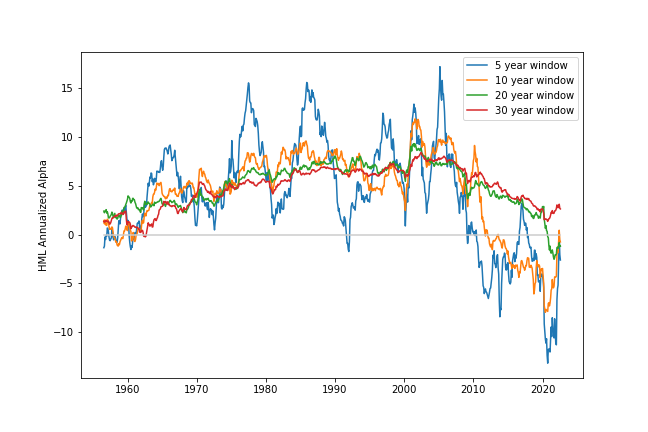
- Counterfactual experiments show that inserting these models into real market data results in large and persistent alpha, with some experiments showing even increased alpha due to wealth and fund flow effects.
- Even when statistical significance is lost in GRS tests due to high volatility, the magnitude of alpha remains large, indicating strong economic significance despite reduced precision.
- Robustness checks confirm that results are stable under alternative specifications, including non-linear demand functions, endogenized AUM, and less elastic incumbent demand, with similar qualitative outcomes.
- The findings suggest that a fundamental limit to arbitrage—rooted in the difficulty of detecting mispricing amid dynamic price movements—may be more important than traditional friction-based limits in explaining limited market efficiency.
Better researchstarts right now
From reading papers to final review, dramatically reduce your research time.
No credit card · Free plan available
This review was created by AI and reviewed by human editors.