
[Paper Review] The evolution and delivery of rocky extra-solar materials to white dwarfs
This paper details the dynamical evolution and delivery mechanisms of rocky exoplanetary materials to white dwarfs, focusing on three stages: stellar evolution through the giant branch, gravitational scattering and tidal disruption, and accretion within the Roche sphere. It demonstrates how planetary system architectures are reshaped by stellar mass loss and tidal forces, enabling chemical spectroscopy of exo-planetesimals via white dwarf pollution.
Understanding stellar evolution and its effect on planetary systems is crucial for correctly interpreting the chemical constraints of exo-planetary material that can be given to us by white dwarfs. This article will describe how asteroids, moons, and comets, as well as boulders, pebbles and dust, evolve into eventual targets for chemical spectroscopy, and how planets and companion stars play a vital role in reshaping system architectures for this purpose.
Motivation & Objective
- To understand the dynamical evolution of rocky planetary system components—asteroids, planetesimals, and dust—through the post-main-sequence evolution of Sun-like stars.
- To identify the mechanisms by which these materials are delivered to the Roche sphere of white dwarfs, where they become observable via accretion and spectroscopy.
- To clarify the role of planets and companion stars in reshaping system architectures during the transition from main-sequence to white dwarf phases.
- To provide a framework linking stellar evolution to the observed chemical pollution in white dwarfs, enabling 'chemical autopsies' of exoplanetary bodies.
- To synthesize existing observational and theoretical results on debris disks and accretion in white dwarf systems to inform future exogeological studies.
Proposed method
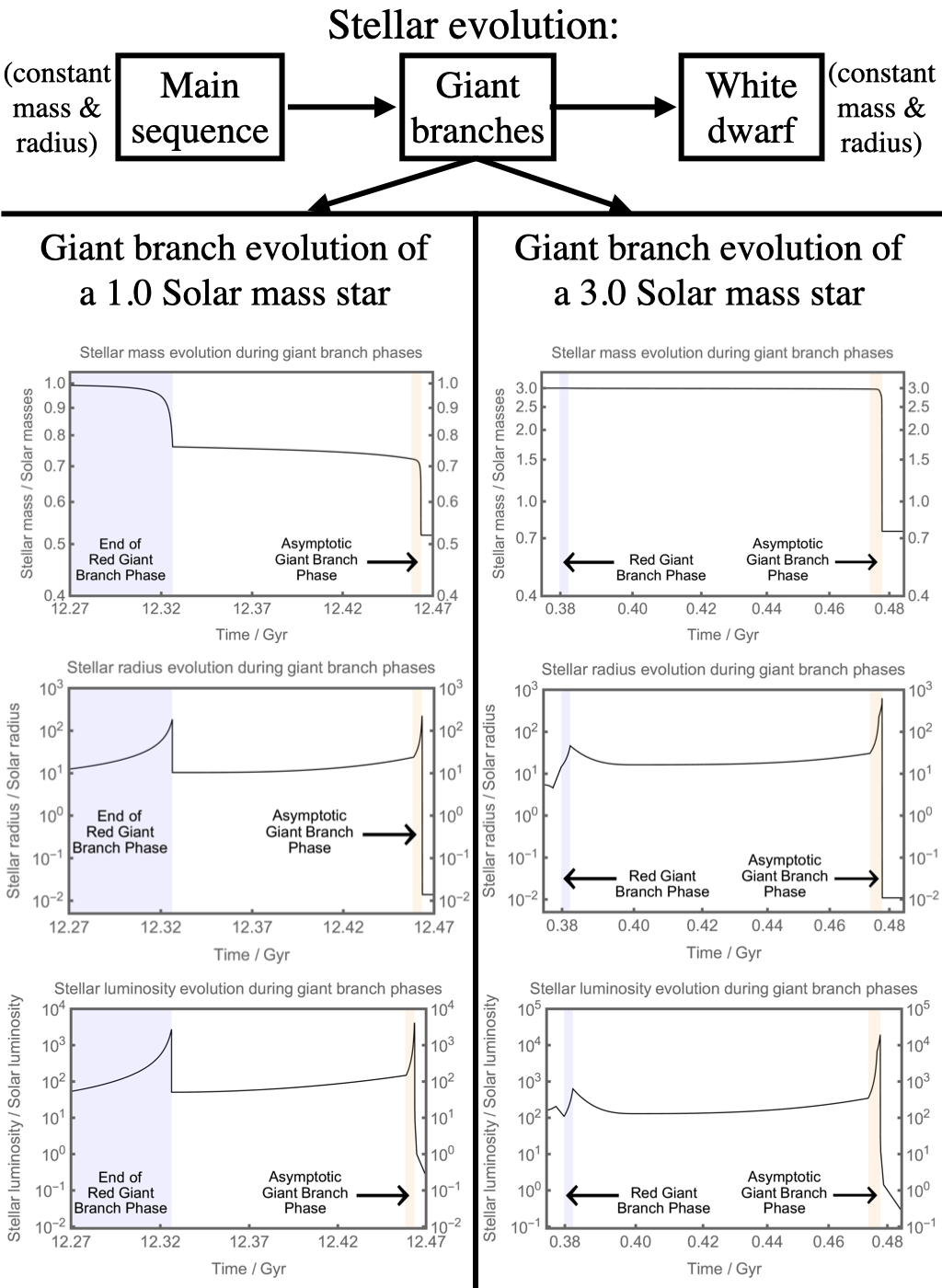
- Modeling the evolution of planetary systems during the giant branch phase, including mass loss, luminosity increase, and radius expansion of the host star.
- Applying celestial mechanics and N-body simulations to track the orbital evolution of planetesimals and small bodies under changing stellar gravity and tidal forces.
- Using Roche limit calculations to determine where and when small bodies are tidally disrupted, forming observable debris disks.
- Integrating observational constraints from Spitzer, Hubble, and Gaia on infrared excesses, transits, and atmospheric pollution to validate dynamical models.
- Analyzing the survival and fragmentation thresholds of dust and pebble-sized particles under tidal and radiative forces in post-main-sequence environments.
- Synthesizing results from prior studies on white dwarf pollution, debris disk variability, and transiting planetesimals to build a coherent evolutionary narrative.
Experimental results
Research questions
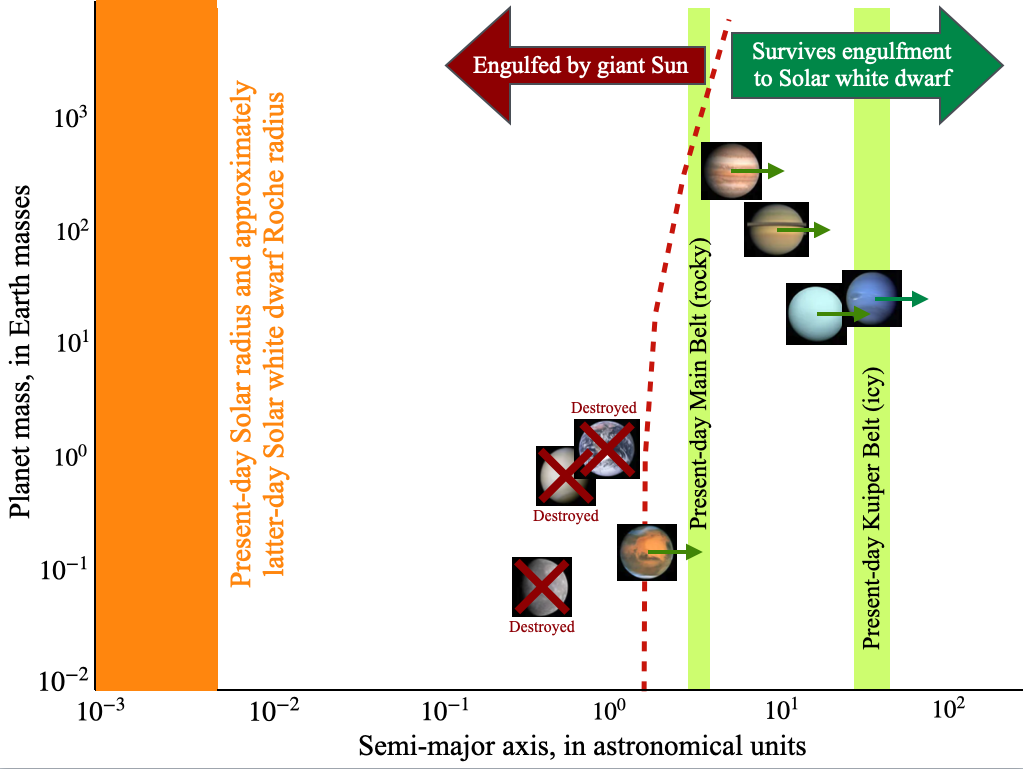
- RQ1How do the mass loss and expansion of a star during the giant branch phase disrupt the orbits of rocky bodies in a planetary system?
- RQ2What dynamical mechanisms—such as gravitational scattering or resonant interactions—enable the delivery of planetesimals to the Roche sphere of a white dwarf?
- RQ3How do tidal forces and stellar luminosity changes affect the survival and fragmentation of dust, pebbles, and larger rocky bodies during post-main-sequence evolution?
- RQ4What role do companion stars or planets play in enhancing or inhibiting the delivery of material to white dwarfs?
- RQ5How do observational signatures—such as infrared excesses, transits, and atmospheric pollution—correlate with the theoretical stages of material delivery and disruption?
Key findings
- Rocky planetary system components, including asteroids and planetesimals, are significantly perturbed during the giant branch phase due to stellar mass loss and radius expansion.
- Tidal forces at the Roche sphere lead to the disruption of planetesimals, producing observable debris disks and enabling chemical spectroscopy of their constituents.
- The survival of dust and pebble-sized particles in post-main-sequence environments is limited by tidal and radiative forces, with grain size survival thresholds identified in simulations.
- Transiting debris clouds, such as those observed around WD 1145+017, provide direct evidence of ongoing disintegration and delivery of rocky material to white dwarfs.
- Observational signatures—including infrared excesses, transit variability, and atmospheric metallicity in white dwarfs—correlate strongly with theoretical models of tidal disruption and accretion.
- The presence of planets or stellar companions can significantly alter the delivery efficiency of material to white dwarfs, either enhancing or suppressing accretion through gravitational focusing or ejection.
Better researchstarts right now
From reading papers to final review, dramatically reduce your research time.
No credit card · Free plan available
This review was created by AI and reviewed by human editors.