
[Paper Review] The fate of quasiparticles at high-temperature
This study reveals that quasiparticles in the correlated metal Sr2RuO4 persist up to temperatures above 200 K, with their residue Z increasing rather than decreasing with temperature. Using angle-resolved photoemission spectroscopy and dynamical mean-field theory, the authors show quasiparticles vanish not by losing weight but via super-Planckian scattering and excessive broadening, challenging the conventional view of quasiparticle decay in bad metals.
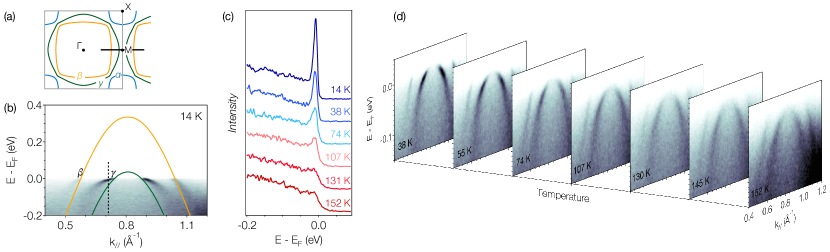
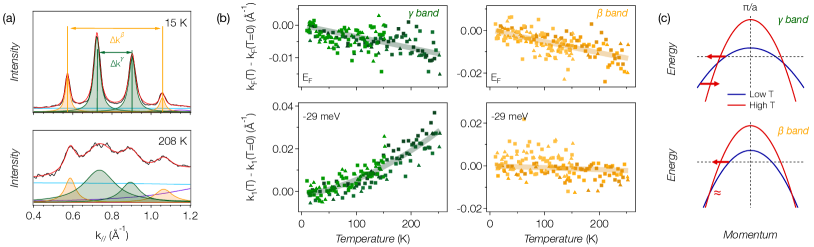
We study the temperature evolution of quasiparticles in the correlated metal Sr_{2}RuO_{4}. Our angle resolved photoemission data show that quasiparticles persist up to temperatures above 200 K, far beyond the Fermi liquid regime. Extracting the quasiparticle self-energy, we demonstrate that the quasiparticle residue Z increases with increasing temperature. Quasiparticles eventually disappear on approaching the bad metal state of Sr_{2}RuO_{4} not by losing weight but via excessive broadening from super-Planckian scattering. We further show that the Fermi surface of Sr_{2}RuO_{4}-defined as the loci where the spectral function peaks-deflates with increasing temperature. These findings are in semiquantitative agreement with dynamical mean field theory calculations.
Motivation & Objective
- To resolve the fate of quasiparticles in correlated metals at high temperatures, particularly in the bad metal regime beyond the Mott-Ioffe-Regel limit.
- To challenge the prevailing assumption that quasiparticle residue Z decreases with temperature in bad metals.
- To determine whether quasiparticle weight or spectral broadening dominates the loss of quasiparticle character in Sr2RuO4.
- To test the consistency of ARPES data with dynamical mean-field theory predictions for temperature-dependent quasiparticle behavior.
- To clarify the role of spectral function line shape evolution and background subtraction in extracting reliable quasiparticle parameters.
Proposed method
- Angle-resolved photoemission spectroscopy (ARPES) was used to measure the momentum- and energy-resolved spectral function of Sr2RuO4 across a range of temperatures up to ~250 K.
- The quasiparticle residue Z was extracted from the dispersion relation by fitting the self-energy to a first-order expansion around the quasiparticle peak energy ω₀.
- A pragmatic background subtraction method was applied, using spectra at π/a momentum where no direct transitions occur, to isolate the intrinsic spectral function.
- The line shape evolution was modeled using a modified spectral function expression: A(k,δω) ≈ Z / π * [Z(Σ′′₀ + αδω)] / [δω² + Z(Σ′′₀ + αδω)²], allowing for temperature-dependent broadening and peak intensity analysis.
- The experimental results were compared with dynamical mean-field theory (DMFT) calculations, using a global, temperature-independent scaling factor to align spectra.
- The self-energy derivative ∂Σ′/∂ω was computed from DMFT data to validate the extracted Z values and confirm consistency with the ARPES-derived quasiparticle weight.
Experimental results
Research questions
- RQ1Does the quasiparticle residue Z decrease with increasing temperature in Sr2RuO4, as traditionally assumed in bad metals?
- RQ2What is the dominant mechanism responsible for the disappearance of quasiparticle peaks at high temperatures—loss of spectral weight or excessive broadening?
- RQ3How does the Fermi surface, defined by the peak of the spectral function, evolve with temperature in Sr2RuO4?
- RQ4To what extent do ARPES-measured spectral functions remain consistent with quasiparticle behavior when the peak becomes broad and less intense?
- RQ5Is the observed increase in Z with temperature consistent with DMFT predictions for multiband correlated systems?
Key findings
- The quasiparticle residue Z increases with temperature in Sr2RuO4, contrary to the conventional expectation of Z → 0 at high T.
- Quasiparticles persist in the spectral function up to temperatures above 200 K, well beyond the Fermi liquid regime and the Mott-Ioffe-Regel limit.
- The spectral peak broadens significantly with increasing temperature, evolving from an asymmetric Fermi liquid shape to a Lorentzian, indicating super-Planckian scattering.
- The Fermi surface, defined as the loci of maximum spectral function intensity, deflates with increasing temperature, reflecting a reduction in coherence.
- The ARPES data, after background subtraction, show excellent qualitative and semi-quantitative agreement with DMFT calculations, supporting the increase in Z with temperature.
- The study demonstrates that quasiparticle weight can increase with temperature even as peak intensity diminishes, challenging the assumption that broadening always implies reduced Z.
Better researchstarts right now
From reading papers to final review, dramatically reduce your research time.
No credit card · Free plan available
This review was created by AI and reviewed by human editors.