
[Paper Review] The Global Network of Cavities to Search for Gravitational Waves (GravNet): A novel scheme to hunt gravitational waves signatures from the early universe
This paper proposes GravNet, a global network of resonant cavities in strong magnetic fields to detect high-frequency gravitational waves (GWs) in the GHz band, primarily from primordial black hole mergers. By coherently correlating single-photon signals from multiple geographically separated cavities, GravNet enhances signal-to-noise ratio and enables detection of transient GW signals with strain sensitivities down to $ h_0 \sim 10^{-24} $, even with modest, commercially available magnet systems.
The idea of searching for gravitational waves using cavities in strong magnetic fields has recently received significant attention. Specifically, discussions focus on cavities with relatively small volumes, which are currently employed in the search for axions. In this context, we propose a novel experimental scheme that enables the detection of gravitational waves in the GHz regime, which could originate, for example, from primordial black hole mergers. The scheme is based on synchronous measurements of cavity signals from multiple devices operating in magnetic fields at distant locations. While gravitational wave signatures might be detectable in individual cavities, distinguishing them from noise is highly challenging. By analyzing the correlation among signals from several, possibly geographically separated cavities, it is not only possible to significantly enhance the signal-to-noise ratio but also to investigate the source of those gravitational wave signatures. In the context of this proposal, a first demonstration experiment with one superconducting cavity is currently conducted, which is the basis of the proposed data-analysis approaches. On this basis the prospects of GravNet (Global Network of Cavities to Search for Gravitational Waves) are outlined in the paper.
Motivation & Objective
- To develop a scalable, cost-effective method for detecting high-frequency gravitational waves (GWs) in the GHz regime, which are inaccessible to current interferometric detectors.
- To overcome the challenge of distinguishing weak GW-induced signals from noise in single-cavity experiments by leveraging spatial and temporal correlation across multiple distant detectors.
- To enable the detection of transient GW signals—such as those from primordial black hole mergers—by using a coincidence-based photon counting strategy across a network of cavities.
- To establish a collaborative, worldwide experimental framework that leverages existing laboratory infrastructure and promotes shared R&D across institutions.
- To achieve sensitivities below $ 10^{-24} $ strain for transient GW signals using a network of 20 or more independent cavity detectors with optimized coincidence windows.
Proposed method
- Utilizes resonant microwave cavities operating in strong static magnetic fields to transduce gravitational wave (GW) signals into measurable electromagnetic signals via the inverse Gertsenshtein effect.
- Employs a dual experimental approach: GravNet-1 (resonant cavity excitation with signal integration over 1–2 hours) and GravNet-2 (single-photon counting with millisecond coincidence windows).
- Applies a correlation-based signal extraction technique across multiple geographically separated cavities to suppress background noise and enhance sensitivity.
- Uses the signal power formula $ P_{\text{sig}} \propto Q \omega_g^3 V^{5/3} (\eta_n h_0 B_0)^2 $ to estimate sensitivity, with sensitivity scaling quadratically with magnetic field $ B_0 $ and with $ V^{5/3} $.
- Applies a coincidence window $ \Delta t $ to identify simultaneous photon detections across $ k $ detectors, reducing false positives from thermal and detector noise.
- Models detection efficiency using Poisson statistics, assuming a dark count rate of 10 Hz per detector, and determines optimal coincidence thresholds (e.g., 18 out of 20 detectors) for signal confirmation.
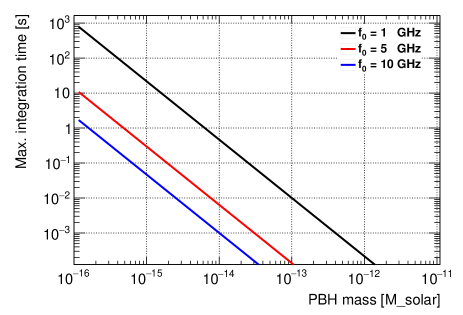
Experimental results
Research questions
- RQ1Can a network of small, commercially available cavities in strong magnetic fields detect high-frequency gravitational waves in the GHz band?
- RQ2How can signal-to-noise ratio be significantly improved by correlating signals from multiple geographically separated cavities?
- RQ3What is the minimum detectable gravitational wave strain for transient signals using a coincidence-based single-photon counting scheme?
- RQ4How does the sensitivity of the network scale with the number of detectors, coincidence window, and photon detection rate?
- RQ5Can this approach detect GWs from primordial black hole mergers with masses above $ 3 \times 10^{-7} M_\odot $?
Key findings
- GravNet-2, using 20 independent cavities with a 31 ms coincidence window, achieves a detection efficiency of 1 for a signal photon flux of 40 Hz, corresponding to a GW strain of $ h_0 = 3 \times 10^{-24} $ for the GravNet-b setup.
- For transient GW signals lasting ~10 ms, GravNet can achieve strain sensitivities down to $ h_0 \sim 10^{-24} $, depending on cavity size and detection efficiency.
- The network achieves background-free operation under the assumed noise model (10 Hz dark count rate), with a coincidence window of 31 ms allowing 1 background coincidence per year for 20 detectors.
- Sensitivities of $ h_0 < 10^{-24} $ are achievable for monochromatic sources with long integration times (e.g., 2 hours), while $ h_0 < 10^{-22} $ is accessible for 10 ms transient signals.
- The method is robust to frequency mismatches between cavities, as it does not require phase alignment, enabling use of off-the-shelf magnet systems.
- The proposed network is scalable and cost-effective, relying on existing commercial magnets and enabling global collaboration without requiring specialized, high-cost infrastructure.
Better researchstarts right now
From reading papers to final review, dramatically reduce your research time.
No credit card · Free plan available
This review was created by AI and reviewed by human editors.