
[Paper Review] The History of Primordial Black Holes
This paper traces the 50-year history of primordial black hole (PBH) research, from theoretical foundations in the 1960s to recent observational constraints and renewed interest following LIGO's gravitational wave detections. It highlights PBHs as a potential dark matter candidate across a wide mass range, especially in the asteroidal and stellar mass regimes, and reviews their roles in early universe structure formation, Hawking radiation, and constraints from microlensing, CMB distortions, and fast radio bursts.
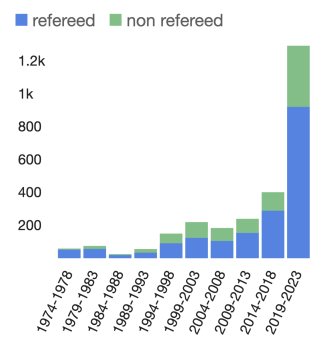
We overview the history of primordial black hole (PBH) research from the first papers around 50 years ago to the present epoch. The history may be divided into four periods, the dividing lines being marked by three key developments: inflation on the theoretical front and the detection of microlensing events by the MACHO project and gravitational waves by the LIGO/Virgo/KAGRA project on the observation front. However, they are also characterised by somewhat different focuses of research. The period 1967-1980 covered the groundbreaking work on PBH formation and evaporation. The period 1980-1996 mainly focussed on their formation, while the period 1996-2016 consolidated the work on formation but also collated the constraints on the PBH abundance. In the period 2016-2024 there was a shift of emphasis to the search for evidence for PBHs and - while opinions about the strength of the purported evidence vary - this has motivated more careful studies of some aspects of the subject. Certainly the soaring number of papers on PBHs in this last period indicates a growing interest in the topic.
Motivation & Objective
- To chronologically document the evolution of primordial black hole (PBH) research over five decades, identifying key theoretical and observational milestones.
- To assess the role of PBHs as a dark matter candidate across a broad mass spectrum, from Planck-scale to stellar masses.
- To evaluate constraints from cosmic microwave background distortions, microlensing surveys (e.g., MACHO), and gravitational wave detections (LIGO/Virgo/KAGRA).
- To examine the potential of PBHs in seeding early structure formation, explaining high-redshift galaxies, and accounting for supermassive black hole origins.
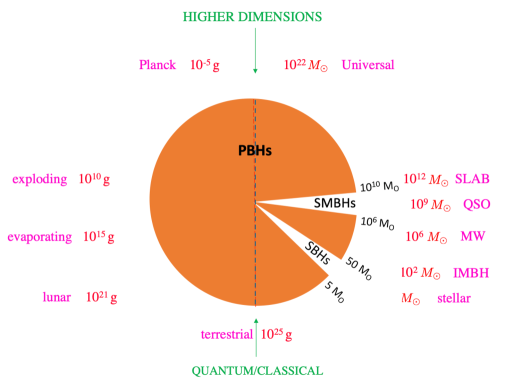
- To synthesize current evidence and controversies, particularly regarding PBHs in the asteroidal (10^−14–10^−8 M⊙) and stellar (1–100 M⊙) mass ranges as dark matter candidates.
Proposed method
- Chronological analysis of PBH research divided into four periods: 1967–1980 (formation and evaporation), 1980–1996 (formation mechanisms), 1996–2016 (constraints on abundance), and 2016–2024 (search for observational evidence).
- Use of the Schwarzschild radius formula $ R_{\rm S} = 2GM/c^2 $ to define black hole formation conditions in the early universe.
- Application of cosmological density contrast arguments to estimate PBH formation mass scales at different epochs (e.g., Planck time, QCD phase transition, 1 second).
- Evaluation of observational constraints from CMB $\mu$-distortions, microlensing (MACHO), and gravitational wave events (LIGO/Virgo/KAGRA) to limit PBH abundance.
- Modeling of PBH effects on cosmic structure via the seed and Poisson effects, with mass binding scales $ \sim 4000M z_{\rm B}^{-1}M_\odot $ and $ \sim 10^7 f M z_{\rm B}^{-2}M_\odot $, respectively.
- Analysis of PBH interactions with neutron stars to explain r-process nucleosynthesis and fast radio bursts, based on models by Fuller et al. (2017) and Abramowicz & Bejger (2018).
Experimental results
Research questions
- RQ1How did the theoretical understanding of primordial black hole formation and evaporation evolve from the 1960s to the present?
- RQ2What observational constraints from microlensing (MACHO), CMB distortions, and gravitational waves have shaped the allowed parameter space for PBHs as dark matter?
- RQ3Can PBHs in the asteroidal mass range (10^{-14}–10^{-8} M⊙) explain observed r-process element abundances via neutron star interactions?
- RQ4To what extent can PBHs in the 10^6–10^9 M⊙ range serve as seeds for early supermassive black holes, and how do they reconcile with high-redshift quasars?
- RQ5How do PBHs influence early structure formation, and can they resolve anomalies in dwarf galaxy populations and the 'too big to fail' problem?
Key findings
- PBHs could form across a vast mass range—from Planck mass (10^{-5} g) to 10^5 M⊙—depending on the epoch of formation, with those lighter than 10^{15} g evaporating via Hawking radiation within the current age of the universe.
- The MACHO microlensing survey in 1996 increased PBH research to ~100 papers per year, while LIGO's 2016 gravitational wave detection triggered a surge to over 1000 papers per year by 2024.
- Constraints from CMB $\mu$-distortions rule out PBHs with masses around 10^6 M⊙ formed at the electron-positron annihilation epoch as the dominant dark matter component.
- PBHs in the 10^{-14}–10^{-8} M⊙ range could produce r-process elements via neutron star interactions if their abundance exceeds f > 0.01.
- PBHs with masses ~10^{23} g may explain fast radio bursts through collisions with neutron stars, based on luminosity and timescale constraints.
- PBHs with masses ~10^6 M⊙ could seed early supermassive black holes and explain high-redshift quasars at z > 7, though such models face tension with CMB constraints unless PBHs make up only 10^{-6}–10^{-3} of dark matter.
Better researchstarts right now
From reading papers to final review, dramatically reduce your research time.
No credit card · Free plan available
This review was created by AI and reviewed by human editors.