
[Paper Review] The opacity limit
This paper re-evaluates the opacity limit in star formation, deriving self-consistent expressions for the thermal evolution of dust-cooled collapsing gas clumps under varying radiation fields and dust opacity laws. It shows that the minimum Jeans mass $M_{ m J}^{ m min}$ scales as $A_{ m d}^{-1/11}$ to $A_{ m d}^{-1/15}$ in weak radiation or low-dust environments, but as $A_{ m d}^{1/3}$ in strong radiation and high-dust conditions—implicating a less bottom-heavy initial mass function in dense, dusty regions like galactic centers or high-redshift galaxies.
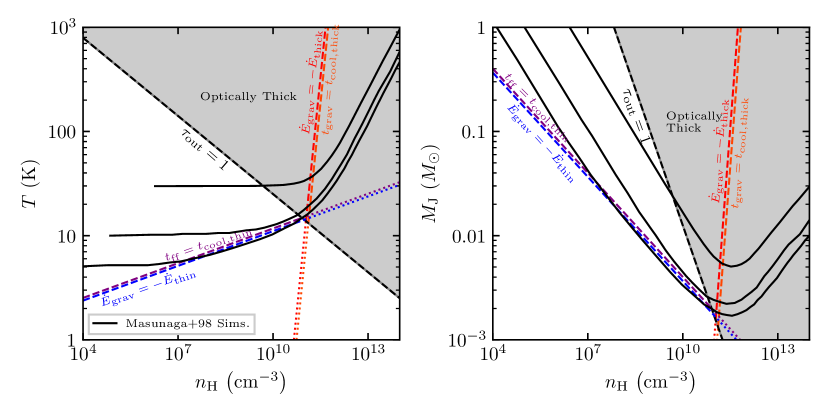
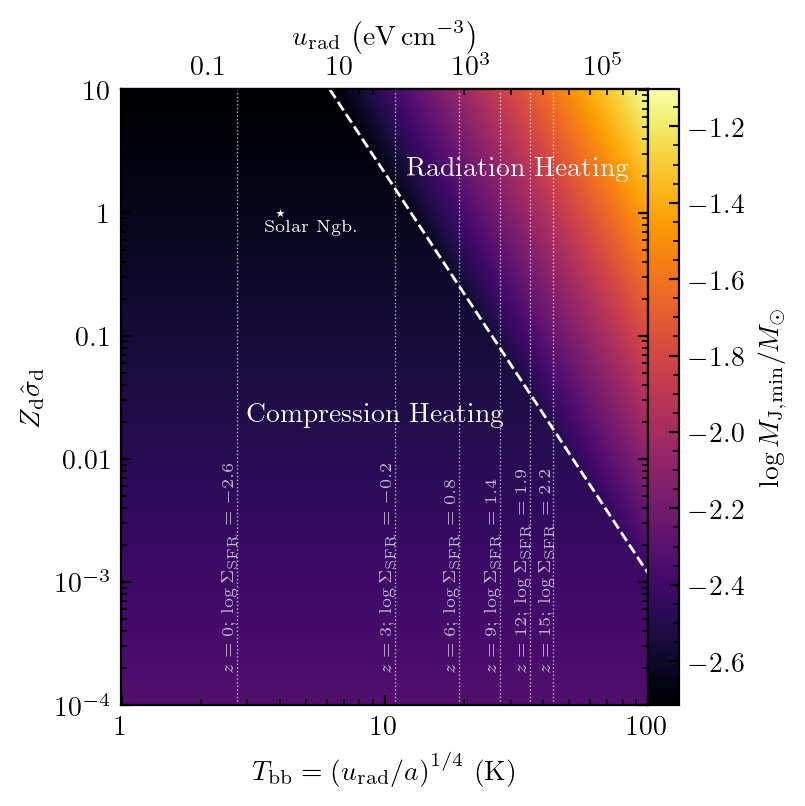
The opacity limit is an important concept in star formation: isothermal collapse cannot proceed without limit, because eventually cooling radiation is trapped and the temperature rises quasi-adiabatically, setting a minimum Jeans mass $M_{ m J}^{ m min}$. Various works have considered this scenario and derived expressions for $M_{ m J}^{ m min}$, generally $\sim 10^{-3}-10^{-2}M_\odot$ in normal star-forming conditions, but with conflicting results about the scaling with ambient conditions and material properties. We derive expressions for the thermal evolution of dust-cooled collapsing gas clumps in various limiting cases, given a general ambient radiation field ($u_{ m rad}$, $T_{ m rad}$) and a general power-law dust opacity law $σ_{ m d} = A_{ m d} T^β$. By accounting for temperature evolution self-consistently we rule out a previously-proposed regime in which the adiabatic transition occurs while the core is still optically-thin. If the radiation field is weak or dust opacity is small, $M_{ m J}^{ m min}$ is insensitive to dust properties/abundance ($\sim A_{ m d}^{-\frac{1}{11}}-A_{ m d}^{-\frac{1}{15}}$), but if the radiation field is strong and dust is abundant it scales $\propto A_{ m d}^{1/3}$. This could make the IMF less bottom-heavy in dust-rich and/or radiation-dense environments, e.g. galactic centers, starburst galaxies, massive high-$z$ galaxies, and proto-star clusters that are already luminous.
Motivation & Objective
- To resolve conflicting results in the literature regarding the scaling of the minimum Jeans mass ($M_{ m J}^{ m min}$) with dust properties and ambient conditions in star formation.
- To correct flawed assumptions in prior works—particularly the idea that adiabatic transition occurs when optical depth $\tau \gtrsim 1$—by self-consistently modeling temperature evolution during collapse.
- To derive general expressions for the opacity-limited Jeans mass and transition density ($n_{\rm ad}$) in various asymptotic regimes, accounting for both compression heating and radiation field effects.
- To assess the implications of environmental variation in $M_{\rm J}^\rm{min}$ for the initial mass function (IMF), especially in extreme environments like galactic centers or high-redshift star clusters.
- To provide a unified, physically consistent framework for the opacity limit using calibrated approximations validated against radiation hydrodynamics simulations.
Proposed method
- Derives the thermal evolution of dust-cooled, self-gravitating gas clumps under a general power-law dust opacity law $\sigma_{\rm d} = A_{\rm d} T^{\beta}$ and ambient radiation field ($u_{\rm rad}, T_{\rm rad}$).
- Identifies two critical regimes: a compression-heated limit (analogous to Low & Lynden-Bell 1976) and a radiation-heated limit (generalizing Masunaga & Inutsuka 1999), with the larger determining $M_{\rm J}^\rm{min}$.
- Uses asymptotic approximations for temperature evolution in the high-density, optically thick limit, avoiding the assumption that $\tau \gtrsim 1$ alone triggers adiabatic behavior.
- Applies dimensional analysis and scaling arguments to derive analytic expressions for $M_{\rm J}^\rm{min}$ and $n_{\rm ad}$, validated against 1D radiation hydrodynamics simulations.
- Evaluates the scaling of $M_{\rm J}^\rm{min}$ with dust abundance $A_{\rm d}$, radiation field strength, and metallicity, distinguishing regimes of weak vs. strong radiation fields.
- Integrates results into a broader context of IMF formation, comparing with turbulent fragmentation and protostellar feedback as alternative regulators of fragment mass.
Experimental results
Research questions
- RQ1What is the correct physical condition for the onset of quasi-adiabatic evolution in collapsing, dust-cooled gas clumps, and why is the $\tau \gtrsim 1$ criterion insufficient?
- RQ2How does the minimum Jeans mass $M_{\rm J}^\rm{min}$ scale with dust abundance $A_{\rm d}$ and ambient radiation field strength in different astrophysical environments?
- RQ3In what regimes does the opacity limit dominate over other fragmentation mechanisms like turbulent fragmentation or protostellar feedback in setting the IMF?
- RQ4Why do previous works report conflicting scalings of $M_{\rm J}^\rm{min}$ with dust opacity, and what assumptions lead to unphysical results like $M_{\rm J}^\rm{min} \propto A_{\rm d}^{-1}$?
- RQ5How do environmental factors such as metallicity and radiation field intensity affect the opacity-limited Jeans mass, and what are the implications for the IMF in extreme star-forming regions?
Key findings
- The adiabatic transition does not occur at $\tau \gtrsim 1$; instead, it is governed by the balance between compressional heating and radiative energy diffusion, invalidating a previously proposed regime where adiabatic evolution begins in optically thin cores.
- In weak radiation fields or low-dust environments, $M_{\rm J}^\rm{min} \propto A_{\rm d}^{-1/11}$ to $A_{\rm d}^{-1/15}$, indicating weak sensitivity to dust abundance.
- In strong radiation fields with abundant dust, $M_{\rm J}^\rm{min} \propto A_{\rm d}^{1/3}$, implying that $M_{\rm J}^\rm{min}$ increases with dust abundance, potentially making the IMF less bottom-heavy in such environments.
- The minimum Jeans mass is determined by the larger of two limits: a compression-heated limit (Low & Lynden-Bell 1976) and a radiation-heated limit (generalizing Masunaga & Inutsuka 1999), with the latter dominating in high-radiation, high-dust conditions.
- The derived scaling of $M_{\rm J}^\rm{min}$ with $A_{\rm d}$ and radiation field strength suggests that the opacity limit may play a more significant role in regulating the IMF in dense, dusty regions such as galactic centers or high-redshift star clusters.
- The results reconcile conflicting literature findings by showing that the $A_{\rm d}^{-1}$ scaling from Masunaga & Inutsuka (1999) is unphysical and arises from incorrect assumptions about the adiabatic transition condition.
Better researchstarts right now
From reading papers to final review, dramatically reduce your research time.
No credit card · Free plan available
This review was created by AI and reviewed by human editors.