
[Paper Review] The Photon Sphere and the AdS/CFT Correspondence
This paper reinterprets the radial Klein–Gordon equation on an AdS-Schwarzschild black hole background via an auxiliary field to reveal that the photon sphere governs the amplification or attenuation of boundary sources dual to scalar operators. It derives a precise formula for signal transmission across the bulk, identifies a phase transition trapping massless fields outside the photon sphere at high angular momentum, and provides an analytic approximation for quasi-normal mode frequencies of small black holes at large $ l $, with the key criterion being that the source frequency must exceed the product of angular momentum and the square of the Lyapunov exponent of unstable null geodesics.
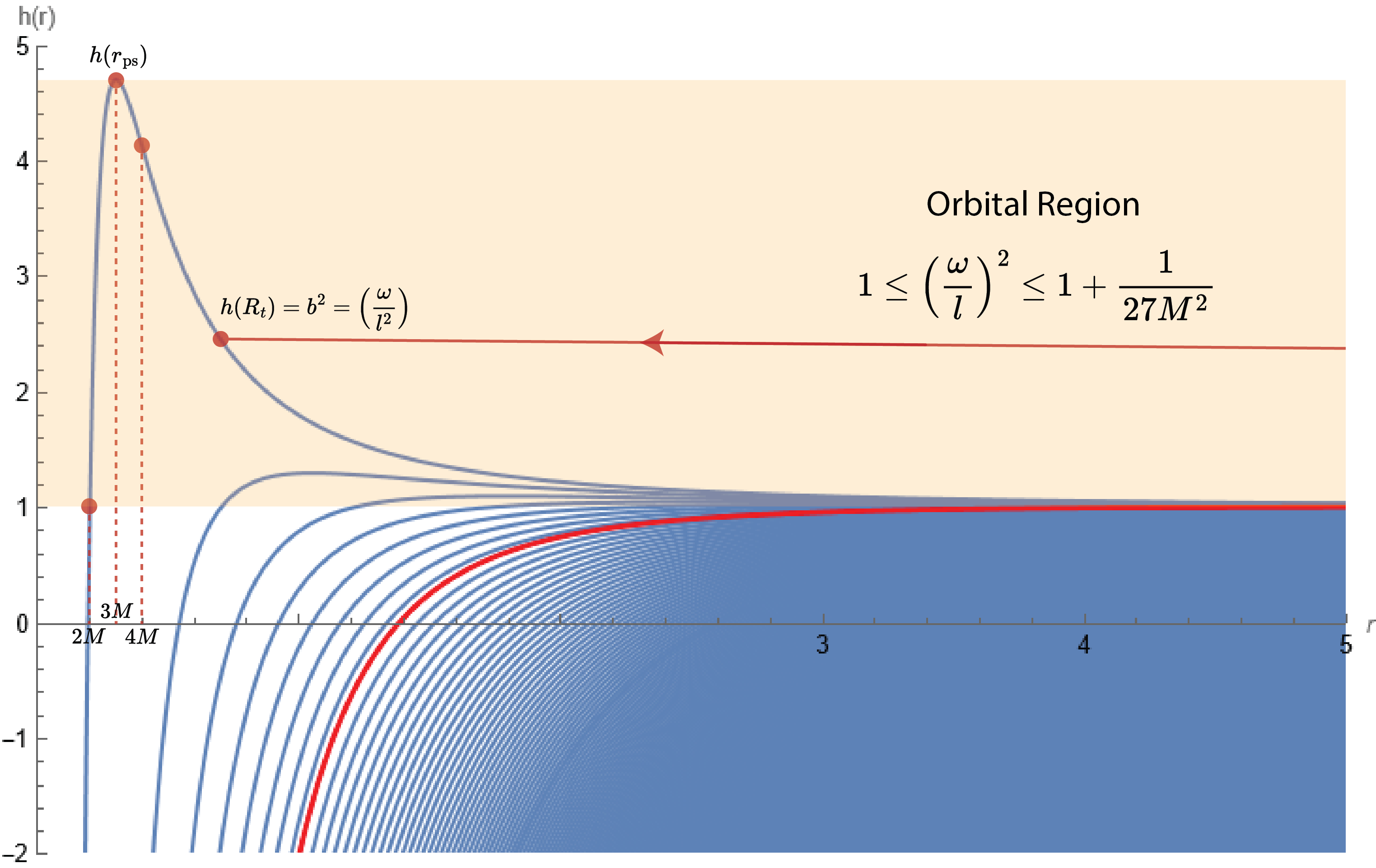
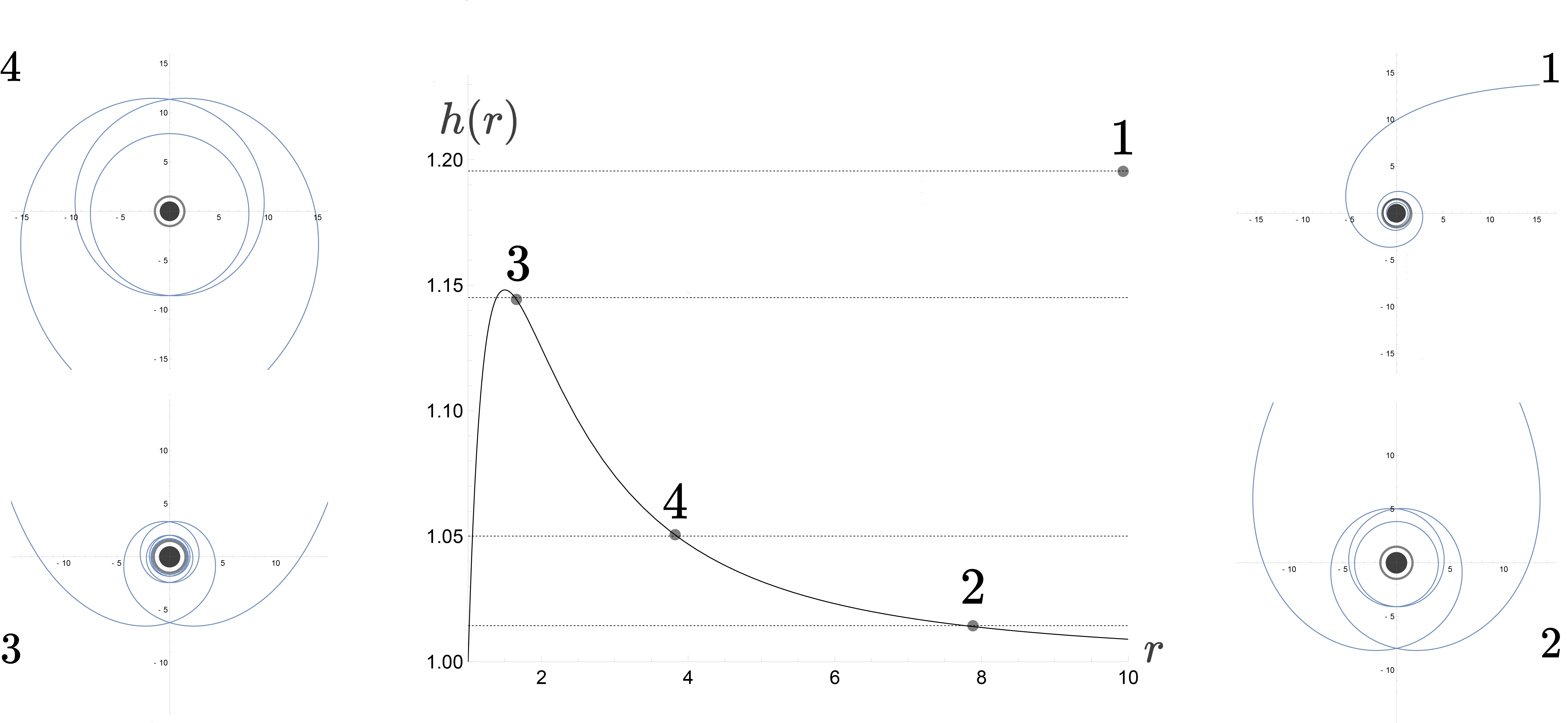
The AdS/CFT correspondence connects bulk fields $ϕ$ to boundary operators $\mathcal{O}$ characterized by source frequency $ω$ and angular momentum $l$. Here we explore their connection to massless particles with an impact parameter $b=ω/l$. In the AdS Schwarzschild spacetime, these particles follow unstable orbits around the photon sphere -- with Lyapunov exponent $λ$ -- when $b$ is near a critical value. The behavior of the bulk field is obtained numerically and then studied using an analytic approach, which leads to a precise approximate formula for the amplitude of the bulk field $ϕ$. This gives the correct qualitative behavior for the system, with the amplitude of the field taking the shape of an arrowhead in tortoise coordinates. The field behaves analogously to the massless particles, and the amplitude of $ϕ$ diverges at the critical impact parameter when the source frequency takes the value $ω\approx λl$, where $λ$ is the Lyapunov exponent of the null geodesics. We find this transition occurs when $b = λ$. We show this is precisely when the first QNM becomes available, and obtain an approximate formula for the first few overtones.
Motivation & Objective
- To understand how the photon sphere influences the transmission of scalar fields in anti-de Sitter (AdS) spacetime via the AdS/CFT correspondence.
- To derive a precise formula for how bulk black holes amplify or attenuate oscillating sources dual to boundary operators, using UV cutoff constraints.
- To identify a phase transition that traps massless fields outside the photon sphere when angular momentum is sufficiently large.
- To develop an approximate analytic formula for the quasi-normal mode (QNM) frequencies of small AdS black holes at large angular momentum $ l $.
- To establish a criterion for signal penetration through the potential barrier peaking at the photon sphere based on frequency, angular momentum, and Lyapunov exponent.
Proposed method
- Reformulate the radial Klein–Gordon equation for a scalar field on AdS-Schwarzschild spacetime into a Schrödinger-type equation using an auxiliary field $ \psi = r\phi $, where $ \phi $ is the radial component of the scalar field.
- Apply the WKB approximation to analyze tunneling and transmission through the effective potential barrier centered at the photon sphere, using the phase integral $ \int p(x)\,dx $ to estimate amplitude decay.
- Use the Lyapunov exponent $ \lambda $ of unstable null geodesics at the photon sphere to define a critical frequency threshold $ \omega > l \lambda^2 $ for signal penetration.
- Derive an amplification formula relating the field amplitude at the horizon $ \phi_H $ to the source amplitude at the AdS boundary $ \phi_B $, validated numerically via Figures 4–6.
- Employ connection formulas near classical turning points to improve WKB accuracy, particularly near the photon sphere where potential spikes occur.
- Analyze the behavior of $ \psi(r_*) $ and $ \phi(r_*) $ in tortoise coordinates to visualize field localization and tunneling effects, especially for small black holes near the Hawking–Page transition.
Experimental results
Research questions
- RQ1How does the photon sphere influence the amplification or attenuation of a boundary source dual to a scalar operator in the AdS/CFT correspondence?
- RQ2What condition determines whether a massless field with large angular momentum $ l $ is trapped outside the photon sphere?
- RQ3Can a precise analytic formula be derived for the amplification of a source across the bulk, constrained by UV cutoffs?
- RQ4What is the criterion for a signal to penetrate the potential barrier peaking at the photon sphere in terms of frequency and angular momentum?
- RQ5How do quasi-normal mode (QNM) frequencies of small AdS black holes behave at large $ l $, and can they be approximated analytically?
Key findings
- The amplification of a boundary source by a bulk black hole is described by a highly precise formula derived from UV cutoff constraints, accurately predicting amplitude ratios $ \phi_H / \phi_B $ across the bulk.
- A phase transition occurs at large angular momentum $ l $, causing massless fields to be trapped outside the photon sphere due to tunneling suppression, as visualized in Figure 7.
- The condition for signal penetration through the photon sphere barrier is $ \omega > l \lambda^2 $, where $ \lambda $ is the Lyapunov exponent of unstable null geodesics, derived from the effective potential peak.
- For small AdS black holes, the effective potential exhibits a sharp spike near the photon sphere, leading to significant deviations from monotonic behavior in the amplification ratio, especially near the Hawking–Page transition.
- The QNM frequency formula for small black holes at large $ l $ is approximated analytically using the WKB method and the Lyapunov exponent, with the potential barrier's height and width dictating the decay rate.
- Numerical validation via Figures 4–6 confirms that the amplification formula predicts both the endpoints and the overall monotonic trend of $ \phi_H / \phi_B $, with breakdowns occurring only in extreme cases like $ M = 0.2 $ near the Hawking–Page transition.
Better researchstarts right now
From reading papers to final review, dramatically reduce your research time.
No credit card · Free plan available
This review was created by AI and reviewed by human editors.