
[Paper Review] The role of interior dynamics and differentiation on the surface and atmosphere of lava planets
This study uses 2D and 3D numerical simulations to investigate how interior dynamics and solid-liquid fractionation govern the long-term evolution of lava planets, revealing two distinct evolutionary regimes: a hot, fully molten interior with a gravitationally unstable night-side crust, and a cooler, mostly solid interior with a shallow day-side magma ocean and a distilled atmosphere lacking Na, K, and FeO—distinguishable via JWST observations.
Lava planets are rocky exoplanets that orbit so close to their host star that their day-side is hot enough to melt silicate rock. Their short orbital periods ensure that lava planets are tidally locked into synchronous rotation, with permanent day and night hemispheres. Such asymmetric magma oceans have no analogs in the Solar System and will exhibit novel fluid dynamics. Here we report numerical simulations of lava planet interiors showing that solid-liquid fractionation in the planetary interior has a major impact on the compositional structure and evolution of the planet. We explored two styles of dynamics that depend primarily on the interior thermal state : 1) a hot fully molten interior, and 2) a mostly solid interior with a shallow day-side magma ocean. In the hot interior scenario, the atmosphere reflects the planet's bulk silicate composition and the night-side crust is gravitationally unstable and constantly replenished. In the cool interior scenario, the distilled atmosphere will lack Na, K and FeO, and the night-side mantle is entirely solid, with a cold surface. These two end-member cases can be distinguished with observations from the James Webb Space Telescope, offering an avenue to probe the diversity of terrestrial exoplanet evolutions.
Motivation & Objective
- To understand how interior dynamics and phase changes in silicate mantle govern the evolution of lava planets with hemispherical magma oceans.
- To investigate the role of thermal state, convection, and phase transitions in shaping planetary structure and atmospheric composition.
- To determine whether the long-term evolution of lava planets leads to distinct end-member states with observable differences.
- To assess the impact of rotation, turbulence, and spherical geometry on magma ocean dynamics in tidally locked exoplanets.
- To provide testable predictions for distinguishing planetary evolution pathways using future James Webb Space Telescope observations.
Proposed method
- Numerical simulations using the MagIC code to model turbulent thermal convection in a rotating spherical shell under the Boussinesq approximation.
- Implementation of heterogeneous surface temperature boundary conditions based on stellar irradiation, with a sub-stellar point at the base temperature and anti-stellar point coldest.
- Use of dimensionless parameters (Rayleigh number, Ekman number, Prandtl number, Rossby number) to scale physical conditions and ensure force balance between buoyancy and rotation.
- Two complementary models: 3D turbulent flow in spherical geometry without phase change, and 2D Cartesian model with phase change and melting curve buffering.
- Application of free-slip boundary conditions and pseudo-spectral methods with Chebyshev polynomials and spherical harmonics for spatial discretization.
- Time integration using a mixed Crank-Nicolson and second-order Adams-Bashforth scheme, with long integration times to ensure convergence.
Experimental results
Research questions
- RQ1How does the presence of solid-liquid phase change influence temperature distribution and convection patterns in a lava planet’s magma ocean?
- RQ2What are the key differences in planetary structure and atmospheric composition between a fully molten interior and a mostly solid interior with a shallow day-side magma ocean?
- RQ3To what extent do rotation and turbulence affect the dynamics of hemispherical magma oceans in tidally locked lava planets?
- RQ4Can the two end-member evolutionary states—hot global magma ocean and cool solid-state mantle—be distinguished through atmospheric composition?
- RQ5How do the dimensionless parameters (e.g., Rossby number) reflect the relative importance of rotation and convection in shaping interior dynamics?
Key findings
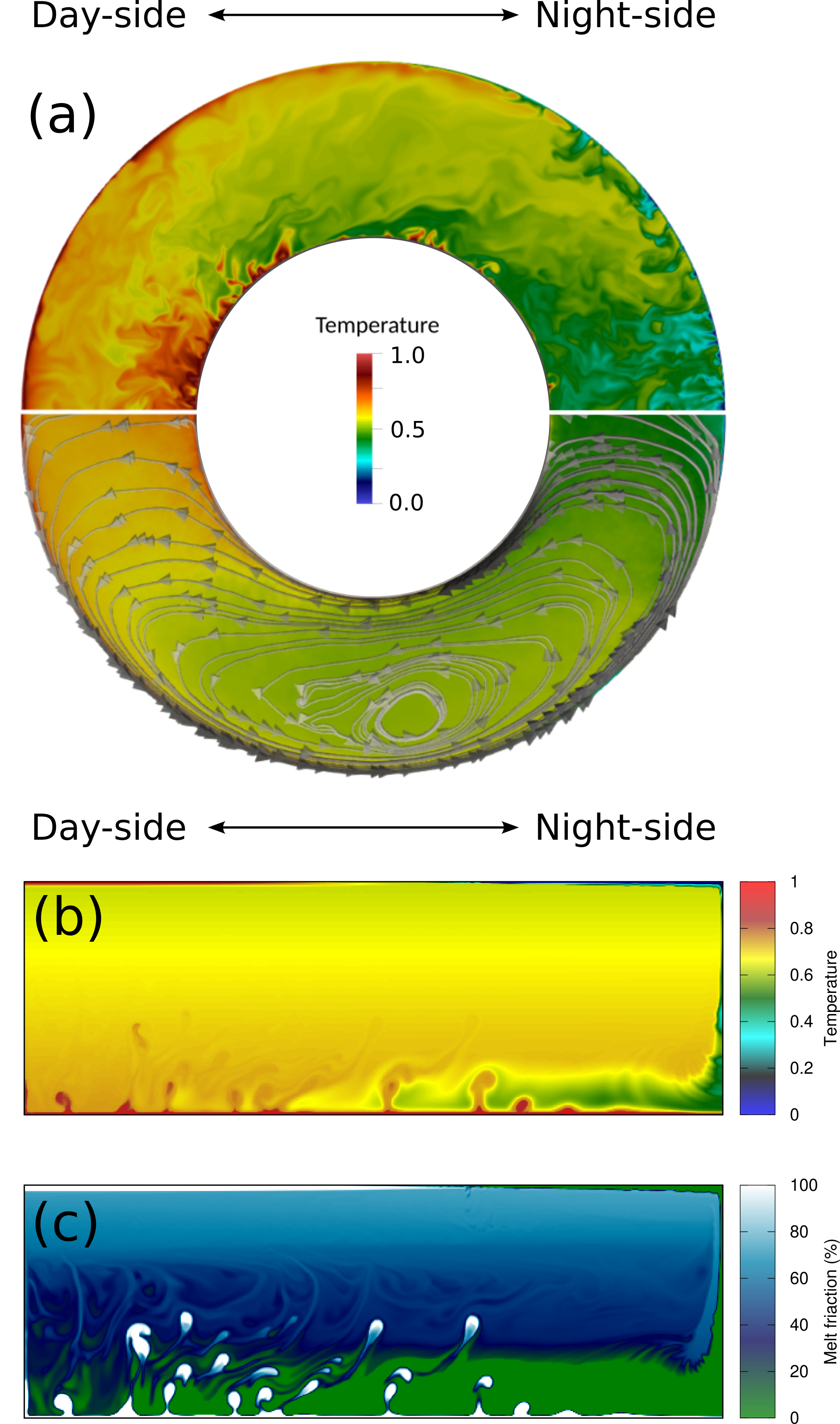
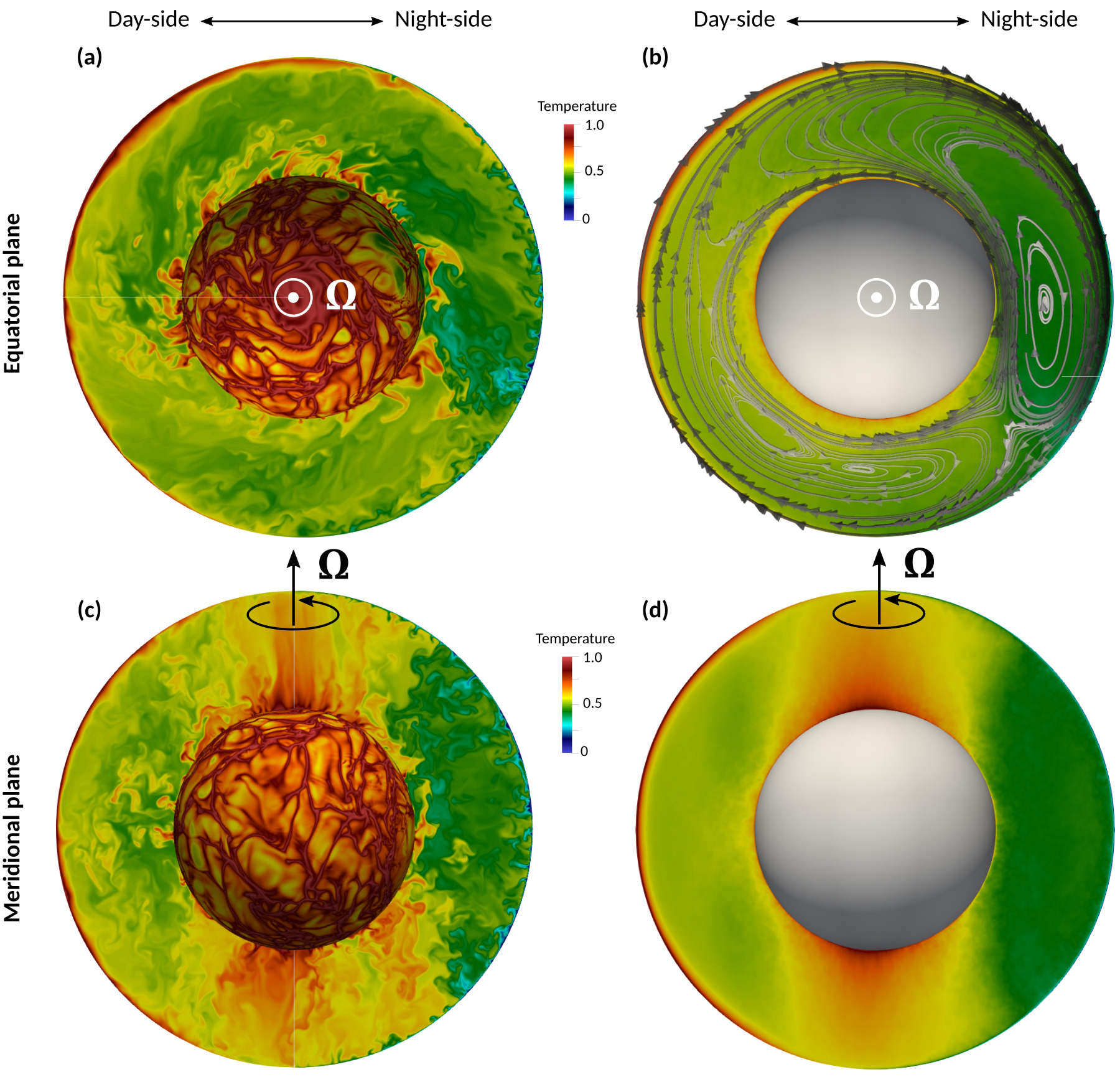
- In the hot, fully molten interior regime, turbulent convection homogenizes temperature, but a clear thermal contrast remains between the day and night hemispheres.
- With phase change, the temperature is buffered by the silicate melting curve, leading to more effective thermal homogenization and reduced super-adiabatic contrasts.
- The night-side crust in the hot interior scenario is gravitationally unstable and continuously replenished due to compositional overturn.
- In the cool interior scenario, the night-side mantle remains entirely solid, and the atmosphere is depleted in volatile elements like Na, K, and FeO.
- The Rossby number (Ro_c ≈ 1.6) indicates that rotational effects are comparable in strength to buoyancy forces, justifying the inclusion of rotation in simulations.
- The two end-member regimes produce distinct atmospheric compositions, offering a pathway for observational discrimination via the James Webb Space Telescope.
Better researchstarts right now
From reading papers to final review, dramatically reduce your research time.
No credit card · Free plan available
This review was created by AI and reviewed by human editors.