
[Paper Review] The Scale of Stellar Yields: Implications of the Measured Mean Iron Yield of Core Collapse Supernovae
This paper uses the recent empirical measurement of the mean iron yield from core-collapse supernovae (CCSN) by Rodriguez et al. (2023), $\bar{y}_{\rm Fe}^{\rm cc} = 0.058 \pm 0.007\,M_\odot$, to infer the absolute scale of $\alpha$-element yields by assuming the observed $[\alpha/{\rm Fe}]$ plateau in low-metallicity stars reflects the true yield ratio. It finds that oxygen and magnesium yields are consistent with solar values, supports the Sukhbold et al. (2016) model with black hole formation in $M < 40\,M_\odot$ progenitors, and implies lower galactic outflows than previously assumed, reducing the need for strong winds to match observed metallicity and abundance patterns.
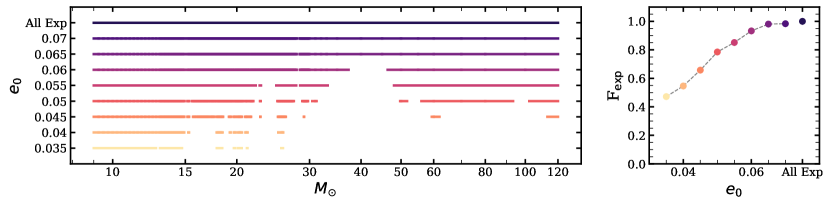
The scale of alpha-element yields is difficult to predict from theory because of uncertainties in massive star evolution, supernova physics, and black hole formation, and it is difficult to constrain empirically because the impact of higher yields can be compensated by greater metal loss in galactic winds. We use a recent measurement of the mean iron yield of core collapse supernovae (CCSN) by Rodriguez et al. (RMN23), $\bar{y}_{ m Fe}^{ m cc} =0.058 \pm 0.007 M_\odot$, to infer the scale of alpha-element yields by assuming that the plateau of [alpha/Fe] abundance ratios observed in low metallicity stars represents the yield ratio of CCSN. For a Kroupa IMF and a plateau at [alpha/Fe]=0.45, we find that the population-averaged yields of O and Mg per unit mass of star formation are about equal to the mass fractions of these elements in the sun. The inferred O and Fe yields agree with predictions of the Sukhbold et al. (2016) CCSN models assuming their Z9.6+N20 neutrino-driven engine, a scenario in which many progenitors with $M<40M_\odot$ implode to black holes rather than exploding. The yields are lower than assumed in some models of galactic chemical evolution (GCE) and the galaxy mass-metallicity relation, reducing the level of outflows needed to match observed abundances. For straightforward assumptions, we find that one-zone GCE models with mass-loading factor $η\approx 0.6$ evolve to solar metallicity at late times. By requiring that models reach [alpha/Fe]=0 at late times, and assuming a mean Fe yield of $0.7M_\odot$ per Type Ia supernova, we infer a Hubble-time integrated SNIa rate of $1.1 imes 10^{-3} M_\odot^{-1}$, compatible with estimates from supernova surveys. The RMN23 measurement provides one of the few empirical anchors for the absolute scale of nucleosynthetic yields, with wide-ranging implications for stellar and galactic astrophysics.
Motivation & Objective
- To determine the absolute scale of $\alpha$-element nucleosynthetic yields in core-collapse supernovae using empirical constraints.
- To resolve the long-standing degeneracy between yield uncertainties and galactic outflow efficiency in galactic chemical evolution (GCE) models.
- To test whether the observed $[\alpha/{\rm Fe}]$ plateau in low-metallicity stars reflects the true yield ratio of CCSN.
- To assess the consistency of inferred yields with theoretical models, particularly those involving black hole formation in massive stars.
- To evaluate the implications for the galaxy mass-metallicity relation and the cosmic metal budget.
Proposed method
- The authors use the empirical measurement of the mean iron yield from CCSN, $\bar{y}_{\rm Fe}^{\rm cc} = 0.058 \pm 0.007\,M_\odot$, from Rodriguez et al. (2023) as a fixed anchor point for yield scaling.
- They assume that the observed $[\alpha/{\rm Fe}]_{\rm cc} = 0.45$ plateau in low-metallicity stars reflects the true yield ratio of $\alpha$-elements to iron from CCSN.
- Using a Kroupa (2001) initial mass function, they infer population-averaged yields for oxygen and magnesium relative to their solar abundances.
- They apply one-zone galactic chemical evolution (GCE) models with time-independent outflow efficiency $\eta = \dot{M}_{\rm out}/\dot{M}_*$ and a delayed-time distribution (DTD) for Type Ia supernovae.
- They use analytic solutions for GCE with a two-parameter star formation history (SFH) to model the evolution of $[\alpha/{\rm Fe}]$ and $[\rm Fe/H]$.
- They test consistency with the primordial deuterium-to-hydrogen (D/H) ratio and infer the Hubble-time integrated SNIa rate from the requirement that $[\alpha/{\rm Fe}] \to 0$ at late times.
![Figure 1: Distribution of APOGEE disk and halo stars in $[\alpha/{\rm Fe}]$ - $[{\rm Fe/H}]$ for the $\alpha$ -elements O (left), Mg (middle), or Si (right). Above $[{\rm Fe/H}]=-0.8$ stars are randomly downsampled by a factor of 10; the transition to full sampling produces the edge at $[{\rm Fe/H}]](https://ar5iv.labs.arxiv.org/html/2309.05719/assets/x1.png)
Experimental results
Research questions
- RQ1What is the absolute scale of $\alpha$-element yields from core-collapse supernovae, given the empirical iron yield measurement?
- RQ2How do the inferred yields compare with theoretical models of massive star nucleosynthesis and black hole formation?
- RQ3What level of galactic outflows is required to reproduce observed metallicity and abundance patterns, given the new iron yield constraint?
- RQ4Is the observed $[\alpha/{\rm Fe}]$ plateau in low-metallicity stars consistent with being the true yield ratio from CCSN?
- RQ5What is the implied Hubble-time integrated SNIa rate needed to match the observed $[\alpha/{\rm Fe}]$ evolution in the Milky Way?
Key findings
- The population-averaged yields of oxygen and magnesium from core-collapse supernovae are found to be $\log y_{\rm O}^{\rm cc}/Z_{{\rm O},\odot} = \log y_{\rm Mg}^{\rm cc}/Z_{{\rm Mg},\odot} = -0.01 \pm 0.1$, indicating they are approximately equal to the solar abundance.
- The inferred yields are consistent with the Sukhbold et al. (2016) CCSN models assuming the Z9.6+N20 neutrino-driven engine, which predicts black hole formation in $M < 40\,M_\odot$ progenitors.
- One-zone GCE models with an outflow efficiency of $\eta \approx 0.6$ reproduce solar metallicity at late times, suggesting lower outflows than previously assumed in some GCE models.
- The models predict an interstellar medium D/H ratio of about 70% of the primordial value, which is consistent with observational estimates at the 2σ level.
- To reach $[\alpha/{\rm Fe}] \approx 0$ at late times, the Hubble-time integrated SNIa rate is inferred to be $1.1 \times 10^{-3}\,M_\odot^{-1}$, compatible with supernova survey estimates.
- The RMN23 iron yield measurement provides a critical empirical anchor for the absolute scale of stellar yields, with broad implications for stellar evolution, galaxy formation, and the cosmic metal budget.
Better researchstarts right now
From reading papers to final review, dramatically reduce your research time.
No credit card · Free plan available
This review was created by AI and reviewed by human editors.