
[Paper Review] The Transition from the Kuiper Belt to the Jupiter-Family (Comets)
This paper reviews the dynamical and physical pathways from Trans-Neptunian Objects (TNOs) in the Kuiper Belt to Jupiter-family comets (JFCs), emphasizing orbital evolution, size distributions, compositions, and activity. It identifies key unresolved issues—such as incomplete TNO size distribution data, the fading problem in JFCs, and the role of distant perturbers like Planet Nine—and highlights upcoming surveys like LSST as critical for resolving them.
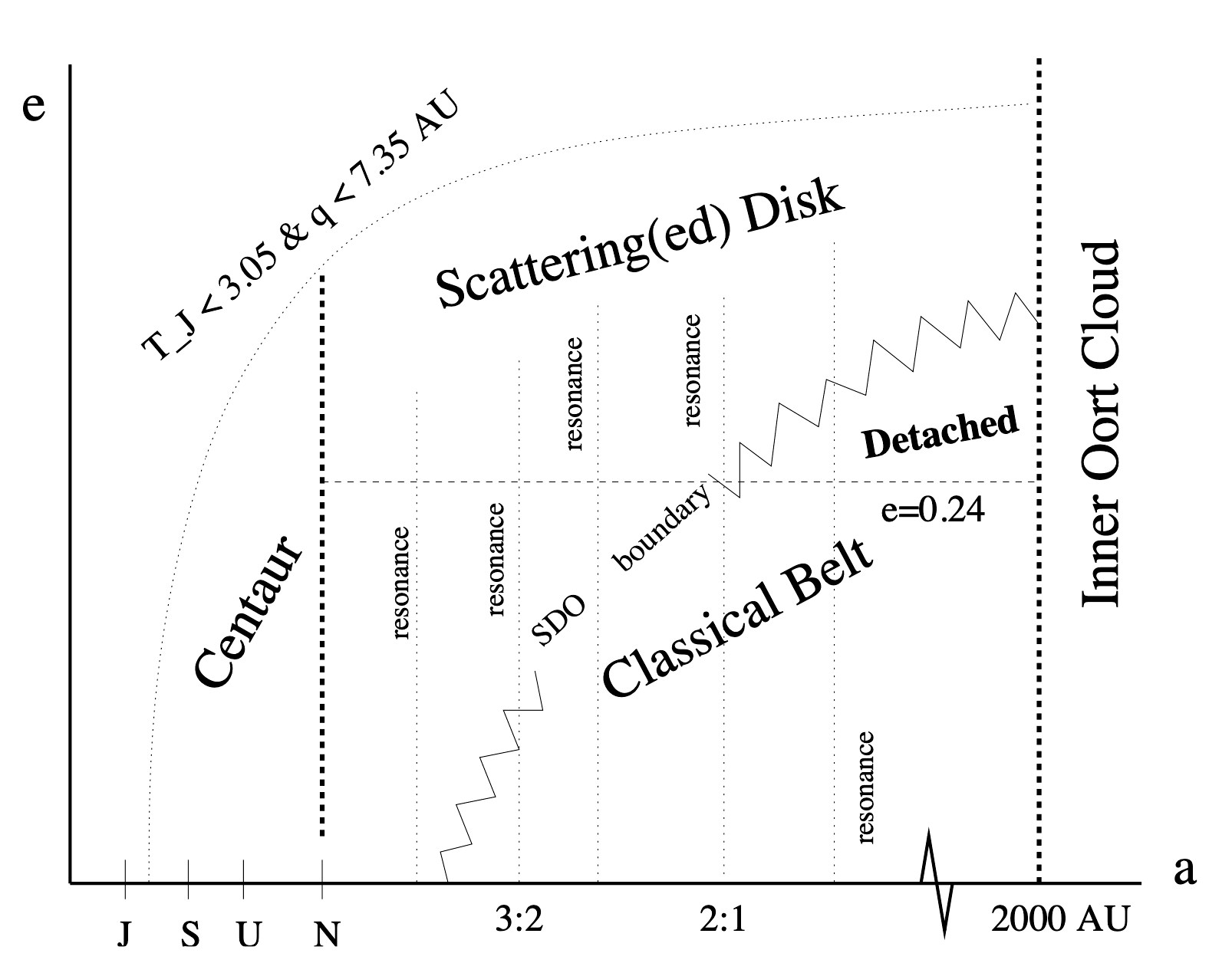
Kuiper Belt Objects, or more generally Trans-Neptunian Objects (TNOs), are planetesimals found beyond the orbit of Neptune. Some TNOs evolve onto Neptune-crossing orbits and become Centaurs. Many Centaurs, in turn, reach Jupiter-crossing orbits and become Jupiter-family comets (JFCs). TNOs are the main source of the JFCs. TNOs offer a different window than the JFCs, of more primordial bodies and over a different size and temperature range. It is in that context that this chapter is written. Here we discuss the dynamical pathways taken from the trans-Neptunian region to the JFCs, and the most important properties of TNOs that relate to the JFC population, including considerations of their origins, compositions, morphologies, and size distributions. We relate these properties to the JFCs whenever possible. We reflect on a few key outstanding issues regarding our incomplete knowledge of TNOs as they pertain to the Centaurs and JFC populations. We finish with a short discussion of notable new and upcoming facilities and the impacts they will have regarding these outstanding questions.
Motivation & Objective
- To synthesize current understanding of the dynamical evolution from TNOs to Centaurs and Jupiter-family comets.
- To identify key unresolved issues in linking TNO populations to JFCs, including incomplete size distribution data and the fading problem.
- To assess the impact of upcoming surveys like LSST on resolving open questions in TNO and JFC population studies.
- To evaluate the role of distant, massive perturbers—such as Planet Nine—in shaping the orbital structure of extreme TNOs.
- To connect TNO properties (composition, morphology, size distribution) to observable JFC characteristics for improved population modeling.
Proposed method
- Analyzes orbital evolution pathways from TNOs through Centaurs to JFCs using numerical integrations and dynamical models.
- Compares observed size distributions of TNOs, Centaurs, and JFCs, focusing on the transition from larger TNOs to smaller cometary nuclei.
- Reviews broadband colors and reflectance spectroscopy data to infer compositions of TNOs and Centaurs.
- Examines active Centaurs to constrain volatile outgassing mechanisms and link to JFC activity.
- Evaluates the impact of observational biases in current surveys and the potential of LSST to reduce them via deep, wide-field, high-cadence monitoring.
- Assesses the influence of hypothetical massive bodies (e.g., Planet Nine) on the orbital structure of distant TNOs and their potential effects on JFC populations.
Experimental results
Research questions
- RQ1What are the dominant dynamical pathways from TNOs to Jupiter-family comets, and how do they compare with observed orbital distributions?
- RQ2How do the size distributions of TNOs, Centaurs, and JFCs relate, and what constraints do they place on the origin and evolution of comets?
- RQ3To what extent do compositional and morphological properties of TNOs and Centaurs reflect primordial conditions or later evolution?
- RQ4What role do massive, distant perturbers like Planet Nine play in shaping the orbital structure of extreme TNOs and influencing JFC delivery?
- RQ5How will upcoming surveys like LSST improve the census and activity monitoring of TNOs, Centaurs, and JFCs to resolve current uncertainties?
Key findings
- The Kuiper Belt is the primary source of Jupiter-family comets, with TNOs evolving through Neptune-crossing orbits into Centaurs and eventually into JFCs.
- Size distributions show TNOs range from ~100 km to over 2000 km in diameter, Centaurs from ~10–300 km, and JFC nuclei from ~0.3 km to over 10 km, indicating a size evolution during dynamical migration.
- LSST is expected to increase the inventory of TNOs with well-determined orbits by at least an order of magnitude and detect numerous comet-sized Centaurs.
- LSST’s 10-year, 4–8 day cadence monitoring will enable robust detection of activity onset and turnoff in JFCs and Centaurs, crucial for resolving the fading problem.
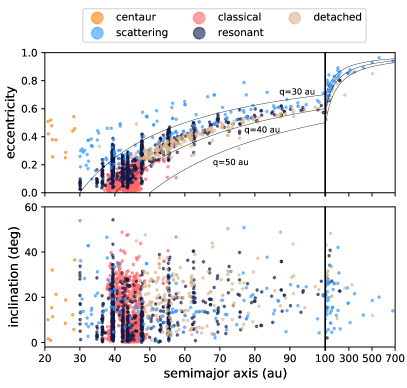
- The orbital clustering of extreme TNOs (a > 150 au, q > 30 au) may be explained by a hypothetical Planet Nine with mass 5–10 M⊕, though alternative models remain viable.
- Despite extensive searches, Planet Nine remains undetected, with predicted R magnitude between 20 and 25 depending on albedo, and future surveys with Rubin, VLT, and Gemini may finally detect it.
Better researchstarts right now
From reading papers to final review, dramatically reduce your research time.
No credit card · Free plan available
This review was created by AI and reviewed by human editors.