
[Paper Review] The undecidability of joint embedding and joint homomorphism for hereditary graph classes
This paper proves the undecidability of the joint embedding property (JEP) and joint homomorphism property (JHP) for hereditary graph classes defined by finite sets of forbidden induced subgraphs. Using a reduction from the undecidable tiling problem, the author constructs graph classes where JEP and JHP correspond precisely to the existence of a tiling solution, establishing that no algorithm can decide these properties in general.
We prove that the joint embedding property is undecidable for hereditary graph classes, via a reduction from the tiling problem. The proof is then adapted to show the undecidability of the joint homomorphism property as well.
Motivation & Objective
- To determine whether the joint embedding property (JEP) is decidable for hereditary graph classes defined by finite sets of forbidden induced subgraphs.
- To investigate the decidability of the joint homomorphism property (JHP) in the same class of graph hereditary classes.
- To extend prior undecidability results on universal countable graphs to the JEP and JHP settings.
- To address open questions on atomicity and universality in permutation classes and monotone graph classes.
Proposed method
- Reduce the undecidable tiling problem to the joint embedding problem by encoding grid and tile structures into graphs with specific induced subgraph constraints.
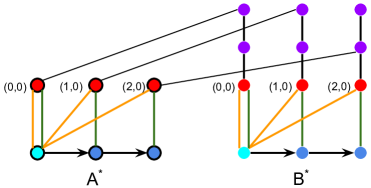
- Construct two canonical graphs, $A^*$ and $B^*$, representing a grid and a tiling system, respectively, using unary predicates for structural control.
- Impose constraints via forbidden induced subgraphs to ensure that joint embedding of $A^*$ and $B^*$ encodes a valid tiling solution.
- Use the compactness theorem to equate finite JEP with JEP for countable structures, enabling model-theoretic reasoning.
- Adapt the proof to the joint homomorphism property by showing that homomorphisms into a common structure must be embeddings under the constraints.
- Apply coding techniques to translate the enriched language (with unary predicates) into the pure graph language, preserving undecidability.
Experimental results
Research questions
- RQ1Is there an algorithm that, given a finite set of forbidden induced subgraphs, decides whether the corresponding hereditary graph class has the joint embedding property?
- RQ2Is there an algorithm that, given a finite set of forbidden induced subgraphs, decides whether the corresponding hereditary graph class has the joint homomorphism property?
- RQ3Can the methods used for graphs be adapted to show undecidability of atomicity in finitely based permutation classes?
- RQ4Is the joint embedding property decidable for monotone graph classes (defined by forbidden non-induced subgraphs)?
- RQ5Can the undecidability of JEP be extended to hereditary classes of permutation graphs defined by forbidden permutations?
Key findings
- The joint embedding property is undecidable for hereditary graph classes defined by finite sets of forbidden induced subgraphs.
- The joint homomorphism property is also undecidable for the same class of graph hereditary classes.
- The undecidability is established via a reduction from the tiling problem, which is known to be undecidable.
- The proof first works in an enriched language with unary predicates and then reduces to the pure graph language using coding techniques.
- The construction ensures that joint embedding of two specific graphs $A^*$ and $B^*$ corresponds exactly to a solution of the tiling problem.
- The result implies that there is no algorithm to decide whether a hereditary graph class admits a universal countable structure.
Better researchstarts right now
From reading papers to final review, dramatically reduce your research time.
No credit card · Free plan available
This review was created by AI and reviewed by human editors.