
[Paper Review] Thermal Conductivity Predictions with Foundation Atomistic Models
The paper introduces a framework combining foundation machine-learning potentials with the Wigner formulation of heat transport to predict anharmonic vibrational and thermal conductivity in diverse solids with first-principles accuracy at reduced cost, including fine-tuning for accuracy. It benchmark-tests mp-fMLPs against DFT data and demonstrates when and how WTE is essential for accurate conductivity predictions.
Advances in machine learning have led to the development of foundation models for atomistic materials chemistry, enabling quantum-accurate descriptions of interatomic forces across chemically diverse compounds at reduced computational cost. Hitherto, the accuracy and utility of these models have been assessed relying on descriptors based on formation energies or idealized harmonic atomic vibrations. Yet, the rigorous and physically interpretable quantification of their capability to describe both realistic anharmonic atomic dynamics and technologically relevant observables remains a pressing problem. Here, we address this problem, leveraging the Wigner formulation of heat transport and the Grüneisen approach to thermal expansion to connect the atomic-physics awareness of foundation models to their utility in predicting experimentally observable thermomechanical properties, presenting standards and fine-tuning protocols needed to achieve first-principles accuracy. We apply our framework to a database of 103 solids with diverse compositions and structures, demonstrating that it overcomes the major bottlenecks of current methods for designing heat-management materials -- high cost, limited transferability, or lack of physics awareness -- and its potential to discover materials for next-gen technologies ranging from thermal insulation to neuromorphic computing.
Motivation & Objective
- Motivate and enable first-principles accuracy in predicting anharmonic vibrational and thermal properties using foundation ML potentials (fMLPs).
- Develop benchmarks and metrics to assess precision and cost trade-offs in conductivity predictions.
- Provide a fine-tuning protocol to achieve higher accuracy when zero-shot fMLP predictions underperform.
- Showcase the framework on a diverse solids database to illustrate discovery potential for thermal management materials.
Proposed method
- Use fMLPs trained on near-universal chemical space to obtain harmonic and third-order anharmonic vibrational properties.
- Compute thermal conductivity via the Wigner transport equation (WTE), which combines particle-like and wave-like contributions.
- Benchmark zero-shot fMLP predictions against DFT-PBE reference data for 103 compounds from the phononDB-PBE database.
- Introduce precision metrics such as Symmetric Relative Error (SRE) and Symmetric Relative Mean Error (SRME) to quantify microscopic and macroscopic accuracy.
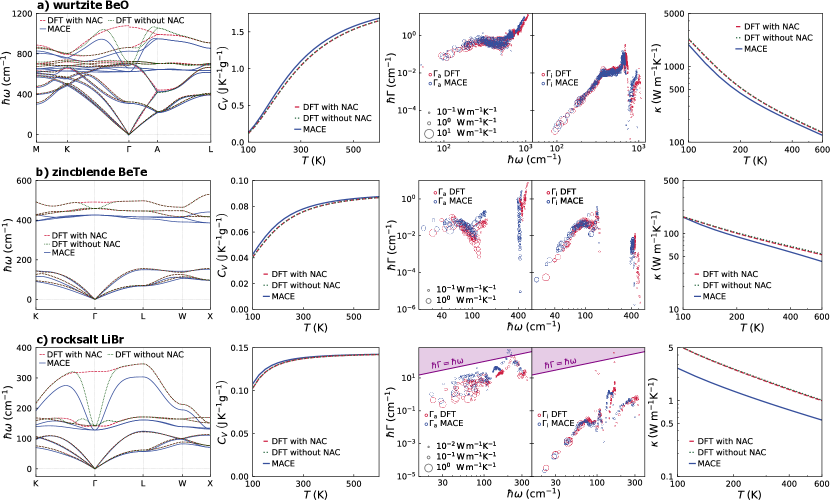
- Apply a fine-tuning protocol with DFT-PBE frames to bring fMLP predictions to first-principles accuracy, demonstrated on LiBr.
Experimental results
Research questions
- RQ1Can foundation ML potentials provide quantum-accurate predictions of anharmonic vibrational properties and thermal conductivity across diverse materials?
- RQ2What benchmarks and metrics accurately reflect the physics-driven accuracy of conductivity predictions from fMLPs?
- RQ3How does the Wigner heat transport framework compare to Boltzmann transport in materials where wave-like contributions are significant?
- RQ4Can fine-tuning of mp-fMLPs achieve first-principles accuracy with modest additional data and cost?
- RQ5Which materials exhibit failures of semiclassical BTE and are better described by the WTE framework?
Key findings
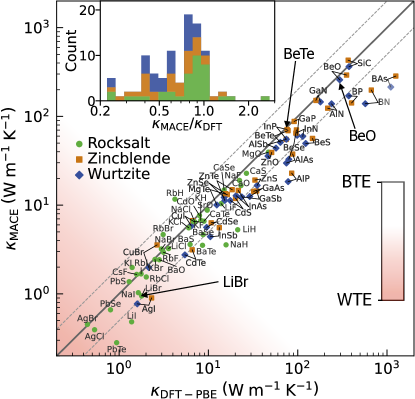
- Zero-shot mp-fMLPs (MACE-MP-0, SevenNet, CHGNet, M3GNet) predict 300 K conductivity within roughly a factor of two of DFT-PBE for about 69% of the 103 compounds in phononDB-PBE.
- Discrepancies in conductivities can arise from underestimation of high-frequency phonons and can be mitigated or compensated by error cancellations depending on the material.
- The WTE framework captures both particle-like and wave-like conduction, essential for materials where the BTE underpredicts or fails to describe heat transport, especially at low conductivities.
- Fine-tuning LiBr with a small, targeted DFT-PBE frame set (3 frames) can yield conductivity predictions within 2% of DFT-PBE at 300 K, with improved phonon and linewidth predictions.
- Predictions at 100–800 K using the fine-tuned model reproduce experimental trends and align with aiMD benchmarks, validating the physics-aware approach.
Better researchstarts right now
From reading papers to final review, dramatically reduce your research time.
No credit card · Free plan available
This review was created by AI and reviewed by human editors.