
[Paper Review] Time Series Dataset for Modeling and Forecasting of $N_2O$ in Wastewater Treatment
This paper presents a two-year, high-resolution (2-minute interval) time series dataset from a full-scale wastewater treatment plant in Denmark, measuring nitrous oxide (N₂O) and associated operational, environmental, and control parameters. The dataset enables advanced modeling and forecasting of N₂O emissions using machine learning and data-driven techniques, addressing real-world complexities like nonstationarity, seasonality, and intermittency to improve mitigation strategies in wastewater treatment.
In this paper, we present two years of high-resolution nitrous oxide ($N_2O$) measurements for time series modeling and forecasting in wastewater treatment plants (WWTP). The dataset comprises frequent, real-time measurements from a full-scale WWTP, with a sample interval of 2 minutes, making it ideal for developing models for real-time operation and control. This comprehensive bio-chemical dataset includes detailed influent and effluent parameters, operational conditions, and environmental factors. Unlike existing datasets, it addresses the unique challenges of modeling $N_2O$, a potent greenhouse gas, providing a valuable resource for researchers to enhance predictive accuracy and control strategies in wastewater treatment processes. Additionally, this dataset significantly contributes to the fields of machine learning and deep learning time series forecasting by serving as a benchmark that mirrors the complexities of real-world processes, thus facilitating advancements in these domains. We provide a detailed description of the dataset along with a statistical analysis to highlight its characteristics, such as nonstationarity, nonnormality, seasonality, heteroscedasticity, structural breaks, asymmetric distributions, and intermittency, which are common in many real-world time series datasets and pose challenges for forecasting models.
Motivation & Objective
- To provide a comprehensive, real-world time series dataset for modeling and forecasting N₂O emissions in full-scale wastewater treatment plants (WWTPs).
- To support the development of data-driven and mechanistic models for real-time control and mitigation of N₂O, a potent greenhouse gas with 265× the global warming potential of CO₂.
- To address the lack of publicly available, high-resolution operational datasets with detailed biochemical and control signals for N₂O in activated sludge processes.
- To serve as a benchmark for evaluating forecasting models and advancing machine learning applications in environmental engineering.
- To foster collaboration and standardization in modeling and control of N₂O emissions across the water sector.
Proposed method
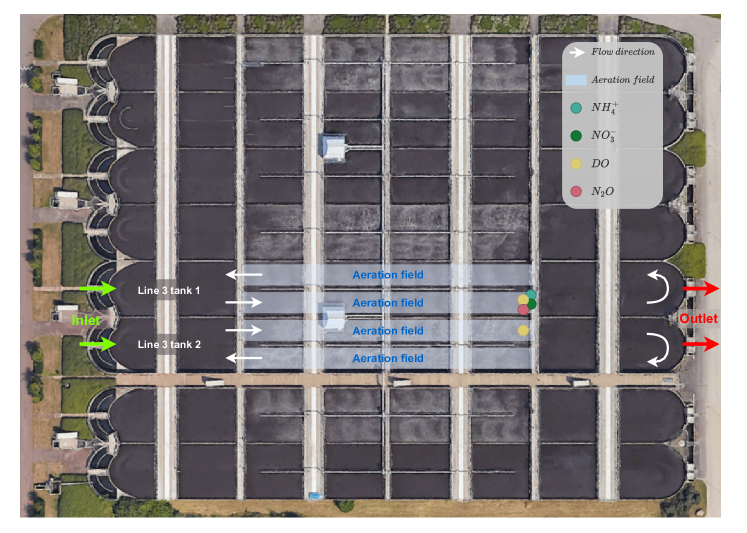
- Data was collected at 2-minute intervals from June 2022 to June 2024 at Avedøre WWTP in Copenhagen, Denmark, using SCADA and cloud-based control platforms.
- The dataset includes 24 signals: 12 sensor measurements (e.g., N₂O, NH₄⁺, NO₃⁻, DO, SS, temperature, flow) and 12 control signals (e.g., O₂ setpoints, valve positions, phase codes).
- Operational data was extracted from an online cloud platform integrated with the plant’s SCADA system, ensuring real-time accuracy and consistency.
- Statistical analysis was performed to characterize data properties such as nonstationarity, nonnormality, seasonality, heteroscedasticity, structural breaks, and asymmetric distributions.
- The dataset includes stormwater mode (SWM) events and alternating aeration control phases, reflecting real operational dynamics.
- The data is publicly available via Mendeley Data (DOI: 10.17632/xmbxhscgpr.1) for use in benchmarking and model development.
![Figure 1: Layout of a WWTP with ASP. The parameters $k$ , $m$ , and $n$ vary based on plant-specific dimensioning. Adapted from [ 1 ] .](https://ar5iv.labs.arxiv.org/html/2407.05959/assets/x1.png)
Experimental results
Research questions
- RQ1What are the key operational and environmental drivers of N₂O concentration fluctuations in full-scale activated sludge processes?
- RQ2How do nonstationary, intermittent, and seasonally varying dynamics in real-world wastewater data affect the performance of time series forecasting models?
- RQ3To what extent can high-resolution, full-scale operational data improve the accuracy of N₂O emission prediction and control strategies?
- RQ4How do control strategies such as alternating aeration and stormwater management influence N₂O emissions over time?
- RQ5Can this dataset serve as a reliable benchmark for evaluating machine learning and deep learning models in environmental time series forecasting?
Key findings
- The dataset spans 24 months of continuous, high-resolution (2-minute) measurements from a full-scale WWTP, capturing complex real-world dynamics.
- N₂O concentrations varied widely, with a maximum recorded value of 12.0 mg/L, indicating significant emission variability.
- The data exhibits strong nonstationarity, seasonality, and structural breaks, particularly during stormwater events and operational phase changes.
- Control signals such as O₂ setpoints and valve positions show dynamic behavior, with O₂ setpoints ranging from 0.0 to 2.5 mg/L and valve positions from 0% to 100%.
- The dataset includes 12 operational signals and 12 sensor measurements, with mean N₂O levels at 0.1 mg/L and standard deviation of 0.2 mg/L across the monitored tanks.
- The availability of this dataset enables researchers to test and validate models under realistic, complex conditions, advancing both environmental engineering and machine learning applications.
Better researchstarts right now
From reading papers to final review, dramatically reduce your research time.
No credit card · Free plan available
This review was created by AI and reviewed by human editors.