
[Paper Review] TiZero: Mastering Multi-Agent Football with Curriculum Learning and Self-Play
TiZero introduces a self-evolving multi-agent reinforcement learning system that masters the full 11 vs. 11 Google Research Football environment from scratch, using adaptive curriculum learning, a novel challenge-and-generalize self-play strategy, and joint policy optimization. It achieves over 30% higher win rates than prior methods, demonstrating superior coordination and strategic planning in complex multi-agent settings.
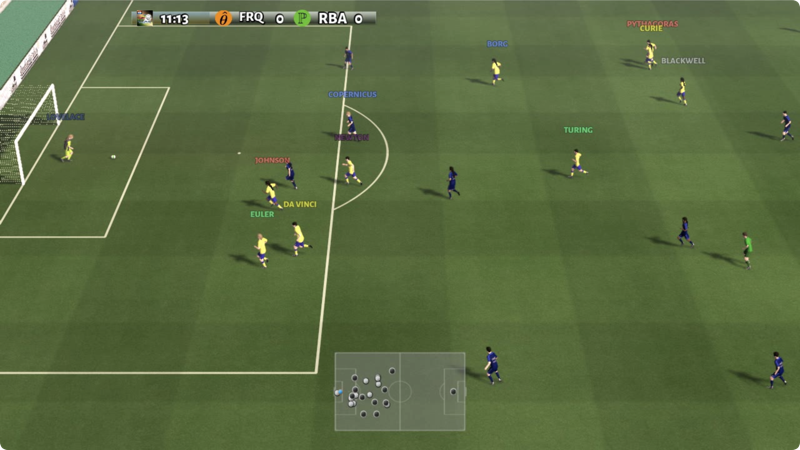
Multi-agent football poses an unsolved challenge in AI research. Existing work has focused on tackling simplified scenarios of the game, or else leveraging expert demonstrations. In this paper, we develop a multi-agent system to play the full 11 vs. 11 game mode, without demonstrations. This game mode contains aspects that present major challenges to modern reinforcement learning algorithms; multi-agent coordination, long-term planning, and non-transitivity. To address these challenges, we present TiZero; a self-evolving, multi-agent system that learns from scratch. TiZero introduces several innovations, including adaptive curriculum learning, a novel self-play strategy, and an objective that optimizes the policies of multiple agents jointly. Experimentally, it outperforms previous systems by a large margin on the Google Research Football environment, increasing win rates by over 30%. To demonstrate the generality of TiZero's innovations, they are assessed on several environments beyond football; Overcooked, Multi-agent Particle-Environment, Tic-Tac-Toe and Connect-Four.
Motivation & Objective
- Address the challenge of training strong multi-agent policies in the complex 11 vs. 11 Google Research Football environment without expert demonstrations.
- Overcome key obstacles in multi-agent reinforcement learning: multi-agent coordination, long-term planning, sparse rewards, and non-transitive dynamics.
- Develop a scalable, decentralized training framework that enables 10 outfield players to coordinate effectively in a competitive, stochastic environment.
- Demonstrate the generality of the method beyond football by evaluating on Overcooked, MPE, Tic-Tac-Toe, and Connect-Four.
- Achieve state-of-the-art performance in the 11 vs. 11 mode by combining curriculum learning with a novel self-play strategy that enhances policy diversity and robustness.
Proposed method
- Introduces a joint-policy optimization objective that trains multiple agents simultaneously to improve coordination and shared policy performance.
- Employs adaptive curriculum learning that gradually increases environmental complexity to stabilize training and accelerate policy convergence.
- Designs a challenge-and-generalize self-play strategy that alternates between training against stronger opponents and diverse, generalizable policies to improve robustness.
- Uses a self-play opponent pool that dynamically evolves, ensuring agents face a wide range of strategies and reducing overfitting.
- Applies a centralized training with decentralized execution (CTDE) paradigm, enabling efficient multi-agent credit assignment and policy optimization.
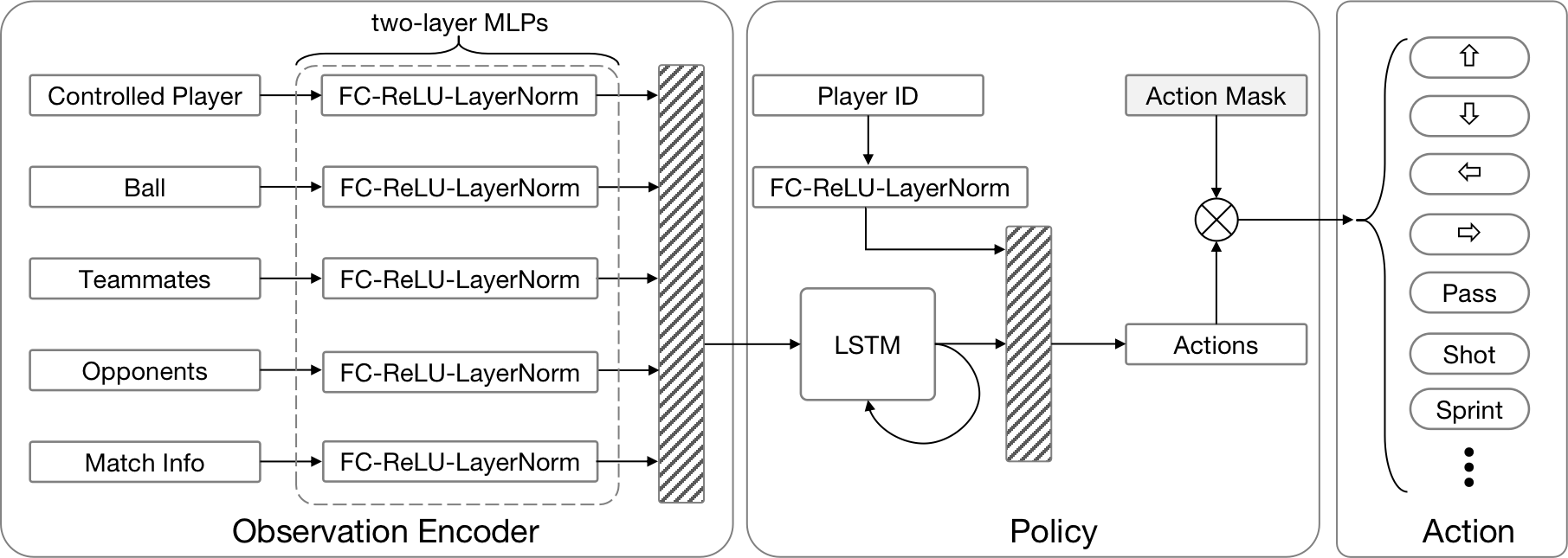
- Leverages a deep neural network architecture with shared encoder heads and individual value heads to balance parameter efficiency and policy specialization.
Experimental results
Research questions
- RQ1Can a multi-agent reinforcement learning system achieve superhuman performance in the 11 vs. 11 Google Research Football environment without expert demonstrations?
- RQ2How does adaptive curriculum learning improve training stability and sample efficiency in complex multi-agent environments?
- RQ3To what extent does the challenge-and-generalize self-play strategy enhance policy diversity and robustness compared to standard self-play?
- RQ4Can the joint-policy optimization objective significantly improve multi-agent coordination and long-term strategic planning?
- RQ5How generalizable are the proposed methodological innovations across diverse multi-agent environments beyond football?
Key findings
- TiZero achieves a win rate increase of over 30% compared to previous methods in the 11 vs. 11 Google Research Football environment, with a significant improvement in goal difference.
- The system demonstrates superior coordination, such as increased passing frequency and assist creation, compared to prior baselines.
- The challenge-and-generalize self-play strategy achieves a diversity index of 8.11 on Tic-Tac-Toe, outperforming baselines (6.65–7.19), indicating more varied and robust opponent policies.
- TiZero reduces GPU memory consumption by 38% on the 10-player GFootball setting compared to MAPPO (121 GB vs. 196 GB), demonstrating improved scalability.
- In multi-environment evaluations, TiZero outperforms or matches state-of-the-art methods on Overcooked, MPE, Tic-Tac-Toe, and Connect-Four, confirming methodological generality.
- Training curves show that TiZero converges faster and achieves higher final performance than MAPPO, MAT, and QMIX across all benchmarks, with faster wall-clock training times.
Better researchstarts right now
From reading papers to final review, dramatically reduce your research time.
No credit card · Free plan available
This review was created by AI and reviewed by human editors.