
[Paper Review] Topological classes of thermodynamics of rotating AdS black holes
This paper extends topological thermodynamics to rotating anti-de Sitter (AdS) black holes, introducing a topological invariant derived from the generalized Helmholtz free energy. It finds that the cosmological constant significantly alters topological numbers, and that the difference between AdS and asymptotically flat black hole topological invariants is always unity, suggesting a universal pattern across black hole types.
In this paper, we extend our previous work [Phys. Rev. D 107, 024024 (2023)] to the more general cases with a negative cosmological constant, and investigate the topological numbers for the singly rotating Kerr-AdS black holes in all dimensions and the four-dimensional Kerr-Newman-AdS black hole as well as the three-dimensional Bañados-Teitelboim-Zanelli black hole. We find that the topological numbers of black holes are remarkably influenced by the cosmological constant. In addition, we also demonstrate that the dimension of spacetimes has an important effect on the topological number for rotating AdS black holes. Furthermore, it is interesting to observe that the difference between the topological number of the AdS black hole and that of its corresponding asymptotically flat black hole is always unity. This new observation leads us to conjure that it might be valid also for other black holes. Of course, this novel conjecture needs to be further verified by examining the topological numbers of many other black holes and their AdS counterparts in the future work.
Motivation & Objective
- To extend topological thermodynamics from static to rotating black holes in AdS spacetime.
- To investigate how the negative cosmological constant influences topological invariants of rotating black holes.
- To examine the role of spacetime dimensionality in determining topological numbers for rotating AdS black holes.
- To test the hypothesis that the topological number of an AdS black hole exceeds that of its asymptotically flat counterpart by exactly one.
- To provide a comprehensive analysis of topological invariants across multiple black hole solutions: d-dimensional Kerr-AdS, 4D Kerr-Newman-AdS, and 3D BTZ black holes.
Proposed method
- Adapts the topological approach from Ref. PRL129-191101, treating black hole solutions as topological thermodynamic defects.
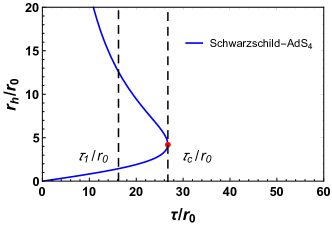
- Constructs the generalized off-shell Helmholtz free energy $\mathcal{F} = M - S/\tau $, where $\tau$ is an auxiliary variable.
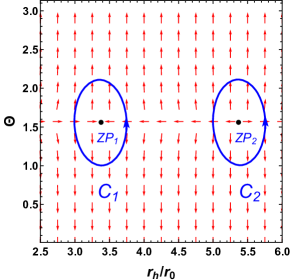
- Defines a vector field $\phi^i = \partial \mathcal{F}/\partial x^i $ in the parameter space spanned by horizon radius $r_h$, temperature $\tau$, and other thermodynamic variables.
- Computes the topological number $W$ via the Brouwer degree of the vector field, counting zero points with sign.
- Applies the method to d-dimensional singly rotating Kerr-AdS, 4D Kerr-Newman-AdS, and 3D BTZ black holes with and without electric charge.
- Uses analytical and numerical techniques to locate zero points of the vector field and compute the winding number $W$.
Experimental results
Research questions
- RQ1How does the cosmological constant affect the topological number of rotating AdS black holes?
- RQ2What is the role of spacetime dimension in determining the topological invariant of rotating AdS black holes?
- RQ3Does the topological number of a rotating AdS black hole always exceed that of its asymptotically flat counterpart by one?
- RQ4How does electric charge influence the topological number in static and rotating AdS black holes?
- RQ5Are the topological invariants of rotating AdS black holes universal constants independent of physical parameters?
Key findings
- The topological number of the four-dimensional Kerr-AdS black hole is $W = 0$, while that of the corresponding asymptotically flat Kerr black hole is $W = -1$, showing a difference of exactly one.
- For $d \geq 6$ singly rotating Kerr-AdS black holes, the topological number is $W = 1$, whereas the corresponding flat-space Kerr black holes have $W = 0$, again confirming a universal difference of one.
- The cosmological constant has a significant and non-trivial influence on the topological number of rotating AdS black holes.
- Spacetime dimension plays a crucial role: the topological number varies with dimension, especially in higher dimensions ($d \geq 6$).
- Electric charge does not alter the topological number in rotating AdS black holes (e.g., Kerr-AdS and Kerr-Newman-AdS have the same $W$), but it does affect static AdS black holes (e.g., charged BTZ has $W = 0$, neutral BTZ has $W = 1$).
- The three-dimensional charged BTZ black hole has a topological number $W = 0$, while the neutral BTZ black hole has $W = 1$, demonstrating that charge can change the topological invariant in static cases.
Better researchstarts right now
From reading papers to final review, dramatically reduce your research time.
No credit card · Free plan available
This review was created by AI and reviewed by human editors.