
[Paper Review] Topological Mixed Valence Model for Twisted Bilayer Graphene
This paper reformulates the Song–Bernevig topological heavy fermion picture of magic-angle twisted bilayer graphene as a mixed-valence Anderson lattice, analyzes high- and low-energy Kondo lattice behavior, and discusses doping- and phonon-renormalization effects on hybridization.
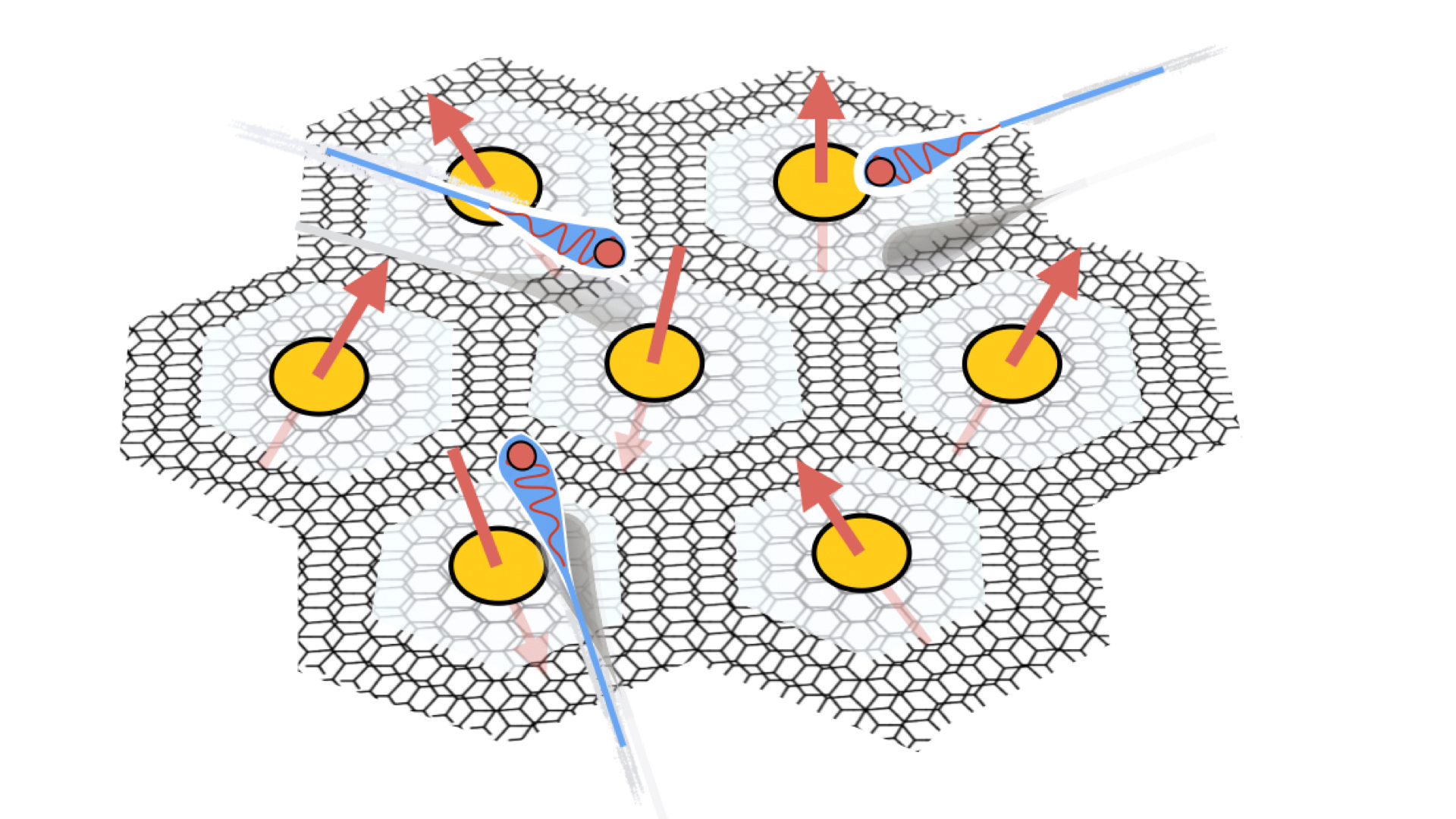
Song and Bernevig (SB) have recently proposed a topological heavy fermion description of the physics of magic angle twisted bilayer graphene (MATBG), involving the hybridization of flat band electrons with a relativistic conduction sea. We explore the consequences of this model, seeking a synthesis of understanding drawn from heavy fermion physics and MATBG experiments. We identify a key discrepancy between measured and calculated onsite Coulomb interactions, implicating renormalization effects that are not contained in the current model. With these considerations in mind, we consider an SB model with a single, renormalized onsite interaction between the f-electrons, containing a phenomenological heavy fermion binding potential on the moiré AA-sites. This feature allows the simplified model to capture the periodic reset of the chemical potential with filling and the observed stability of local moment behavior. We argue that a two stage Kondo effect will develop in MATBG as a consequence of the relativistic conduction band: Kondo I occurs at high temperatures, establishing a coherent hybridization at the $Γ$ points and a non-Fermi liquid of incoherent fermions at the moiré K-points; at much low temperatures Kondo II leads to a Fermi liquid in the flat band. Utilizing an auxiliary-rotor approach, we formulate a mean-field treatment of MATBG that captures this physics, describing the evolution of the normal state across a full range of filling factors. By contrasting the relative time-scales of phonons and valence fluctuations in bulk heavy fermion materials with that of MATBG we propose a valley-polaron origin to the Coulomb renormalization and the heavy fermion binding potential identified from experiment. We also discuss the possibility that the two-fluid, non-Fermi liquid physics of the relativistic Kondo lattice is responsible for the strange metal physics observed in MATBG.
Motivation & Objective
- Motivate a real-space, topological description of MATBG that captures local moments and symmetry anomalies.
- Reformulate the Song–Bernevig model as an Anderson lattice with valence fluctuations.
- Analyze high-energy U(8) and low-energy U(4) Kondo lattice behavior and their consequences for band structure.
- Predict how hybridization and Hubbard-band widths scale with energy and filling, and discuss renormalization effects from phonons.
Proposed method
- Start from the Song–Bernevig Hamiltonian combining localized f-like Wannier states with a topological c-band.
- Define the hybridization H_fc with strength γ0 and form factors φ^(η)(k, γ0) to connect f and c sectors.
- Map valence fluctuations to a mixed-valence (b, t) bosonic representation and derive an Anderson lattice action.
- Perform a mean-field treatment of the valence fluctuations leading to a topological Kondo lattice with SU(8) orbitals.
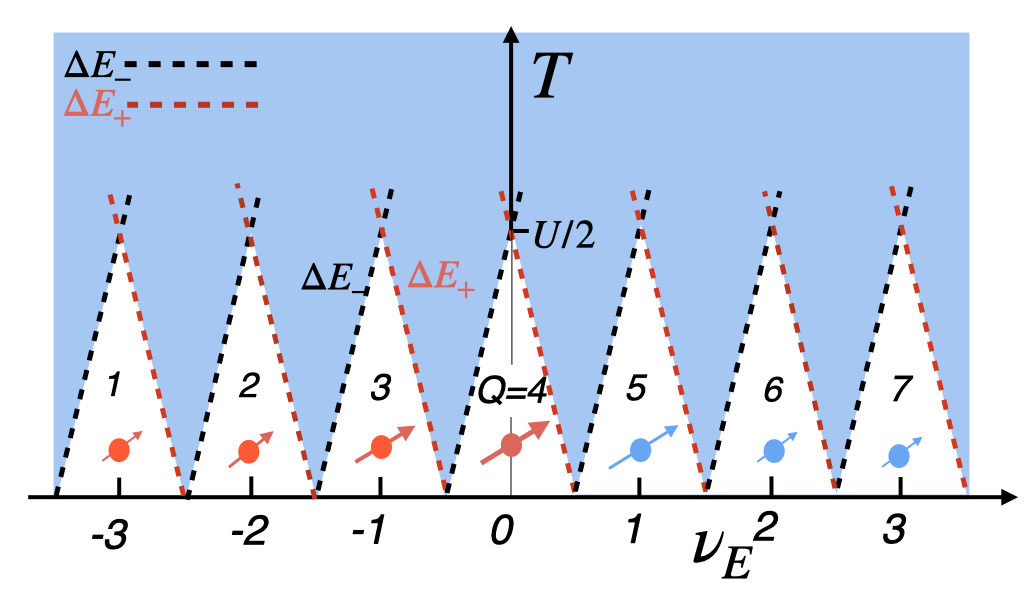
- Discuss Doniach-type competition between Kondo screening (T_K) and RKKY (T_RKKY) and outline a phase diagram around integer fillings.
Experimental results
Research questions
- RQ1Can the SB topological heavy fermion picture be recast as a mixed-valence Anderson lattice for MATBG?
- RQ2How do valence fluctuations and hybridization affect the low-energy band structure and local moment formation?
- RQ3What are the energy scales (Kondo, RKKY, Hubbard) as functions of filling, and how do they organize the phase diagram near integer fillings?
- RQ4Is the bare hybridization γ0 renormalized by phonon (polaronic) effects to account for observed local moment behavior?
- RQ5Do the high-energy (U) and low-energy (Kondo) limits map onto an SU(8) to SU(4) Kondo lattice description?
Key findings
- The interaction with the conduction sea behaves as a U(8) Kondo lattice at high energies and a U(4) Kondo lattice at low energies.
- The underlying hybridization scale and Hubbard-band widths scale linearly with energy (via μ ~ Uν and the density of states).
- Bare hybridization γ0 predicted by the SB model is too large to account for observed local moment behavior at large filling, suggesting a phonon-driven renormalization.
- A mixed-valence formulation yields a topological Kondo lattice with SU(8) composites and a tunable Kondo scale T_K that competes with RKKY interactions.
- The work anticipates a Doniach-type phase diagram with magnetic valley-spin phases, heavy Fermi liquid regions, and possible weakly coupled Song–Bernevig Fermi liquid regimes.
Better researchstarts right now
From reading papers to final review, dramatically reduce your research time.
No credit card · Free plan available
This review was created by AI and reviewed by human editors.