
[Paper Review] Toward Blockchain-based Fashion Wearables in the Metaverse: the Case of Decentraland
This study presents the first quantitative analysis of blockchain-based fashion wearables in Decentraland, revealing that most are distributed via airdrops or promotions rather than sold on the marketplace. Key findings show that rarity is the primary driver of pricing, while promotional use outweighs commercial sales, highlighting the need for rethinking economic models beyond direct monetization.
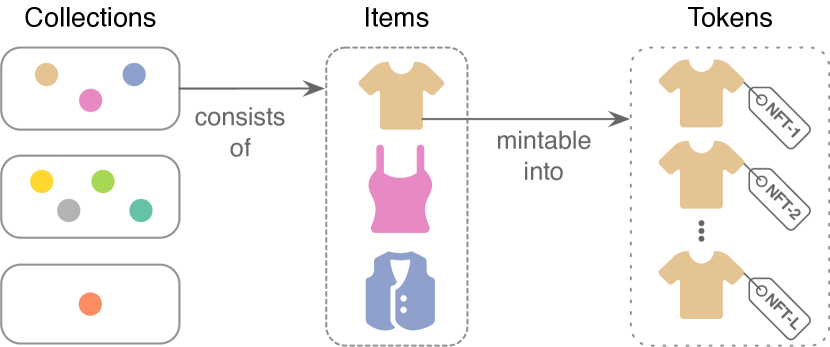
Among the earliest projects to combine the Metaverse and non-fungible tokens (NFTs) we find Decentraland, a blockchain-based virtual world that touts itself as the first to be owned by its users. In particular, the platform's virtual wearables (which allow avatar appearance customization) have attracted much attention from users, content creators, and the fashion industry. In this work, we present the first study to quantitatively characterize Decentraland's wearables, their publication, minting, and sales on the platform's marketplace. Our results indicate that wearables are mostly given away to promote and increase engagement on other cryptoasset or Metaverse projects, and only a small fraction is sold on the platform's marketplace, where the price is mainly driven by the preset wearable's rarity. Hence, platforms that offer virtual wearable NFTs should pay particular attention to the economics around this kind of assets beyond their mere sale.
Motivation & Objective
- To quantitatively characterize the publication, minting, and marketplace sales of Decentraland’s virtual fashion wearables.
- To understand the economic dynamics behind blockchain-based digital fashion assets in the Metaverse.
- To investigate whether sales or promotional distribution dominates the lifecycle of NFT wearables on the platform.
- To assess the role of rarity, collection size, and 3D model complexity in determining wearable value.
Proposed method
- Collected on-chain data on wearable minting, ownership, and marketplace transactions from Decentraland’s v2 NFT system.
- Analyzed primary and secondary sales data from Decentraland’s official marketplace and external platforms like OpenSea.
- Constructed a linear regression model to evaluate the impact of rarity, collection cardinality, and texture count on price.
- Conducted manual verification of high-minting and high-complexity items to validate distribution and promotional intent.
- Used data from Decentraland’s DAO curation process and tokenomics to contextualize minting and governance mechanisms.
- Compared findings with broader NFT and virtual world literature to position Decentraland’s wearable economy within the Metaverse ecosystem.
Experimental results
Research questions
- RQ1What is the distribution pattern of Decentraland wearables—primarily sold or given away?
- RQ2How do factors like rarity, collection size, and 3D model complexity influence the pricing of wearables?
- RQ3To what extent are wearables used for promotional purposes rather than direct monetization?
- RQ4How does the economic model of wearables in Decentraland compare to broader NFT market dynamics?
- RQ5What are the limitations of using on-chain ownership data as a proxy for actual in-world fashion usage?
Key findings
- Only 3.4% of wearable mints were conducted via primary sales on Decentraland’s marketplace, indicating that sales are not the primary distribution mechanism.
- The majority of wearables (96.6%) were distributed through airdrops or awards, primarily to promote other crypto or Metaverse projects.
- The most minted wearable, 'CCC - Hat - Gray', was distributed 99,961 times, primarily as part of a promotional campaign.
- The 'Sophia 42 - #2' wearable, with 8,657 triangles and 7 textures, was created to promote Sophia The Robot, illustrating promotional use of complex designs.
- The 'Royal Family Crown' had 7,781 primary sales at zero price plus network fees, confirming that promotional value often outweighs monetary gain.
- Rarity was the most significant factor in pricing, followed by collection size and number of textures, with rarity being the strongest predictor in the linear model.
Better researchstarts right now
From reading papers to final review, dramatically reduce your research time.
No credit card · Free plan available
This review was created by AI and reviewed by human editors.