
[Paper Review] Towards Co-Creative Generative Adversarial Networks for Fashion Designers
This paper proposes a co-creative framework for fashion designers using Generative Adversarial Networks (GANs) by integrating mixed-initiative co-creation principles with GANs' latent space manipulation. It introduces five interaction patterns—Exploring, Evolving, Conditioning, Rewriting, and Stylistic Steering—enabling iterative, intentional human-AI collaboration in fashion design, with a focus on enhancing creative agency and diversity through adaptive, interactive GAN interfaces.
Originating from the premise that Generative Adversarial Networks (GANs) enrich creative processes rather than diluting them, we describe an ongoing PhD project that proposes to study GANs in a co-creative context. By asking How can GANs be applied in co-creation, and in doing so, how can they contribute to fashion design processes? the project sets out to investigate co-creative GAN applications and further develop them for the specific application area of fashion design. We do so by drawing on the field of mixed-initiative co-creation. Combined with the technical insight into GANs' functioning, we aim to understand how their algorithmic properties translate into interactive interfaces for co-creation and propose new interactions.
Motivation & Objective
- To investigate how Generative Adversarial Networks (GANs) can be meaningfully applied in co-creative fashion design processes, moving beyond passive generation to active collaboration.
- To address the knowledge gap between non-expert users and complex GAN architectures by developing interactive interfaces grounded in algorithmic insights and human perception.
- To explore how GANs can evolve beyond static conditioning by enabling dynamic, iterative interaction patterns such as Rewriting, where the model learns from human feedback.
- To examine the implications of GANs' latent space entanglement and non-linear semantics for creative control and diversity in fashion design outputs.
- To support inclusive design by enabling fashion designers to critically assess and influence data biases in training datasets, particularly regarding body diversity and representation.
Proposed method
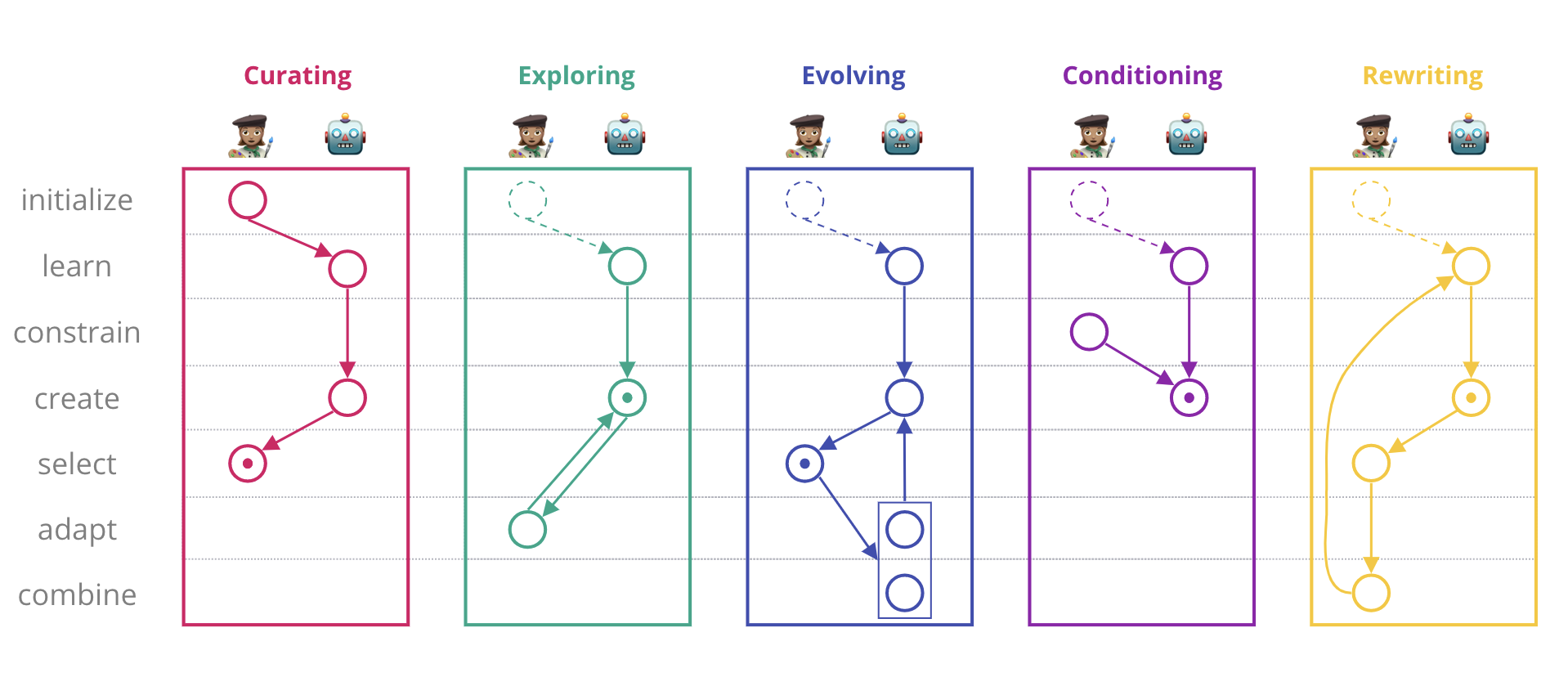
- Adopting mixed-initiative co-creation as a theoretical framework, the study maps GAN-based interactions into five distinct patterns: Exploring, Evolving, Conditioning, Rewriting, and Stylistic Steering.
- Leveraging latent space interpolation and disentanglement techniques (e.g., perceptual path length, linear separability), the method enables interactive navigation and semantic editing of generated fashion designs.
- Integrating conditional generation via text, sketches, and loss-based constraints (e.g., color, texture, shape) to allow designers to guide GAN outputs with high-level design intent.
- Proposing 'Rewriting' as a novel pattern where GAN weights are fine-tuned based on human feedback, enabling the AI to adapt its behavior during co-creation over time.
- Using tools like GANLab and interactive genetic algorithms to prototype and evaluate high-dimensional latent space exploration in low- and high-resolution design contexts.
- Incorporating style recognition models to enable unsupervised style discovery and steering, potentially revealing machine-specific interpretations of fashion aesthetics.
Experimental results
Research questions
- RQ1How can GANs be structured to support iterative, interactive co-creation in fashion design, rather than one-way generation?
- RQ2What are the algorithmic and interface design requirements for enabling intentional, conscious human-AI collaboration in fashion design?
- RQ3How do GAN-specific properties—such as latent space entanglement and non-linear semantics—translate into tangible interaction patterns for designers?
- RQ4In what ways can GANs be adapted during co-creation (e.g., via weight updates) to reflect designer preferences and evolve over time?
- RQ5How can GAN-based co-creation systems be designed to support diversity and inclusivity in fashion design, particularly regarding body forms and cultural representation?
Key findings
- The study identifies five distinct interaction patterns—Exploring, Evolving, Conditioning, Rewriting, and Stylistic Steering—that structure human-AI collaboration in GAN-based fashion design.
- Latent space interpolation and disentanglement techniques enable designers to navigate and manipulate fashion designs through perceptual paths, offering a form of interactive exploration.
- The 'Rewriting' pattern, where GAN weights are updated based on human feedback, introduces a new mode of co-creation in which the AI learns from the designer’s input over time.
- Conditional generation via text, sketches, or loss functions allows for high-level design constraints, though such approaches remain limited to one-way conditioning without iterative feedback.
- Stylistic steering using unsupervised style recognition models may reveal machine-specific interpretations of fashion, suggesting new forms of AI-driven aesthetic understanding.
- The research highlights the importance of addressing data bias in training datasets to ensure diverse and inclusive design outcomes, particularly in silhouette and body form representation.
Better researchstarts right now
From reading papers to final review, dramatically reduce your research time.
No credit card · Free plan available
This review was created by AI and reviewed by human editors.