
[Paper Review] Towards LLM-based Fact Verification on News Claims with a Hierarchical Step-by-Step Prompting Method
This paper proposes a Hierarchical Step-by-Step (HiSS) prompting method that enhances LLM-based fact verification by decomposing complex news claims into subclaims and verifying each via step-by-step reasoning with external search. Evaluated on RAWFC and LIAR datasets, HiSS outperforms fully-supervised state-of-the-art models by 4.95% in macro F1 and generates more accurate, readable, and comprehensive explanations than existing baselines.
While large pre-trained language models (LLMs) have shown their impressive capabilities in various NLP tasks, they are still under-explored in the misinformation domain. In this paper, we examine LLMs with in-context learning (ICL) for news claim verification, and find that only with 4-shot demonstration examples, the performance of several prompting methods can be comparable with previous supervised models. To further boost performance, we introduce a Hierarchical Step-by-Step (HiSS) prompting method which directs LLMs to separate a claim into several subclaims and then verify each of them via multiple questions-answering steps progressively. Experiment results on two public misinformation datasets show that HiSS prompting outperforms state-of-the-art fully-supervised approach and strong few-shot ICL-enabled baselines.
Motivation & Objective
- To investigate the effectiveness of in-context learning (ICL) with large language models (LLMs) for news claim verification.
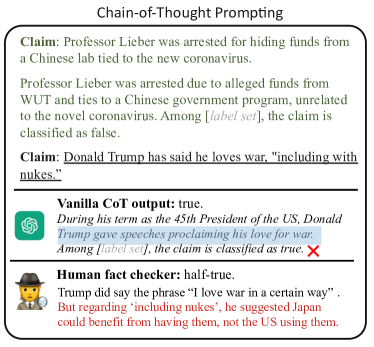
- To address key limitations of vanilla Chain-of-Thought (CoT) prompting—such as thought omission and fact hallucination—in the context of misinformation.
- To design a hierarchical prompting framework that enables fine-grained, step-by-step verification of news claims using LLMs.
- To improve both accuracy and explainability of LLM-based fact verification through structured reasoning and external evidence retrieval.
Proposed method
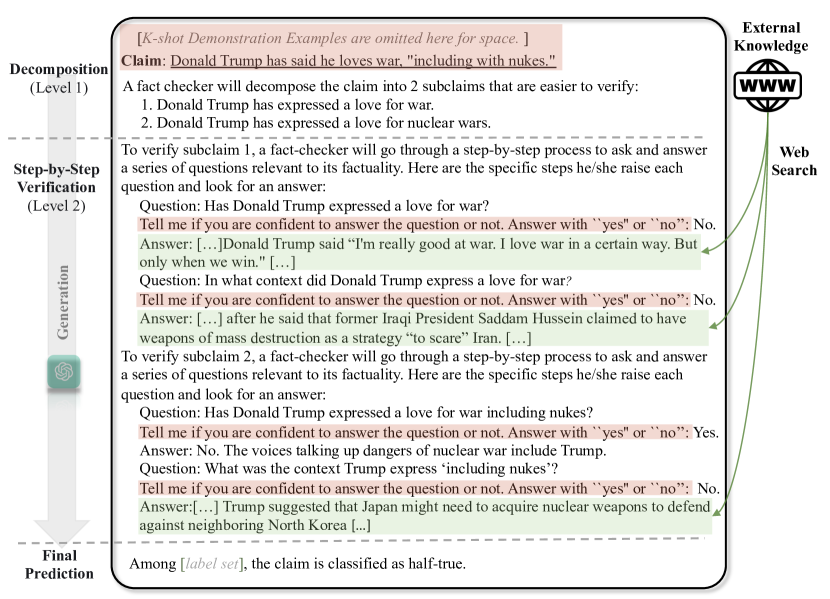
- The HiSS prompting method consists of two stages: claim decomposition and subclaim verification.
- In claim decomposition, the LLM is prompted to split a complex claim into smaller, logically independent subclaims.
- For each subclaim, the LLM performs step-by-step verification using a chain-of-thought reasoning process.
- External evidence is retrieved via search engines to ground reasoning and reduce hallucination.
- The method uses few-shot in-context learning with four demonstration examples to guide the LLM without fine-tuning.
- Human-annotated explanations are used to evaluate the quality and coherence of generated reasoning chains.
Experimental results
Research questions
- RQ1Can few-shot in-context learning with LLMs achieve performance comparable to fully-supervised models in news claim verification?
- RQ2Why does vanilla Chain-of-Thought prompting underperform compared to standard prompting in fact verification?
- RQ3Can hierarchical decomposition of claims improve reasoning completeness and reduce hallucination in LLM-based verification?
- RQ4To what extent does integrating external search enhance the factual consistency and accuracy of LLM-generated explanations?
- RQ5How does the explainability of HiSS-generated reasoning compare to human-written explanations and existing automatic baselines?
Key findings
- With only four-shot demonstrations, LLMs using in-context learning achieve performance comparable to strong supervised models on news claim verification.
- Vanilla Chain-of-Thought prompting underperforms due to omission of key claim components and generation of hallucinated facts.
- The HiSS prompting method improves macro F1 by 4.95% on average over state-of-the-art fully-supervised models on two benchmark datasets.
- Human evaluation shows that HiSS-generated explanations are more readable and comprehensive than those from the CofCED baseline, with coverage scores nearly matching human-written explanations.
- HiSS explanations achieve higher readability and non-redundancy than the CofCED model, though they still fall slightly short of gold-standard human explanations.
- The method effectively reduces fact hallucination by grounding reasoning in external search results, though performance depends on the availability of indexed information.
Better researchstarts right now
From reading papers to final review, dramatically reduce your research time.
No credit card · Free plan available
This review was created by AI and reviewed by human editors.