
[Paper Review] Towards LogiGLUE: A Brief Survey and A Benchmark for Analyzing Logical Reasoning Capabilities of Language Models
This paper introduces LogiGLUE, a comprehensive benchmark comprising 24 diverse logical reasoning datasets spanning deductive, abductive, and inductive reasoning, standardized into Seq2Seq tasks for consistent training and evaluation. It proposes LogiT5, a fine-tuned model that achieves strong performance across in-domain and out-of-domain reasoning tasks, with knowledge distillation from chain-of-thought reasoning significantly improving generalization when using 15K training samples.
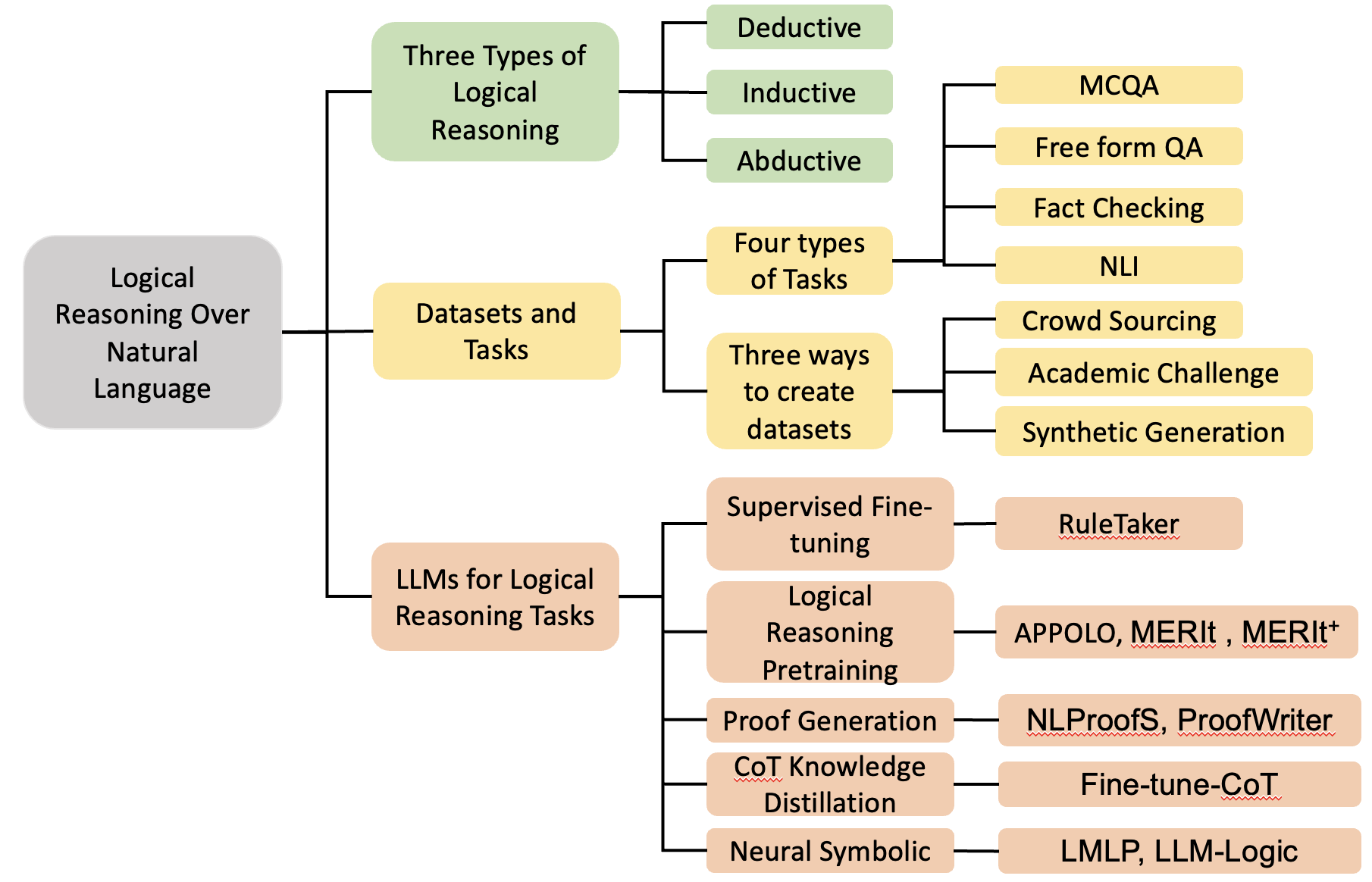
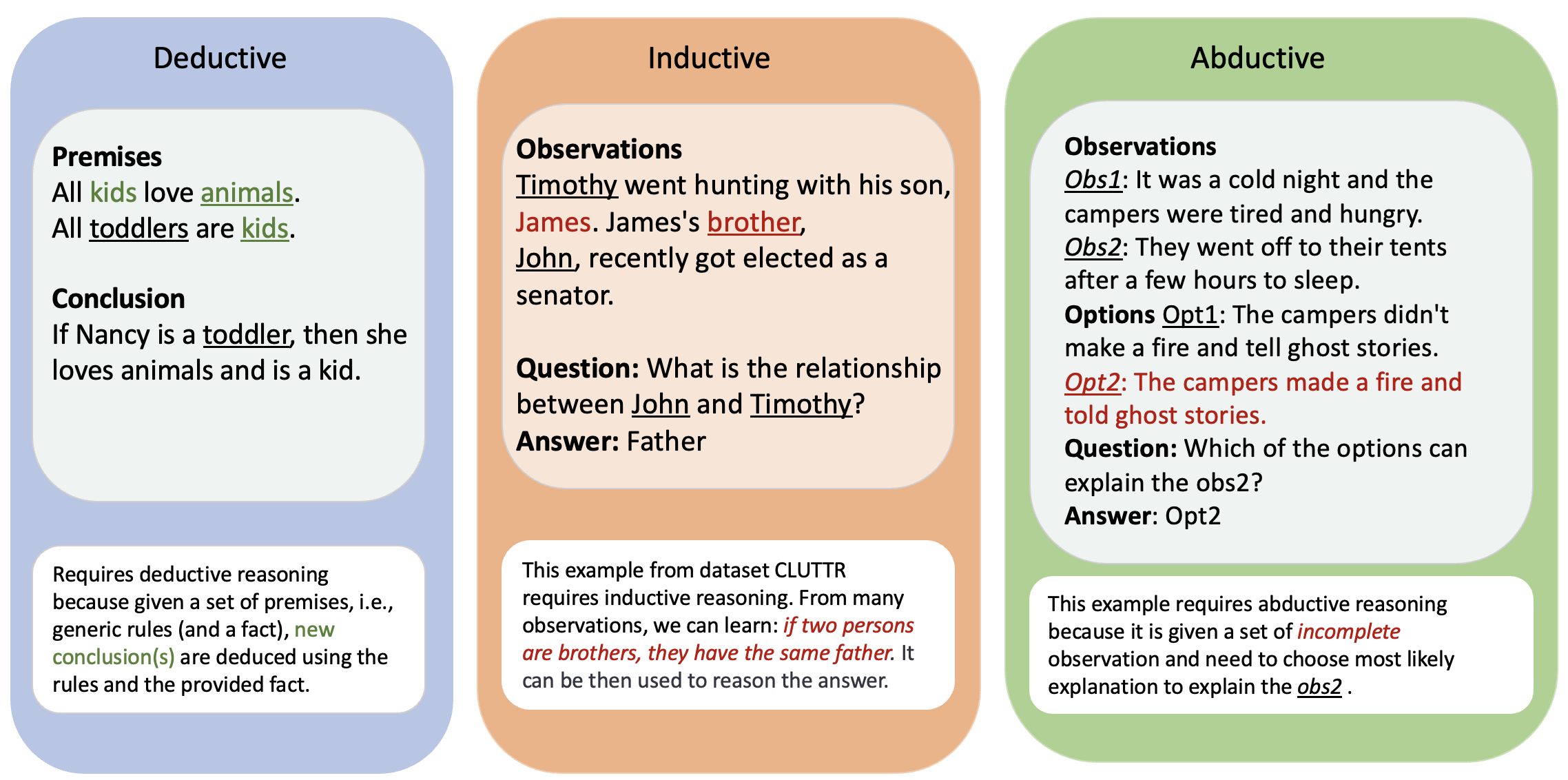
Logical reasoning is fundamental for humans yet presents a substantial challenge in the domain of Artificial Intelligence. Initially, researchers used Knowledge Representation and Reasoning (KR) systems that did not scale and required non-trivial manual effort. Recently, the emergence of large language models (LLMs) has demonstrated the ability to overcome various limitations of formal Knowledge Representation (KR) systems. Consequently, there's a growing interest in using LLMs for logical reasoning via natural language. This work strives to understand the proficiency of LLMs in logical reasoning by offering a brief review of the latest progress in this area; with a focus on the logical reasoning datasets, tasks, and the methods adopted to utilize LLMs for reasoning. To offer a thorough analysis, we have compiled a benchmark titled LogiGLUE. This includes 24 varied datasets encompassing deductive, abductive, and inductive reasoning. Utilizing LogiGLUE as a foundation, we have trained an instruction fine-tuned language model, resulting in LogiT5. We study single-task training, multi-task training, and "chain-of-thought" knowledge distillation fine-tuning technique to assess the performance of model across the different logical reasoning categories. We also assess various LLMs using LogiGLUE, and the findings indicate that LLMs excel most in abductive reasoning, followed by deductive reasoning, while they are least effective at inductive reasoning. We aim to shed light on the capabilities and potential pathways for enhancing logical reasoning proficiency in LLMs, paving the way for more advanced and nuanced developments in this critical field.
Motivation & Objective
- To assess the current state of logical reasoning capabilities in large language models (LLMs) through a systematic survey of existing datasets, tasks, and methodologies.
- To address the lack of standardized evaluation benchmarks for logical reasoning in LLMs by creating LogiGLUE, a unified benchmark integrating 24 diverse datasets.
- To improve LLM reasoning performance through instruction fine-tuning and knowledge distillation techniques, particularly chain-of-thought prompting.
- To evaluate generalization capabilities of LLMs on out-of-domain reasoning tasks, identifying limitations in zero-shot inference.
- To provide open-source access to the LogiGLUE benchmark and LogiT5 model to accelerate future research in logical reasoning.
Proposed method
- The authors compiled 24 existing logical reasoning datasets into a unified Seq2Seq format to standardize training and evaluation across diverse reasoning types, including deductive, abductive, and inductive reasoning.
- They fine-tuned the Flan-T5 model on LogiGLUE using single-task, multi-task, and chain-of-thought (CoT) knowledge distillation strategies to assess performance across reasoning categories.
- For CoT distillation, they generated reasoning traces from LLaMA-7B on the LogiQA dataset, selecting samples with correct answers to create 3K, 6K, and 15K training sets for distillation.
- They employed a higher initial learning rate (3e-4) and longer training (40 epochs) to stabilize training during CoT fine-tuning, observing improved performance with larger CoT data volumes.
- To evaluate out-of-domain generalization, they used zero-shot prompting with 'let’s think step by step' and applied ConceptNet to match synonyms in LLaMA-2 outputs for evaluation.
- They evaluated model performance on in-domain (LogiGLUE) and out-of-domain datasets, including ReClor, Winogrande, BigBench, and PrOntoQA-OOD, using exact match and synonym-based matching for LLaMA-2.
Experimental results
Research questions
- RQ1Can large language models generalize logical reasoning skills across diverse, out-of-domain datasets, and what are the limitations of their zero-shot capabilities?
- RQ2How effective is chain-of-thought knowledge distillation in improving logical reasoning performance, and does model performance scale with the size of the distilled CoT training data?
- RQ3Does multi-task fine-tuning on LogiGLUE improve reasoning performance compared to single-task or no-fine-tuning baselines?
- RQ4To what extent do LLMs rely on memorization or retrieval of known facts rather than genuine logical inference, especially in out-of-distribution settings?
- RQ5How do different prompting strategies, such as 'let’s think step by step', affect reasoning performance across models like Flan-T5 and LLaMA-2?
Key findings
- LogiT5 achieved an average accuracy of 51.24% on the in-domain LogiGLUE benchmark, demonstrating strong performance across diverse reasoning types.
- Out-of-domain generalization was limited: LLaMA-2 achieved only 6.50% on PrOntoQA-OOD and 15.54% on WaNLI, indicating poor zero-shot reasoning on unseen tasks.
- Chain-of-thought distillation improved performance by 4% when using 15K CoT samples, showing that larger, high-quality reasoning data enhances model generalization.
- CoT distillation with 3K and 6K samples did not improve performance over baseline fine-tuning, suggesting that data quantity is critical for distillation gains.
- Flan-T5 outperformed LLaMA-2 on structured benchmarks due to its instruction-tuned, template-based generation style, which facilitated more reliable evaluation.
- Manual analysis revealed that LLaMA-2 often generated synonym-based answers or ignored input, indicating reliance on memorized knowledge rather than reasoning from context.
Better researchstarts right now
From reading papers to final review, dramatically reduce your research time.
No credit card · Free plan available
This review was created by AI and reviewed by human editors.