
[Paper Review] Towards Openness Beyond Open Access: User Journeys through 3 Open AI Collaboratives
The paper analyzes three open AI collaboratives—BigScience, The Turing Way, and Mozilla Festival’s Building Trustworthy AI Working Group—to map their community structures and user journeys from discovery to leadership, highlighting how open collaboratives broaden participation in AI.
Open Artificial Intelligence (Open source AI) collaboratives offer alternative pathways for how AI can be developed beyond well-resourced technology companies and who can be a part of the process. To understand how and why they work and what additionality they bring to the landscape, we focus on three such communities, each focused on a different kind of activity around AI: building models (BigScience workshop), tools and ways of working (The Turing Way), and ecosystems (Mozilla Festival's Building Trustworthy AI Working Group). First, we document the community structures that facilitate these distributed, volunteer-led teams, comparing the collaboration styles that drive each group towards their specific goals. Through interviews with community leaders, we map user journeys for how members discover, join, contribute, and participate. Ultimately, this paper aims to highlight the diversity of AI work and workers that have come forth through these collaborations and how they offer a broader practice of openness to the AI space.
Motivation & Objective
- Understand how open AI collaboratives are organized and governed in practice.
- Map how members discover, join, contribute, and lead within three distinct communities.
- Identify how these initiatives broaden participation and democratize AI beyond traditional tech companies.
Proposed method
- Qualitative analysis of three open AI communities using published materials (GitHub, Hugging Face Hub, meeting notes) to document structures and activities.
- Interviews with community leaders to understand explicit and implicit governance and member experience.
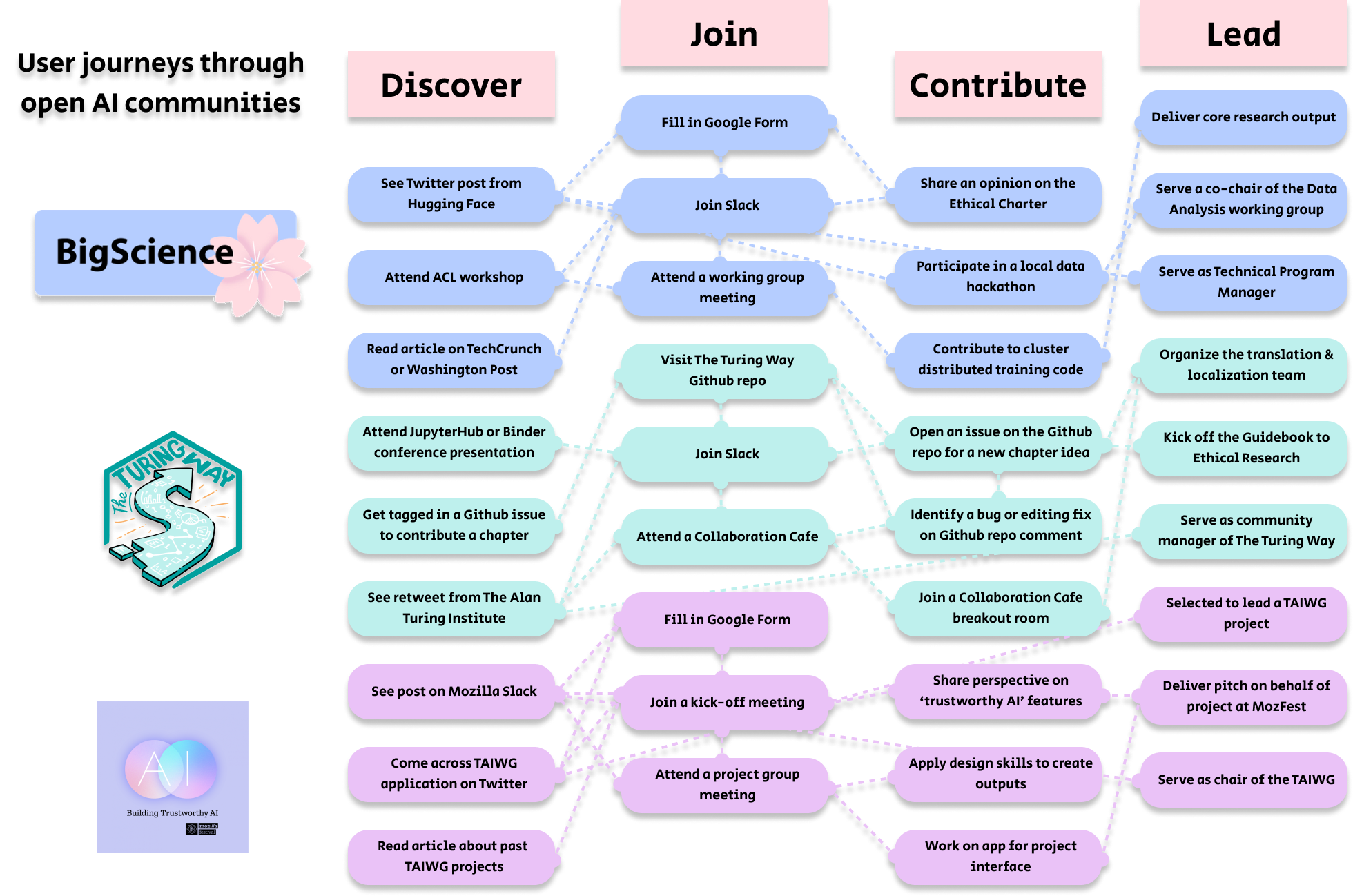
- Comparative mapping of member journeys across discovery, joining, contributing, and leading.
Experimental results
Research questions
- RQ1How are the three open AI communities structured to enable distributed, volunteer-led work?
- RQ2What are the typical user journeys for members from discovery to leadership within these communities?
- RQ3In what ways do these communities diversify participation and broaden the AI ecosystem beyond traditional organizations?
Key findings
- BigScience, The Turing Way, and MozFest TAIWG each enable open participation through digital doorways and public materials.
- Discovery often relies on reputation of organizations and prominent members, with diversification efforts to reach broader membership.
- Joining is facilitated by open channels but may involve lurker participation before active contribution.
- Contribution is guided by community-specific entry points and may require pairing with experienced members in some cases.
- Leadership pathways arise through formal roles, project ownership, or invitation, with recognition and infrastructure support.
- These collaboratives collectively demonstrate diverse models of open AI work and offer a template for broader, inclusive AI collaboration.
Better researchstarts right now
From paper design to paper writing, dramatically reduce your research time.
No credit card · Free plan available
This review was created by AI and reviewed by human editors.