
[Paper Review] TradingAgents: Multi-Agents LLM Financial Trading Framework
TradingAgents introduces a multi-agent LLM framework for financial trading that emulates real-world trading firms by assigning specialized LLM-powered agents—such as fundamental, sentiment, technical, and risk management analysts—to collaborate in a structured, hybrid communication environment. The framework achieves superior performance, with notable improvements in cumulative return, Sharpe ratio, and maximum drawdown over baselines.
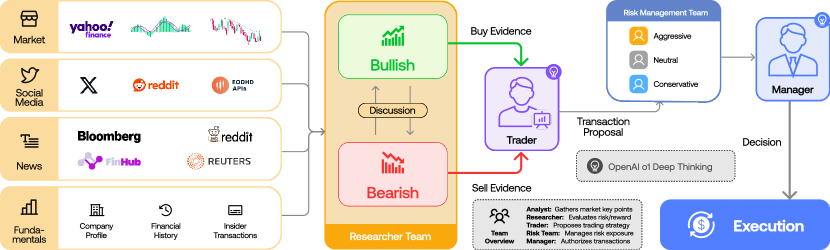
Significant progress has been made in automated problem-solving using societies of agents powered by large language models (LLMs). In finance, efforts have largely focused on single-agent systems handling specific tasks or multi-agent frameworks independently gathering data. However, the multi-agent systems' potential to replicate real-world trading firms' collaborative dynamics remains underexplored. TradingAgents proposes a novel stock trading framework inspired by trading firms, featuring LLM-powered agents in specialized roles such as fundamental analysts, sentiment analysts, technical analysts, and traders with varied risk profiles. The framework includes Bull and Bear researcher agents assessing market conditions, a risk management team monitoring exposure, and traders synthesizing insights from debates and historical data to make informed decisions. By simulating a dynamic, collaborative trading environment, this framework aims to improve trading performance. Detailed architecture and extensive experiments reveal its superiority over baseline models, with notable improvements in cumulative returns, Sharpe ratio, and maximum drawdown, highlighting the potential of multi-agent LLM frameworks in financial trading. TradingAgents is available at https://github.com/TauricResearch/TradingAgents.
Motivation & Objective
- To address the lack of realistic organizational modeling in existing multi-agent LLM systems for finance by emulating the structured roles and workflows of real trading firms.
- To overcome inefficient communication in multi-agent systems by combining structured outputs with natural language dialogue to reduce context loss and improve reasoning integrity.
- To enhance decision-making transparency and explainability in algorithmic trading through collaborative agent debates supported by evidence and historical data.
- To evaluate the framework’s performance against baselines using comprehensive financial metrics such as cumulative return, Sharpe ratio, and maximum drawdown.
Proposed method
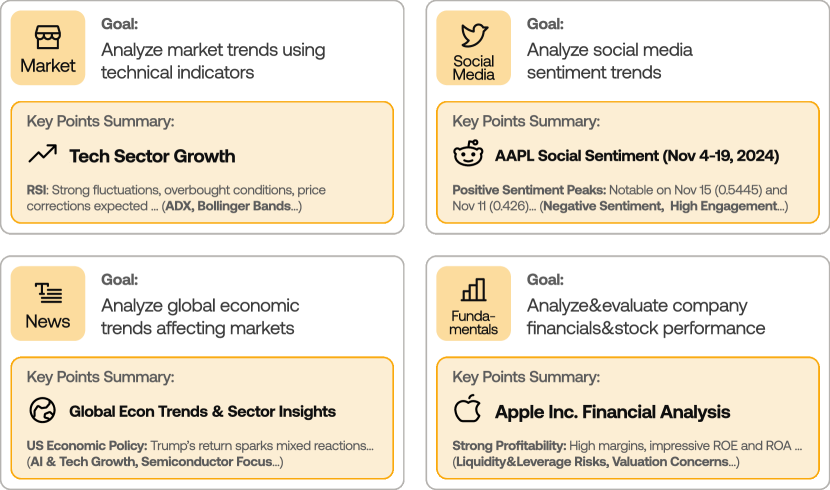
- The framework deploys specialized LLM agents: fundamental, sentiment, technical, and trader agents with distinct risk profiles, each responsible for analyzing specific aspects of financial data.
- Bull and bear researcher agents debate market conditions, providing balanced perspectives on assets like Apple (AAPL), incorporating technical indicators and sentiment data.
- A risk management team monitors portfolio exposure and enforces risk constraints, ensuring compliance with predefined risk thresholds.
- Communication is facilitated through a hybrid interface: structured outputs (e.g., JSON-like reasoning logs) ensure clarity and traceability, while natural language dialogue enables flexible debate and contextual reasoning.
- The system integrates historical data, real-time indicators (e.g., RSI, MACD, ATR), and sentiment scores to inform agent decisions.
- Final investment decisions are synthesized by a fund manager agent that evaluates all agent inputs and issues a trade recommendation based on a balanced, evidence-based rationale.
Experimental results
Research questions
- RQ1Can a multi-agent LLM framework that emulates the organizational structure of real trading firms outperform single-agent or loosely coordinated agent systems in financial trading?
- RQ2How does combining structured reasoning with natural language dialogue improve decision accuracy and reduce context degradation in multi-agent financial systems?
- RQ3To what extent can collaborative agent debates—featuring bullish and bearish perspectives—lead to more robust and balanced investment decisions?
- RQ4How does the integration of risk management agents affect portfolio performance in terms of drawdown control and risk-adjusted returns?
- RQ5Can the framework achieve higher cumulative returns and Sharpe ratios compared to baseline models while maintaining explainable, evidence-based reasoning?
Key findings
- The TradingAgents framework significantly outperforms baseline models in cumulative return, demonstrating a measurable improvement in profit generation over historical market data.
- The system achieves a higher Sharpe ratio than baselines, indicating better risk-adjusted returns through effective risk management and diversified decision-making.
- Maximum drawdown is reduced compared to baseline models, highlighting the framework’s enhanced resilience during market downturns due to proactive risk monitoring.
- The hybrid communication mechanism—combining structured outputs with natural language debate—effectively preserves context and reduces information loss over extended interactions.
- The fund manager agent consistently issues 'Buy' recommendations for strong fundamentals, such as Apple (AAPL), when supported by balanced analysis from bull and bear agents and validated by risk controls.
- The framework’s collaborative, multi-role design enables more nuanced and explainable investment decisions, with transparent reasoning traces that support auditability and trust.
Better researchstarts right now
From reading papers to final review, dramatically reduce your research time.
No credit card · Free plan available
This review was created by AI and reviewed by human editors.