
[Paper Review] Trapped Imbalanced Quantum Droplets
This paper investigates how isotropic harmonic traps modify the ground states and breathing modes of imbalanced two-component quantum droplets in ultracold Bose gases. Using mean-field and Lee-Huang-Yang corrections, it shows that trap strength controls imbalance stability: low-frequency traps preserve initial imbalance after release, while high-frequency traps cause core density reversal and imbalance inversion, enabling robust free-space imbalanced droplets via trap release.
A two-component quantum droplet is an attractive mixture of ultracold bosons stabilised against collapse by quantum fluctuations. Commonly, two-component quantum droplets are studied within a balanced mixture. However, the mixture can be imbalanced resulting in a lower energy but less stably bound droplet, or even a droplet submerged in a gas. This work focuses on the experimentally relevant question: how are imbalanced droplets modified by harmonic trap potentials? Droplet ground states and breathing modes are analysed across the two-dimensional parameter space of imbalance and trap strength. The robustness of the droplet imbalance is also studied by releasing the droplet from the trap, demonstrating that this can lead to the creation of free-space, imbalanced droplets.
Motivation & Objective
- To understand how isotropic harmonic traps modify the ground states and breathing modes of imbalanced two-component quantum droplets.
- To investigate the stability of imbalanced droplet configurations under trap release, relevant to experimental realizations.
- To determine whether free-space imbalanced droplets can be created and stabilized using trap-release protocols.
- To analyze the role of trap frequency and population imbalance in shaping droplet structure and dynamics.
- To extend prior free-space studies of imbalanced droplets to the experimentally relevant trapped regime.
Proposed method
- Formulates a zero-temperature energy functional combining kinetic energy, trap potentials, mean-field (MF) interactions, and Lee-Huang-Yang (LHY) beyond-mean-field corrections.
- Solves the Gross-Pitaevskii-type equations derived from the energy functional to obtain ground state wavefunctions under isotropic harmonic confinement.
- Performs time-evolution simulations of perturbed ground states to extract breathing mode frequencies and decay rates.
- Applies an instantaneous trap release protocol to simulate experimental conditions and analyze post-release dynamics.
- Analyzes chemical potential divergence and density profiles to characterize imbalance evolution and core reversal.
- Compares results with prior free-space studies to isolate the effects of trapping on droplet structure and stability.
Experimental results
Research questions
- RQ1How does the application of an isotropic harmonic trap alter the ground state structure of imbalanced quantum droplets?
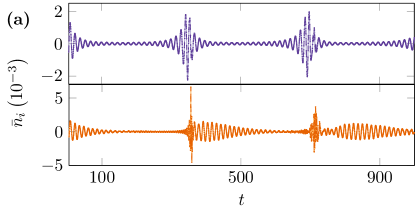
- RQ2How do breathing mode frequencies and decay rates in trapped imbalanced droplets compare to those in free space?
- RQ3What happens to the population imbalance when an imbalanced droplet is released from a harmonic trap into free space?
- RQ4Can the trap release protocol generate stable, free-space imbalanced droplets with preserved or inverted imbalance?
- RQ5How does increasing trap frequency affect the stability and reversal of the droplet's core imbalance?
Key findings
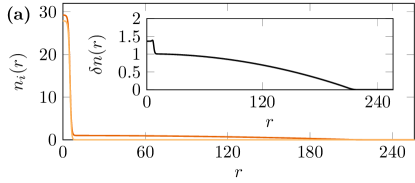
- The trap squeezes unbound majority-component atoms toward the droplet surface, increasing surface gas density and enhancing chemical potential divergence.
- For low trap frequencies, the initial imbalance is preserved after trap release, indicating robustness to expansion.
- At high trap frequencies, the imbalance is lost or even reversed, with the core density of the majority component decreasing significantly.
- Core density reversal occurs even when the majority component still contains more total atoms, indicating a reconfiguration into a stable excited state with atoms at the surface.
- The imbalance reversal can be suppressed by increasing the initial imbalance, i.e., by enhancing the surrounding gas density.
- The presence of a significant majority-component gas reduces the decay rate of breathing modes, improving mode visibility in experiments.
Better researchstarts right now
From reading papers to final review, dramatically reduce your research time.
No credit card · Free plan available
This review was created by AI and reviewed by human editors.