
[Paper Review] TuRMoiL of Survival: A Unified Survival Criterion for Cloud-Wind Interactions
This paper proposes a new unified survival criterion for clouds in hot supersonic winds, based on comparing the shear timescale of hot wind fluid elements crossing the cloud to the maximum cooling timescale of the mixed gas. The criterion resolves long-standing discrepancies in prior models by using physically consistent timescales and accurately predicts cloud survival in hydrodynamic simulations with high wind/cloud density contrasts.
Cloud-wind interactions play an important role in long-lived multiphase flows in many astrophysical contexts. When this interaction is primarily mediated by hydrodynamics and radiative cooling, the survival of clouds can be phrased in terms of the comparison between a timescale that dictates the evolution of the cloud-wind interaction, (the dynamical time-scale $τ_{ m dyn}$) and the relevant cooling timescale $τ_{ m cool}$. Previously proposed survival criteria, which can disagree by large factors about the size of the smallest surviving clouds, differ in both their choice of $τ_{ m cool}$ and (to a lesser extent) $τ_{ m dyn}$. Here we present a new criterion which agrees with a previously proposed empirical formulae but is based on simple physical principles. The key insight is that clouds can grow if they are able to mix and cool gas from the hot wind faster than it advects by the cloud. Whereas prior criteria associate $τ_{ m dyn}$ with the cloud crushing timescale, our new criterion links it to the characteristic cloud-crossing timescale of a hot-phase fluid element, making it more physically consistent with shear-layer studies. We develop this insight into a predictive expression and validate it with hydrodynamic ENZO-E simulations of ${\sim}10^4\, { m K}$, pressure-confined clouds in hot supersonic winds, exploring, in particular, high wind/cloud density contrasts, where disagreements are most pronounced. Finally, we illustrate how discrepancies among previous criteria primarily emerged due to different choices of simulation conditions and cooling properties, and discuss how they can be reconciled.
Motivation & Objective
- To resolve long-standing disagreements in cloud survival criteria for pressure-confined clouds in hot supersonic winds.
- To identify the physically correct dynamical timescale for cloud-wind interactions, replacing the cloud-crushing timescale with the cloud-crossing timescale of hot-phase fluid elements.
- To define a cooling timescale that is physically consistent with turbulent radiative mixing layer (TRML) entrainment and phase-dependent cooling.
- To validate the new criterion against enzo-e hydrodynamic simulations across high density contrasts.
- To reconcile discrepancies among prior criteria by tracing them to differences in simulation conditions and cooling prescriptions.
Proposed method
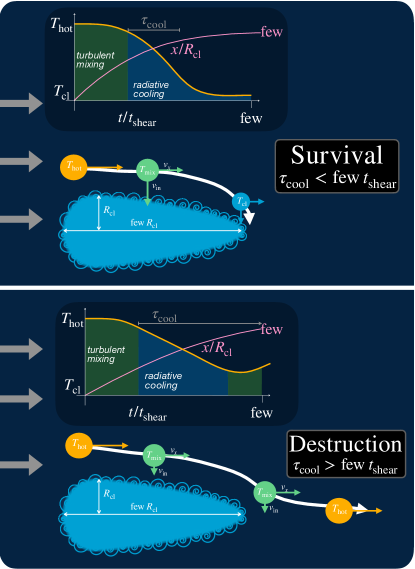
- Proposes a new survival criterion based on comparing the shear timescale $ t_{\rm shear} $, representing the time for a hot wind fluid element to cross the cloud, to the maximum cooling timescale $ t_{\rm cool,max} $ of the mixed gas.
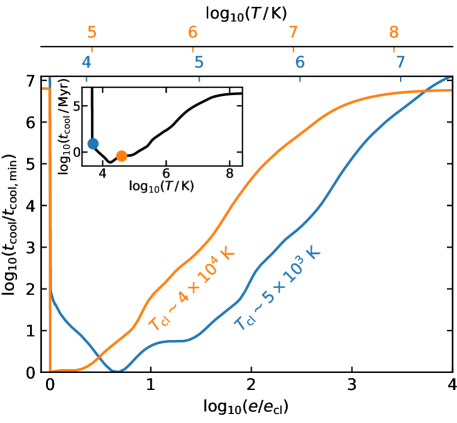
- Defines $ t_{\rm cool,max} $ as the maximum of the cooling timescale between the cloud temperature $ T_{\rm cl} $ and the minimum temperature $ T_{\rm min,cool} $ reached in the mixing layer.
- Uses a physically motivated $ \tau_{\rm dyn} $ derived from shear-layer dynamics, rather than the cloud-crushing timescale used in prior works.
- Validates the criterion using high-resolution enzo-e simulations of $ \sim 10^4 \, \text{K} $, pressure-confined clouds in hot supersonic winds with $ \chi \sim 10^4 $.
- Employs a phase-dependent cooling function with a floor at $ T_{\rm min,cool} = \max(T_{\rm cl}, \, 10^{4.25} \, \text{K}) $ to model realistic cooling in the mixing layer.
- Compares the new criterion to prior empirical and theoretical survival criteria, showing agreement with observed simulation outcomes and resolving discrepancies.
Experimental results
Research questions
- RQ1What is the physically correct dynamical timescale for cloud-wind interactions in turbulent radiative mixing layers?
- RQ2How should the cooling timescale be defined in multiphase flows to accurately predict cloud survival?
- RQ3Why do prior survival criteria disagree significantly in their predictions for the minimum surviving cloud size?
- RQ4Can a single, physically motivated criterion reproduce the accuracy of empirically calibrated survival criteria?
- RQ5How do differences in simulation setup and cooling prescriptions explain discrepancies among existing survival criteria?
Key findings
- The new criterion, based on $ t_{\rm shear} \gtrsim t_{\rm cool,max} $, accurately predicts cloud survival in enzo-e simulations with high wind/cloud density contrasts ($ \chi \sim 10^4 $).
- The criterion resolves discrepancies among prior works by showing they arise from inconsistent choices of $ \tau_{\rm dyn} $ and $ \tau_{\rm cool} $, not from fundamental physical differences.
- The shear timescale $ t_{\rm shear} $, derived from hot-phase fluid crossing, is more physically consistent with shear-layer studies than the cloud-crushing timescale.
- The maximum cooling timescale $ t_{\rm cool,max} $, evaluated between $ T_{\rm cl} $ and $ T_{\rm min,cool} $, provides a robust and physically grounded cooling timescale.
- The criterion performs well even in extreme conditions, such as $ T_{\rm cl} \gtrsim 10^4 \, \text{K} $, where previous criteria fail or require unphysical cloud sizes.
- The criterion is consistent with results from Farber & Gronke (2022) on cold clouds ($ \sim 10^3 \, \text{K} $), suggesting broader applicability to cold phases in starburst outflows.
Better researchstarts right now
From reading papers to final review, dramatically reduce your research time.
No credit card · Free plan available
This review was created by AI and reviewed by human editors.