
[Paper Review] Ultracool Dwarfs Observed with the Spitzer Infrared Spectrograph: Equatorial Latitudes in L Dwarf Atmospheres are Cloudier
This study provides direct observational evidence that dust cloud opacity in L dwarf atmospheres is higher at equatorial latitudes than at polar latitudes, using Spitzer IRS mid-infrared spectra and spin axis inclination measurements. A strong positive correlation between viewing geometry and silicate absorption strength confirms that equator-on views show more opaque clouds, explaining spectral diversity in ultracool dwarfs and supporting atmospheric circulation models.
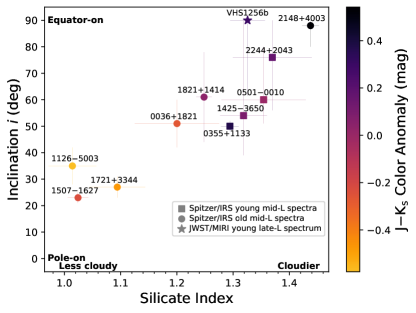
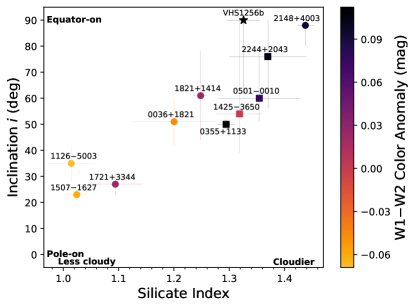
We report direct observational evidence for a latitudinal dependence of dust cloud opacity in ultracool dwarfs, indicating that equatorial latitudes are cloudier than polar latitudes. These results are based on a strong positive correlation between the viewing geometry and the mid-infrared silicate absorption strength in mid-L dwarfs using mid-infrared spectra from the Spitzer Space Telescope and spin axis inclination measurements from available information in the literature. We confirmed that the infrared color anomalies of L dwarfs positively correlate with dust cloud opacity and viewing geometry, where redder objects are inclined equator-on and exhibit more opaque dust clouds while dwarfs viewed at higher latitudes and with more transparent clouds are bluer. These results show the relevance of viewing geometry to explain the appearance of brown dwarfs and provide insight into the spectral diversity observed in substellar and planetary atmospheres. We also find a hint that dust clouds at similar latitudes may have higher opacity in low-surface gravity dwarfs than in higher-gravity objects.
Motivation & Objective
- To investigate whether dust cloud opacity in L dwarf atmospheres varies with latitude, particularly comparing equatorial and polar regions.
- To determine the role of viewing geometry in shaping observed infrared colors and spectral features in ultracool dwarfs.
- To test predictions from atmospheric circulation models that equatorial regions should have higher cloud opacity due to upwelling and weather patterns.
- To examine the influence of surface gravity on cloud opacity, especially comparing low- and high-gravity dwarfs.
- To provide observational confirmation of the link between silicate absorption strength and viewing inclination in mid-L dwarfs.
Proposed method
- Analysis of mid-infrared spectra from the Spitzer Infrared Spectrograph (IRS) for 10 mid-L dwarfs, focusing on the 9–13 μm silicate absorption feature.
- Measurement of the silicate index as a proxy for cloud opacity, derived from reprocessed Spitzer IRS data (Suárez & Metchev, 2022).
- Incorporation of spin axis inclination values from the literature (Vos et al., 2017, 2018, 2020) to determine viewing geometry (equator-on vs. pole-on).
- Statistical correlation analysis between silicate index (cloud opacity) and inclination angle to assess latitudinal dependence.
- Classification of objects by surface gravity (γ classification and kinematic membership to young moving groups) to compare low- vs. high-gravity cloud properties.
- Use of 2MASS and WISE photometry to validate spectral types and color anomalies, supporting the interpretation of cloud opacity variations.
Experimental results
Research questions
- RQ1Is there a measurable latitudinal variation in dust cloud opacity in L dwarf atmospheres, with higher opacity at the equator compared to the poles?
- RQ2To what extent does viewing geometry—specifically inclination angle—affect the observed strength of mid-infrared silicate absorption in L dwarfs?
- RQ3How do cloud opacity and spectral diversity in ultracool dwarfs relate to atmospheric circulation patterns predicted by models?
- RQ4Does surface gravity influence the opacity of dust clouds at similar latitudes, with low-gravity objects showing more opaque clouds than high-gravity ones?
- RQ5Can the observed infrared color anomalies in L dwarfs be explained by a combination of viewing geometry and variable cloud opacity?
Key findings
- A strong positive correlation was found between viewing inclination and silicate absorption strength, with equator-on views (lower inclination angles) showing significantly stronger silicate absorption (e.g., 1.44 ± 0.01 for J2148+4003 at 88° inclination).
- Objects viewed at higher latitudes (e.g., J1507-1627 at 23° inclination) exhibited weaker silicate absorption (1.02 ± 0.02), indicating lower cloud opacity at poles.
- The results confirm that redder L dwarfs (bluer in near-IR) are viewed closer to equator-on, while bluer objects are viewed closer to pole-on, linking color anomalies directly to viewing geometry.
- Low-surface gravity dwarfs (γ-classified) showed a hint of higher cloud opacity at similar latitudes compared to high-gravity objects, suggesting gravity-dependent sedimentation effects.
- The observed spectral diversity in L dwarfs is primarily explained by viewing geometry and latitudinal cloud opacity variations, consistent with atmospheric circulation models.
- The findings support the use of mid-infrared spectroscopy with JWST to further probe cloud structure and gravity effects in substellar and exoplanetary atmospheres.
Better researchstarts right now
From reading papers to final review, dramatically reduce your research time.
No credit card · Free plan available
This review was created by AI and reviewed by human editors.