
[Paper Review] Ultrashort dissipative Raman solitons in Kerr resonators driven with phase-coherent optical pulses
This paper demonstrates deterministic generation of ultrashort dissipative Raman solitons with sub-100 fs durations in standard telecom fiber Kerr resonators via phase-coherent pulsed driving. By exploiting the intrinsic Raman gain in fused silica and precise dispersion management, the authors achieve record-short pulses while maintaining sub-GHz repetition rates, enabling scalable, chip-compatible frequency combs with customizable line spacing.
External driving of passive, nonlinear optical resonators has emerged over the past decade as a novel route for the generation of ultrashort optical pulses and corresponding broadband frequency combs. Whilst the pulse formation dynamics in such systems differ dramatically from those manifesting themselves in conventional mode-locked lasers, the demarcation between the two traditionally distinct paradigms has recently begun to blur, with demonstrations of hybrid systems incorporating both external driving and active media shown to offer specific advantages. Here we explore a new pathway for ultrashort pulse generation at the interface of externally-driven passive resonators and lasers. By leveraging the nonlinear Raman gain inherent to fused silica, we achieve deterministic generation of low-noise dissipative solitons with durations well below 100 fs via phase-coherent pulsed driving of resonators made of standard, commercially-available optical fibre. We explore and explain the physics of the new dissipative Raman soliton states, identifying scaling laws that govern the pulses' characteristics and that allow output repetition rates to be scaled at will without influencing the soliton duration. The scheme explored in our work enables the shortest ever pulses generated in resonators (active or passive) made from a single commercially-available optical fibre, and it has the potential to be transferred into a chip-scale format by using existing dispersion-engineered silica microresonators.
Motivation & Objective
- To overcome the fundamental trade-off between ultrashort pulse duration and low repetition rate in passive Kerr resonators.
- To leverage intrinsic Raman gain in fused silica to enable deterministic, low-noise soliton formation without active gain media.
- To demonstrate that soliton duration is decoupled from repetition rate through scaling laws, enabling flexible comb design.
- To establish a pathway for chip-scale integration using dispersion-engineered silica microresonators.
- To bridge the gap between externally driven passive resonators and conventional mode-locked lasers by introducing a hybrid Raman-dissipative soliton mechanism.
Proposed method
- Utilized phase-coherent pulsed pumping at the round-trip time of a standard single-mode fiber resonator to excite dissipative solitons.
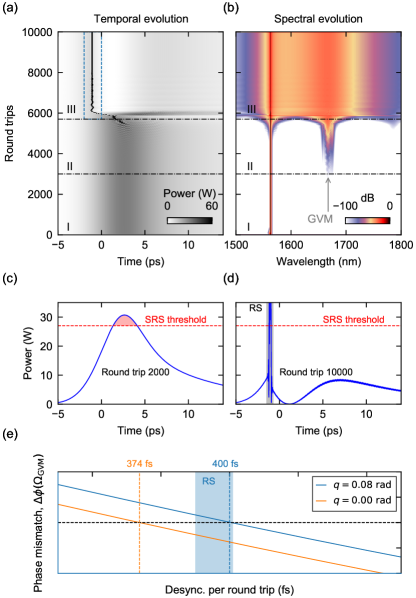
- Exploited the intrinsic stimulated Raman scattering (SRS) gain in fused silica to provide nonlinear amplification without external gain media.
- Engineered the resonator's dispersion to achieve group-velocity matching and enable stable, phase-locked soliton operation.
- Applied the generalized Lugiato-Lefever equation (GLE) in dimensionless form to model soliton dynamics, with key parameters including desynchronization $d_1$, normalized timescale $ au_s$, and third-order dispersion $d_3$.
- Used numerical simulations to identify that soliton characteristics depend primarily on $ au_s$ and $ au_R$ (Raman response timescale), not detuning or driving amplitude.
- Validated experimental results through comparison with simulations, confirming deterministic soliton formation and pulse duration scaling.
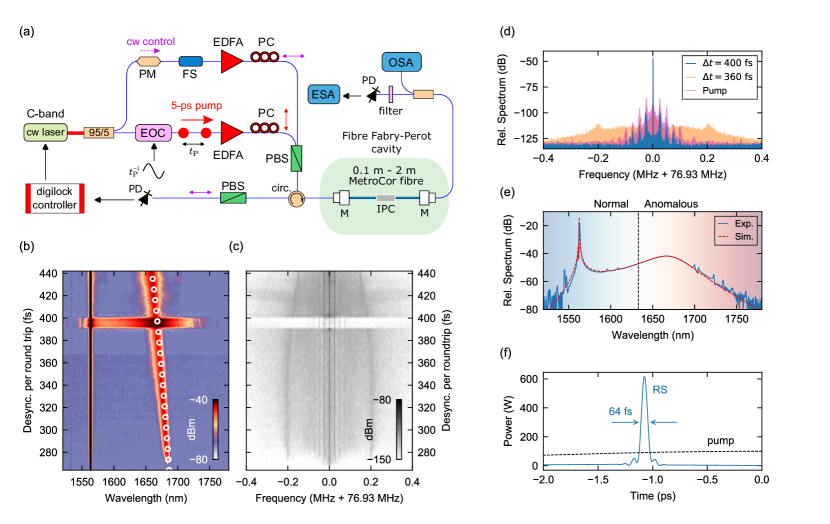
Experimental results
Research questions
- RQ1Can intrinsic Raman gain in fused silica enable the generation of ultrashort dissipative solitons in standard fiber resonators without active gain?
- RQ2How does phase-coherent pulsed driving influence soliton coherence and duration compared to conventional synchronously pumped Raman oscillators?
- RQ3To what extent can soliton duration be decoupled from repetition rate through dispersion and pump timing control?
- RQ4What scaling laws govern the pulse duration and stability of Raman solitons in this system?
- RQ5Can this mechanism be transferred to chip-scale microresonators for integrated frequency comb applications?
Key findings
- The authors achieved dissipative Raman solitons with full-width at half-maximum (FWHM) pulse durations below 100 fs in standard telecom fiber resonators, representing the shortest pulses ever generated in such systems.
- Pulse duration is independent of repetition rate, as demonstrated by scaling laws showing that soliton characteristics depend only on $ au_s$ and $ au_R$, enabling arbitrary repetition rate tuning without changing pulse width.
- The system exhibits deterministic, high-fidelity soliton formation due to phase-coherent pumping and group-velocity matching, overcoming the low coherence and broad pulses typical of earlier Raman oscillator designs.
- Simulations confirm that the Raman response function $ ilde{ au}_R$ and normalized timescale $ au_s$ are the dominant parameters governing soliton width and stability.
- The scheme is scalable to chip-scale silica microresonators, as the underlying physics and scaling laws are compatible with dispersion-engineered integrated platforms.
- The method enables the generation of broadband frequency combs with fine line spacing (sub-GHz), suitable for applications such as dual-comb spectroscopy, while maintaining ultrashort pulse characteristics.
Better researchstarts right now
From reading papers to final review, dramatically reduce your research time.
No credit card · Free plan available
This review was created by AI and reviewed by human editors.