
[Paper Review] Ultraviolet Compactness of High-Redshift Galaxies as a Tracer of Early-Stage Gas Infall, Bursty Star Formation, and Offset from the Fundamental Metallicity Relation
This study uses JWST NIRSpec/NIRCam data to probe how compactness relates to metallicity offset from the local FMR in z>3 galaxies, finding mild FMR evolution and a link between compactness and metal deficiency that supports stochastic, inside-out early star formation.
The empirical anti-correlation between gas-phase metallicity and star formation rate (SFR) at a fixed stellar mass, known as the fundamental metallicity relation (FMR), is commonly interpreted as an equilibrium state in the interplay between gas infall, enrichment, and gas removal. JWST/NIRSpec spectroscopy has shown a $z>3$ deviation from the local-universe FMR calibrations, suggesting that these galaxies are potentially caught out of equilibrium. To investigate this, we inferred the stellar population, nebular, and morphological properties of 427 galaxies at $310^9M_{\odot}$ galaxies exhibit negligible redshift evolution. We also confirm the redshift evolution of the FMR: $z>3$ galaxies appear metal-deficient compared to expectations for their stellar mass and SFR according to the local-universe FMR. This offset grows with redshift. Metal deficiency is correlated with compactness: galaxies most offset from the average mass-size relation are also the most metal-poor for their stellar mass and SFR. We interpret this as a product of bursty star formation: compact galaxies exhibit elevated SFR surface densities, indicating that they are observed during burst episodes triggered by gas infall. While accretion of metal-poor gas has reduced their gas-phase metallicity by diluting the interstellar medium, they are observed prior to chemical yield release by newly formed massive stars. Simply, they are chemically out of equilibrium compared to the equilibrium state known as the FMR.
Motivation & Objective
- Explain the redshift evolution of the mass-metallicity relation beyond z≈3 and test the applicability of the fundamental metallicity relation (FMR) at high redshift.
- Investigate whether more compact high-redshift galaxies are more metal-deficient and offset from local FMR calibrations.
- Measure rest-UV sizes and the mass-size relation for z>4 galaxies and assess its evolution with redshift.
- Assess whether compactness correlates with FMR offsets to infer early-stage gas accretion and stochastic star formation modes.
Proposed method
- Compile a sample of 427 z>3 galaxies with both NIRSpec prism spectroscopy and NIRCam photometry (334 from public programs + 93 from JADES).
- Measure rest-UV sizes using galight with WebbPSF PSFs to ensure consistency across the sample.
- Infer stellar masses, SFRs, and metallicities via SED fitting (prospector/FSPS) and emission-line analyses (pPXF with MILES library).
- Use R23 and O32 diagnostics, guided by EW(Hβ) as a proxy for ISM ionization, to derive gas-phase metallicities and resolve metallicity degeneracies.
- Assess redshift evolution of the FMR by predicting metallicities from stellar mass and SFR via the Andrews & Martini (2013) calibration translated to Chabrier IMF (via Nakajima et al. 2023).
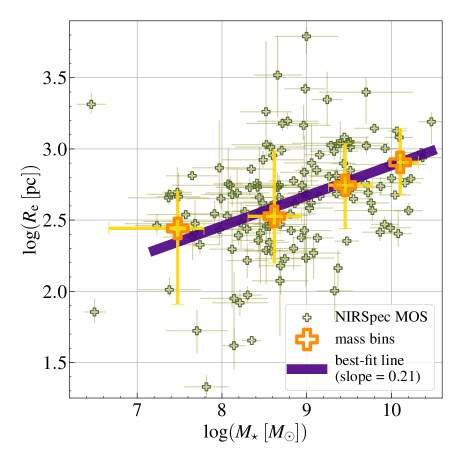
- Quantify galaxy compactness as κ log(M*) − log(Re) with κ fixed to the mass-size slope found (0.21).
Experimental results
Research questions
- RQ1Does the fundamental metallicity relation evolve mildly at z>4, and how do high-z metallicities compare to FMR predictions?
- RQ2Is there a robust anti-correlation between galaxy compactness and gas-phase metallicity at z>3, indicating early-stage gas accretion?
- RQ3What is the redshift evolution of the mass-size relation for z=4–10 galaxies, and how does this evolution depend on stellar mass?
- RQ4Do compact, low-metallicity, high-SFR systems support an inside-out, stochastic star-formation scenario for the earliest galaxies?
Key findings
- There is mild redshift evolution of the fundamental metallicity relation offsets for z>3 galaxies when using local FMR calibrations.
- The mass-size relation at z=4–10 has a best-fit power-law slope of 0.21 ± 0.04.
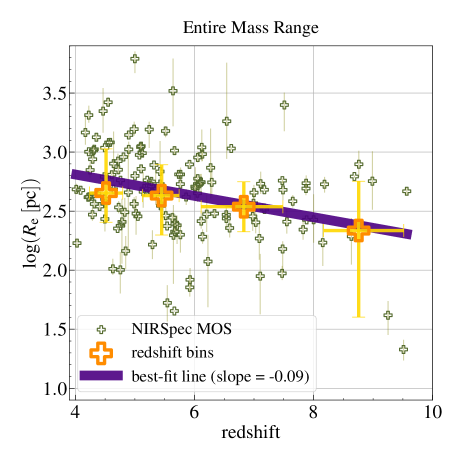
- Galaxies become more compact at higher redshift at fixed stellar mass, with a size–redshift relation slope of −0.090 ± 0.02.
- More compact galaxies at a fixed mass tend to be more metal-deficient and more offset from the local FMR calibration, showing a linear FMR-offset vs compactness trend with slope −0.35 ± 0.11 and intercept −0.56 ± 0.09.
- The analysis supports an inside-out, bursty star-formation picture for the earliest galaxies, with rapid, central accretion driving compact, low-metallicity cores.
Better researchstarts right now
From paper design to paper writing, dramatically reduce your research time.
No credit card · Free plan available
This review was created by AI and reviewed by human editors.