
[Paper Review] Understanding and Facilitating Mental Health Help-Seeking of Young Adults: A Socio-technical Ecosystem Framework
This study proposes a Socio-technical Ecosystem Framework that categorizes mental health resources into four hierarchical levels—societal, community, interpersonal, and technological—and identifies three support mechanisms: care-giving, care-mediating, and care-outreaching. The framework reveals two types of support systems (single- and multi-resource) and maps diverse pathways to care, while identifying barriers at each level, offering actionable design implications for mental health technologies.
Prior research on young adults' mental health help-seeking mostly focuses on one particular resource such as a mobile app or digital platform, paying less attention to their lived experiences interacting with the ecosystem of resources. We conducted in-depth interviews with 18 participants about their help-seeking and non-help-seeking experiences. Guided by Social Ecological Theory, we proposed a Socio-technical Ecosystem Framework for mental health care, consisting of four levels of resources, including technological-, interpersonal-, community-, and societal level resources. Using this framework, we identified two types of support systems for help-seeking, single-resource support system and multi-resource support system. These resources support young adults' help-seeking via three mechanisms, extit{care-giving}, extit{care-mediating}, and extit{care-outreaching}, forming various pathways to care. We then pointed out the barriers to resource use at each level and the general challenges in finding a support system. Our findings contributed to a conceptual framework to categorize mental health care. It also serves as a practical framework to identify challenges in the pathways to care and discover design implications.
Motivation & Objective
- Address the gap in understanding young adults’ mental health help-seeking beyond isolated digital tools by examining their lived experiences within a broader ecosystem of resources.
- Investigate why mental health technology adoption remains low despite increasing availability of digital interventions.
- Develop a comprehensive conceptual framework to categorize and analyze the complex pathways young adults take to access mental health support.
- Identify barriers to help-seeking at multiple levels—societal, community, interpersonal, and technological—and understand systemic challenges in forming stable support systems.
- Provide design implications for mental health technologies that align with real-world user practices and ecological validity.
Proposed method
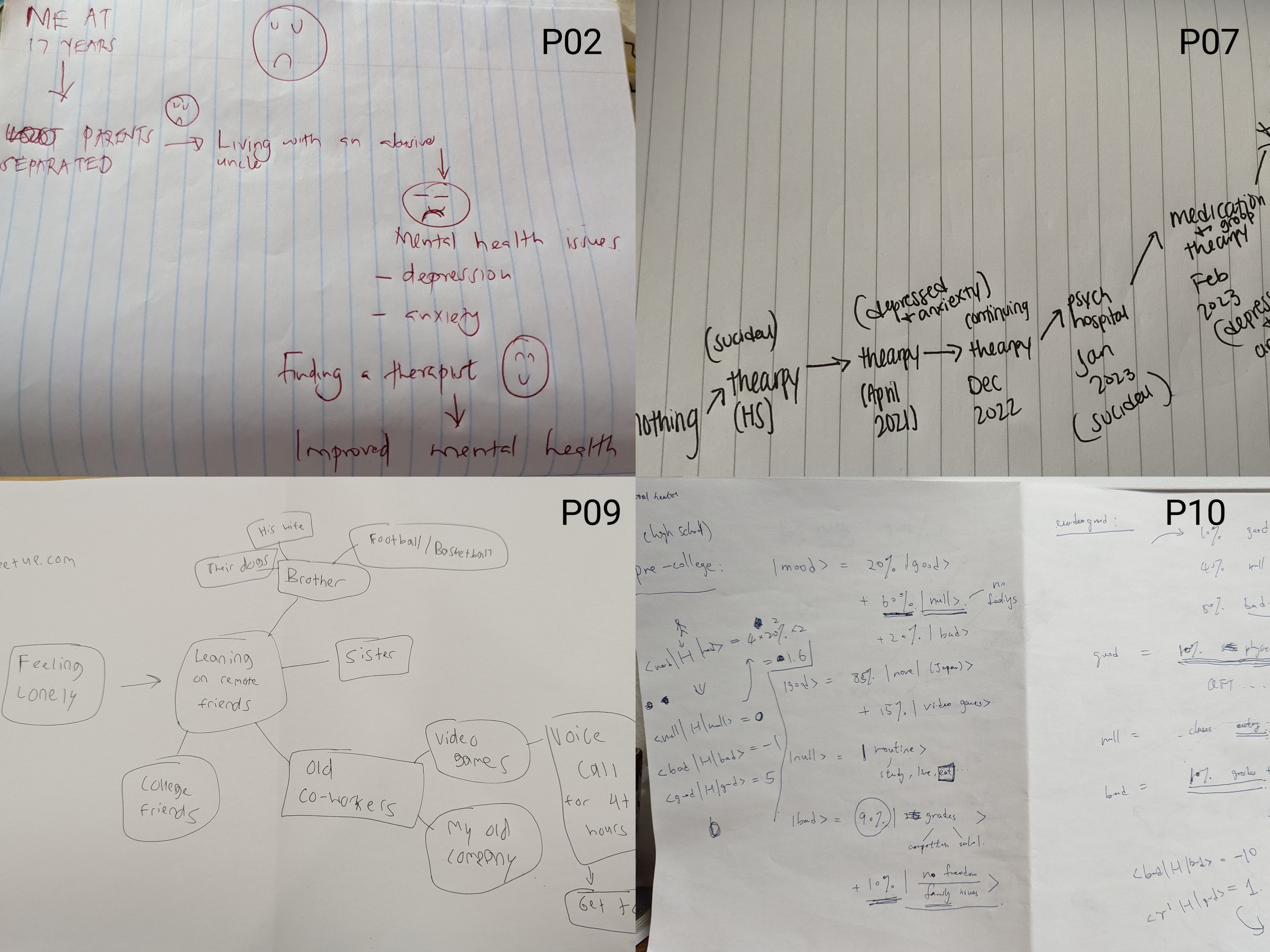
- Conducted in-depth, semi-structured interviews with 18 young adults experiencing varying mental health concerns to explore their help-seeking and non-help-seeking practices.
- Applied Social Ecological Theory as the foundational theoretical lens to analyze interactions across multiple levels of influence in mental health help-seeking.
- Developed a four-level socio-technical ecosystem framework: technological, interpersonal, community, and societal resources, each contributing to care pathways.
- Identified and analyzed three support mechanisms: care-giving (direct support), care-mediating (facilitating access), and care-outreaching (proactive outreach).
- Mapped diverse pathways to care by tracing how participants navigated combinations of resources across levels and mechanisms.
- Used iterative data analysis to classify support systems as single-resource or multi-resource and to identify barriers at each level.
Experimental results
Research questions
- RQ1What are young adults’ resource use practices when seeking help for their mental health concerns?
- RQ2What are the barriers to young adults’ mental health help-seeking across different levels of the socio-technical ecosystem?
- RQ3How do different combinations of resources form stable or unstable support systems in the help-seeking process?
- RQ4What roles do care-giving, care-mediating, and care-outreaching mechanisms play in shaping pathways to mental health care?
Key findings
- Young adults navigate a complex ecosystem of resources spanning technological tools, interpersonal relationships, community services, and societal structures, with no single resource type dominating their help-seeking journey.
- Two distinct types of support systems emerged: single-resource systems (relying on one type of support, e.g., friends or apps) and multi-resource systems (integrating multiple sources), with the latter showing greater stability and effectiveness.
- The three mechanisms—care-giving, care-mediating, and care-outreaching—were observed in participants’ narratives, with care-giving (e.g., emotional support from friends) and care-mediating (e.g., referrals from counselors) being more commonly used than care-outreaching (e.g., proactive alerts from apps).
- Barriers to help-seeking were identified at all four levels: societal (stigma, lack of mental health literacy), community (inadequate access to services), interpersonal (lack of trust or intimacy), and technological (poor usability, low engagement with apps).
- Only 10.1–13.8% of surveyed students had used digital mental health tools, indicating low real-world adoption despite technological availability.
- Low-tech interventions such as text messages, social media posts, and search engine results were more effective in raising awareness and prompting help-seeking than high-tech apps, especially in urgent or low-resource contexts.

Better researchstarts right now
From reading papers to final review, dramatically reduce your research time.
No credit card · Free plan available
This review was created by AI and reviewed by human editors.