
[Paper Review] Understanding Stokes drift mechanism via crest and trough phase estimates
This paper provides a unified mathematical framework to understand Stokes drift by parameterizing fluid particle motion using the Lagrangian phase θ, enabling exact asymptotic solutions for pathline equations in both 1D sound waves and 2D water waves. It quantifies that particles spend more time and experience greater velocity in the crest phase than in the trough phase, leading to a net forward drift—providing the first second-order-accurate estimates of time duration, displacement, and average velocity in crest and trough phases across different wave types.
By providing mathematical estimates, this paper answers a fundamental question -- "what leads to Stokes drift"? Although overwhelmingly understood for water waves, Stokes drift is a generic mechanism that stems from kinematics and occurs in any non-transverse wave in fluids. To showcase its generality, we undertake a comparative study of the pathline equation of sound (1D) and intermediate-depth water (2D) waves. Although we obtain a closed-form solution $\mathbf{x}(t)$ for the specific case of linear sound waves, a more generic and meaningful approach involves the application of asymptotic methods and expressing variables in terms of the Lagrangian phase $θ$. We show that the latter reduces the 2D pathline equation of water waves to 1D. Using asymptotic methods, we solve the respective pathline equation for sound and water waves, and for each case, we obtain a parametric representation of particle position $\mathbf{x}(θ)$ and elapsed time $t(θ)$. Such a parametric description has allowed us to obtain second-order-accurate expressions for the time duration, horizontal displacement, and average horizontal velocity of a particle in the crest and trough phases. All these quantities are of higher magnitude in the crest phase in comparison to the trough, leading to a forward drift, i.e. Stokes drift. We also explore particle trajectory due to second-order Stokes waves and compare it with linear waves. While finite amplitude waves modify the estimates obtained from linear waves, the understanding acquired from linear waves is generally found to be valid.
Motivation & Objective
- To resolve fundamental unanswered questions about the physical origin and quantitative dynamics of Stokes drift in non-transverse waves.
- To develop a Lagrangian-phase-based asymptotic framework that avoids the small-excursion approximation used in classical Stokes theory.
- To provide second-order-accurate estimates of time, displacement, and velocity during crest and trough phases in both 1D (sound) and 2D (water) waves.
- To demonstrate the generality of Stokes drift beyond surface gravity waves by analyzing longitudinal (sound) waves.
- To validate that linear wave theory yields accurate estimates of Stokes drift when crest and trough phase domains are corrected for second-order elevation effects.
Proposed method
- Parameterize particle motion using the Lagrangian phase θ, transforming the 2D pathline equation into a 1D problem via phase-based asymptotic expansion.
- Derive parametric solutions for particle position x(θ) and time t(θ) by solving the pathline equation asymptotically up to O(ε²) for both sound and water waves.
- Use the parametric description to compute second-order-accurate expressions for time duration, horizontal displacement, and average horizontal velocity in crest and trough phases.
- Apply the method to both linear and second-order Stokes waves, comparing results to assess finite-amplitude corrections.
- Verify consistency between z- and x-component pathline equations by deriving dθ/dt from both and showing equivalence up to O(ε²).
- Extend the framework to internal interfaces at arbitrary depths by deriving θ-pathline equations and net drift velocities for material surfaces.
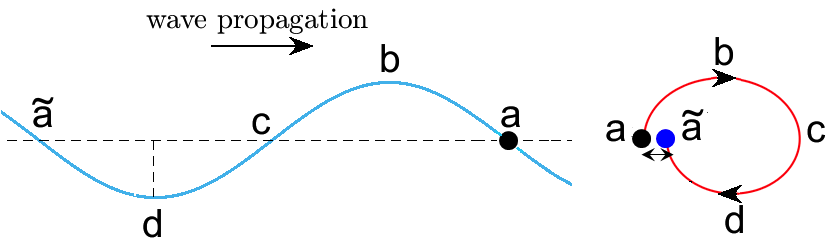
Experimental results
Research questions
- RQ1What causes Stokes drift at a fundamental kinematic level, independent of wave type or transverse structure?
- RQ2How much longer does a fluid particle spend in the crest phase compared to the trough phase in non-transverse waves?
- RQ3Can second-order-accurate estimates of time, displacement, and velocity be derived for crest and trough phases using a Lagrangian-phase formalism?
- RQ4Does the linear wave theory provide reliable estimates of Stokes drift when second-order elevation effects are included?
- RQ5How does the Stokes drift mechanism manifest in 1D longitudinal waves (e.g., sound), where transverse velocity variation does not exist?
Key findings
- Particles spend significantly more time in the crest phase than in the trough phase, leading to a net forward drift due to asymmetric temporal and velocity contributions.
- The average horizontal velocity during the crest phase is greater than during the trough phase, contributing directly to the net Stokes drift.
- Second-order-accurate expressions for time duration, displacement, and average velocity in crest and trough phases are derived and shown to be consistent across both sound and water waves.
- The Stokes drift velocity for a material interface at depth z = -h is given by ū^SD = (c/2)(cosh 2β / sinh²α) ε², which depends on the relative depth and wave steepness.
- Finite-amplitude effects modify linear wave estimates, but the qualitative understanding from linear theory remains valid when second-order elevation corrections are included.
- The parametric solution using θ-phase parameterization successfully reduces the 2D pathline problem to a 1D asymptotic system, enabling exact second-order analysis without the small-excursion approximation.
Better researchstarts right now
From reading papers to final review, dramatically reduce your research time.
No credit card · Free plan available
This review was created by AI and reviewed by human editors.