
[Paper Review] Understanding the Trustworthiness Management in the Social Internet of Things: A Survey
This survey provides a comprehensive analysis of trustworthiness management in the Social Internet of Things (SIoT), categorizing trust management schemes into four types and evaluating their components, strengths, limitations, and performance across key dimensions. It identifies gaps in current approaches and outlines future research directions for scalable, privacy-preserving, and intelligent trust aggregation in SIoT environments.
The next generation of the Internet of Things (IoT) facilitates the integration of the notion of social networking into smart objects (i.e., things) in a bid to establish the social network of interconnected objects. This integration has led to the evolution of a promising and emerging paradigm of Social Internet of Things (SIoT), wherein the smart objects act as social objects and intelligently impersonate the social behaviour similar to that of humans. These social objects are capable of establishing social relationships with the other objects in the network and can utilize these relationships for service discovery. Trust plays a significant role to achieve the common goal of trustworthy collaboration and cooperation among the objects and provide systems' credibility and reliability. In SIoT, an untrustworthy object can disrupt the basic functionality of a service by delivering malicious messages and adversely affect the quality and reliability of the service. In this survey, we present a holistic view of trustworthiness management for SIoT. The essence of trust in various disciplines has been discussed along with the Trust in SIoT followed by a detailed study on trust management components in SIoT. Furthermore, we analyzed and compared the trust management schemes by primarily categorizing them into four groups in terms of their strengths, limitations, trust management components employed in each of the referred trust management schemes, and the performance of these studies vis-a-vis numerous trust evaluation dimensions. Finally, we have discussed the future research directions of the emerging paradigm of SIoT, particularly for trustworthiness management in SIoT.
Motivation & Objective
- To provide a holistic review of trustworthiness management in the emerging SIoT paradigm, where smart objects form social relationships akin to humans.
- To identify and analyze the core components of trust management systems in SIoT, including trust metrics, aggregation, and decay mechanisms.
- To compare existing trust management schemes across four categories, evaluating their strengths, limitations, and performance in diverse trust evaluation dimensions.
- To highlight critical challenges such as trust aggregation inefficiencies, lack of privacy-preserving mechanisms, and the need for intelligent, low-latency trust computation.
- To outline future research directions, particularly in optimizing machine learning-based trust aggregation and developing robust privacy-preserving frameworks for SIoT.
Proposed method
- The paper conducts a systematic survey of 15 recent studies on trust management in SIoT, categorizing them into four groups based on their underlying trust mechanisms and design principles.
- It evaluates trust management schemes using a multi-dimensional assessment framework, including trust metrics, aggregation techniques, decay models, and privacy preservation mechanisms.
- The study analyzes conventional trust aggregation using linear weighted sums and critiques their limitations, such as arbitrary weight assignment and inability to identify dominant trust metrics.
- It explores emerging machine learning-based trust aggregation methods that dynamically assign weights to trust metrics based on environmental context, though noting their high computational cost.
- The paper proposes a generic trust management framework for service-oriented SIoT, integrating social relationships, reputation, and experience-based trust with time-decay and privacy-preserving mechanisms.
- It examines privacy-preserving techniques such as one-way hashing and homomorphic encryption to protect social profile data during interactions in SIoT.
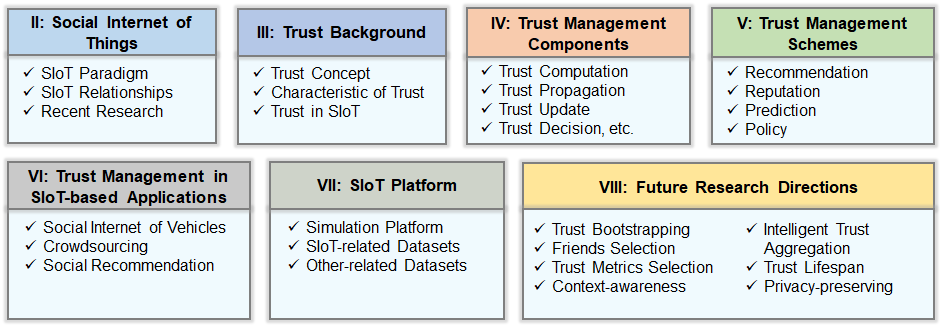
Experimental results
Research questions
- RQ1How do existing trust management schemes in SIoT differ in their design, components, and performance across key evaluation dimensions?
- RQ2What are the limitations of conventional trust aggregation techniques, and how can machine learning-based approaches improve their accuracy and adaptability?
- RQ3How can trust decay mechanisms be effectively modeled in SIoT to reflect the dynamic and time-sensitive nature of social relationships between smart objects?
- RQ4What role do social relationships and interaction frequency play in shaping trust and reputation in SIoT environments?
- RQ5What are the key open challenges in privacy-preserving trust management, and how can they be addressed in future SIoT systems?
Key findings
- Conventional trust aggregation methods based on linear weighted sums suffer from arbitrary weight assignment and fail to identify the most influential trust metrics in specific contexts.
- Machine learning-based trust aggregation shows promise in dynamically assigning weights to trust metrics but introduces high computational overhead and latency, limiting real-time deployment.
- Trust decay is essential for maintaining relevance, and models like Truong et al.’s experience-reputation system demonstrate time-based decay, though they lack clear criteria for defining strong versus weak social ties.
- Only a few studies address privacy preservation in SIoT trust management, with notable approaches including one-way hashing (Chen et al.) and homomorphic encryption (Azad et al.) to protect object identities and social profiles.
- The survey identifies a critical research gap in scalable, efficient, and privacy-preserving trust aggregation frameworks, particularly for large-scale, dynamic SIoT networks.
- A generic trust management framework is proposed, integrating social relationships, reputation, experience, and time-decay models, with future work focusing on optimizing machine learning models for cluster-level trust aggregation to reduce latency.
Better researchstarts right now
From reading papers to final review, dramatically reduce your research time.
No credit card · Free plan available
This review was created by AI and reviewed by human editors.