
[Paper Review] Unified Differentiable Learning of Electric Response
This paper introduces a unified differentiable machine learning framework that jointly predicts electric enthalpy, atomic forces, polarization, Born charges, and polarizability by differentiating the electric enthalpy with respect to atomic positions and electric field. The method enforces exact physical constraints—conservative polarization, acoustic sum rule for Born charges, and enthalpy conservation—via local equivariant representations, enabling accurate, large-scale molecular dynamics under electric fields with first-principles accuracy, validated on α-SiO₂ with excellent agreement to density functional perturbation theory.
Predicting response of materials to external stimuli is a primary objective of computational materials science. However, current methods are limited to small-scale simulations due to the unfavorable scaling of computational costs. Here, we implement an equivariant machine-learning framework where response properties stem from exact differential relationships between a generalized potential function and applied external fields. Focusing on responses to electric fields, the method predicts electric enthalpy, forces, polarization, Born charges, and polarizability within a unified model enforcing the full set of exact physical constraints, symmetries and conservation laws. Through application to $α$-SiO$_2$, we demonstrate that our approach can be used for predicting vibrational and dielectric properties of materials, and for conducting large-scale dynamics under arbitrary electric fields at unprecedented accuracy and scale. We apply our method to ferroelectric BaTiO$_3$ and capture the temperature-dependence and time evolution of hysteresis, revealing the underlying microscopic mechanisms of nucleation and growth that govern ferroelectric domain switching.
Motivation & Objective
- To develop a machine learning model that simultaneously predicts electric enthalpy, forces, polarization, Born charges, and polarizability with first-principles accuracy.
- To enforce exact physical constraints—conservative polarization, acoustic sum rule for Born charges, and electric enthalpy conservation—within a differentiable learning framework.
- To enable efficient, large-scale molecular dynamics simulations under electric fields by leveraging a local equivariant representation of atomic environments.
- To validate the model’s accuracy in predicting vibrational and dielectric properties, including infrared spectra and frequency-dependent dielectric constants.
- To generalize the approach to other thermodynamic potentials and complex materials, including disordered and liquid systems.
Proposed method
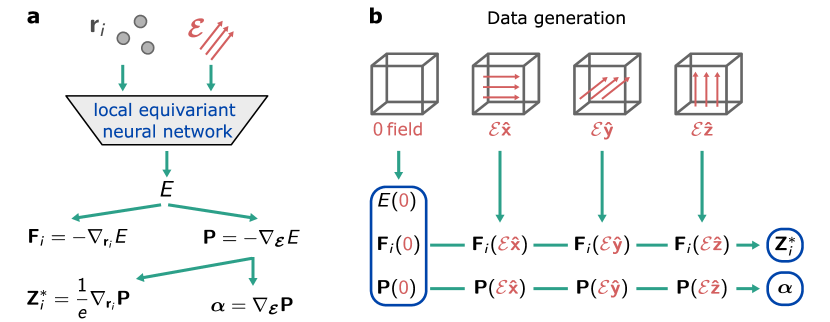
- The model uses a local equivariant neural network to represent the atomic environment, ensuring $E(3)$ symmetry (translations, rotations, inversion).
- Electric enthalpy is predicted as a differentiable function of atomic positions and electric field, with all physical quantities derived via exact differentiation.
- Polarization is obtained as the first derivative of electric enthalpy with respect to electric field, ensuring it is a conservative vector field.
- Born charges are computed as the second derivative of enthalpy with respect to atomic positions and electric field, enforcing the acoustic sum rule.
- Polarizability is derived as the second derivative of enthalpy with respect to electric field, ensuring consistency with linear response theory.
- The formulation is general and does not require message-passing; the locality enables efficient computation over large-scale and long-timescale simulations.
Experimental results
Research questions
- RQ1Can a single differentiable machine learning model accurately predict electric enthalpy, forces, polarization, Born charges, and polarizability in a unified framework?
- RQ2How can exact physical constraints—conservative polarization, acoustic sum rule, and enthalpy conservation—be enforced in a differentiable machine learning model?
- RQ3To what extent can such a model enable accurate large-scale molecular dynamics simulations under finite electric fields?
- RQ4How well does the model reproduce dielectric and vibrational properties compared to density functional perturbation theory?
- RQ5Can the framework be generalized to other thermodynamic potentials and complex materials, including liquids and disordered systems?
Key findings
- The model achieves high-frequency and static dielectric constants of εzz∞ = 2.41 and εzz⁰ = 4.76 for α-SiO₂, matching DFT results exactly.
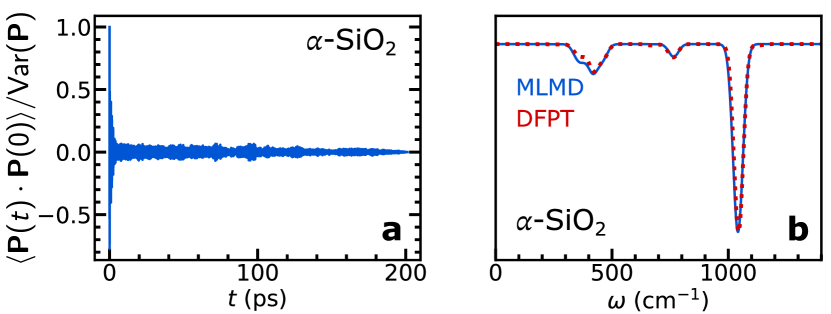
- The infrared spectrum and frequency-dependent dielectric constant computed via MLMD are in excellent agreement with density functional perturbation theory.
- Electric-field contributions to electric enthalpy, forces, and polarization are accurately captured, with deviations from DFT below 10⁻⁴ Hartree/au.
- The model successfully enforces the acoustic sum rule for Born charges and ensures polarization is a conservative vector field through exact differentiation.
- The framework enables long-timescale, large-length-scale molecular dynamics under electric fields with first-principles accuracy and computational efficiency.
- The approach generalizes readily to other thermodynamic potentials such as free energy, grand potential, and enthalpy, enabling broader applications in materials physics.
Better researchstarts right now
From reading papers to final review, dramatically reduce your research time.
No credit card · Free plan available
This review was created by AI and reviewed by human editors.