
[Paper Review] Unified treatment of mean-field dynamo and angular-momentum transport in magnetorotational instability-driven turbulence
This paper presents a unified mean-field model for magnetorotational instability (MRI)-driven turbulence that simultaneously treats angular-momentum transport and large-scale dynamo action. By employing direct statistical simulations and a statistical closure for three-point cumulants, it identifies two key dynamo mechanisms—rotation-shear-current and rotation-shear-vorticity effects—that generate radial and vertical magnetic fields, respectively, with explicit nonperturbative transport coefficients derived from the turbulent stress web including Maxwell, Reynolds, and Faraday contributions.
Magnetorotational instability (MRI)-driven turbulence and dynamo phenomena are analyzed using direct statistical simulations. Our approach begins by developing a unified mean-field model that combines the traditionally decoupled problems of the large-scale dynamo and angular-momentum transport in accretion disks. The model consists of a hierarchical set of equations, capturing up to the second-order cumulants, while a statistical closure approximation is employed to model the three-point correlators. We highlight the web of interactions that connect different components of stress tensors -- Maxwell, Reynolds, and Faraday -- through shear, rotation, correlators associated with mean fields, and nonlinear terms. We determine the dominant interactions crucial for the development and sustenance of MRI turbulence. Our general mean field model for the MRI-driven system allows for a self-consistent construction of the electromotive force, inclusive of inhomogeneities and anisotropies. Within the realm of large-scale magnetic field dynamo, we identify two key mechanisms -- the rotation-shear-current effect and the rotation-shear-vorticity effect -- that are responsible for generating the radial and vertical magnetic fields, respectively. We provide the explicit (nonperturbative) form of the transport coefficients associated with each of these dynamo effects. Notably, both of these mechanisms rely on the intrinsic presence of large-scale vorticity dynamo within MRI turbulence.
Motivation & Objective
- To unify the traditionally decoupled problems of angular-momentum transport and large-scale dynamo action in MRI-driven accretion disk turbulence.
- To develop a hierarchical mean-field model capturing up to second-order cumulants, with statistical closure for three-point correlators to model nonlinear interactions.
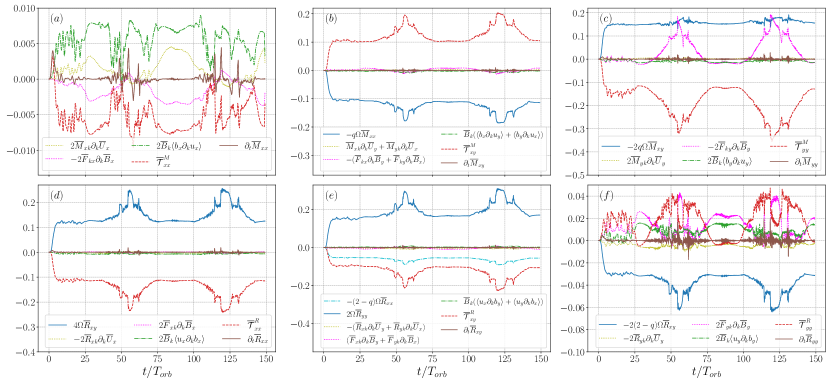
- To identify the dominant interactions among Maxwell, Reynolds, and Faraday stress components mediated by shear, rotation, and mean-field correlators.
- To determine the explicit, nonperturbative transport coefficients for dynamo mechanisms in MRI turbulence.
- To establish the role of intrinsic large-scale vorticity dynamo in enabling radial and vertical field generation.
Proposed method
- Formulates a hierarchical set of mean-field equations including up to second-order cumulants for velocity, magnetic field, and cross-correlations.
- Applies a statistical closure approximation to model three-point velocity-magnetic field correlators, enabling closure of the moment hierarchy.
- Uses Fourier-space representation of correlation tensors $R_{ij}$, $M_{ij}$, and $F_{ij}$ to express stress and electromotive force in terms of wavevector and spatial dependence.
- Derives the electromotive force (EMF) in a self-consistent manner, including inhomogeneities and anisotropies via $\bar{\bf E} = \alpha_{ij}\bar{B}_j$.
- Performs Taylor expansion in wavevector space to simplify nonlinear terms, retaining leading-order contributions involving $\partial R_{ij}/\partial k_l$ and $\nabla \bar{B}$.
- Computes the mean stress and EMF by integrating over wavevectors, yielding nonperturbative expressions for transport coefficients involving $\bar{B}_m \int i k_m R_{ij} d^3k$ and $\bar{F}_{ij}$ terms.
Experimental results
Research questions
- RQ1What are the dominant nonlinear interactions that sustain MRI turbulence and couple angular-momentum transport to large-scale magnetic field generation?
- RQ2How do shear, rotation, and vorticity collectively influence the generation of radial and vertical magnetic fields in MRI turbulence?
- RQ3What is the explicit form of the transport coefficients for dynamo action in MRI-driven systems, and how do they depend on mean-field gradients?
- RQ4To what extent do the rotation-shear-current and rotation-shear-vorticity effects govern the dynamo process in MRI turbulence?
- RQ5How does the intrinsic large-scale vorticity dynamo contribute to the self-consistent regeneration of poloidal magnetic fields?
Key findings
- The rotation-shear-current effect is identified as the primary mechanism for generating radial magnetic fields in MRI turbulence, with a nonperturbative transport coefficient derived from the turbulent stress web.
- The rotation-shear-vorticity effect is found to be responsible for the generation of vertical magnetic fields, with a distinct, explicit transport coefficient derived from the same framework.
- Both dynamo mechanisms are shown to rely critically on the presence of an intrinsic large-scale vorticity dynamo within MRI turbulence, which sustains the poloidal field component.
- The model self-consistently constructs the electromotive force (EMF) including inhomogeneities and anisotropies, resolving the limitations of prior models that assumed $\bar{F}_{ij} = 0$.
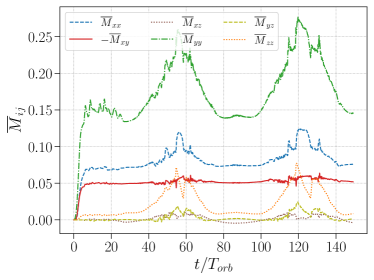
- The Maxwell stress dominates angular-momentum transport, confirming that magnetic fluctuations are the primary driver of turbulent transport in MRI systems.
- The derived transport coefficients are nonperturbative and explicitly depend on the mean magnetic field gradient and turbulent correlation tensors, enabling predictive modeling of MRI turbulence.
Better researchstarts right now
From reading papers to final review, dramatically reduce your research time.
No credit card · Free plan available
This review was created by AI and reviewed by human editors.